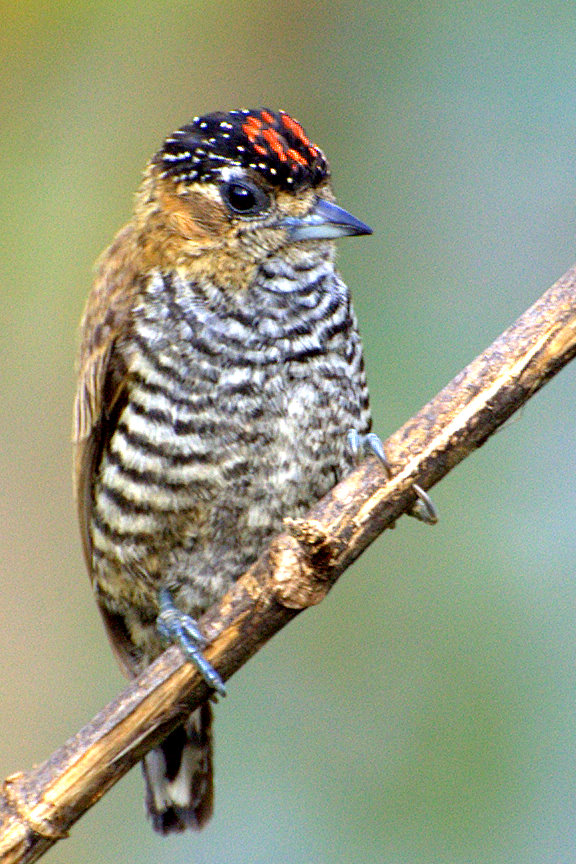
Speckle-chested Piculet
Picumnus steindachneri
Order: Piciformes / Family: Picidae

Wikimedia Commons
About the Speckle-chested Piculet
The Speckle-chested Piculet (Picumnus steindachneri) is a fascinating member of the Picidae family, endemic to the humid montane forests of northern Peru. This avian species is notable for its diminutive size, measuring approximately 10 cm in length, and its unique plumage, which features a speckled chest that gives the bird its name. The Speckle-chested Piculet plays a critical role in its ecosystem as both a predator and a prey species, contributing to the health and balance of its forest habitat.
Found specifically in the departments of Amazonas and Cajamarca, the Speckle-chested Piculet occupies a restricted range, making its conservation status of particular concern. These forests, characterized by their elevation and humidity, provide a rich biodiversity, which the piculet relies on for food and nesting.
The ecological significance of the Speckle-chested Piculet extends beyond its immediate environment. As an insectivorous bird, it helps control insect populations, thus protecting trees from excessive insect damage. Its foraging habits also aid in seed dispersal and contribute to the forest's regeneration processes.
Throughout the year, the Speckle-chested Piculet engages in various seasonal behaviors. During the breeding season, which aligns with the rainy season from November to March, these birds become particularly vocal and active, establishing territories and seeking mates. Their presence in the ecosystem during these months is vital for the maintenance of the forest's ecological processes.
The Speckle-chested Piculet belongs to the family Picidae, within the order Piciformes. These birds typically live average 4 years, with a maximum recorded of 6 years..
How to Identify a Speckle-chested Piculet
Identifying the Speckle-chested Piculet involves observing several key field marks. Adults of this species exhibit a distinctive speckled chest, which contrasts with their otherwise greenish-brown plumage. This speckling is more pronounced in males, who also boast a small red patch on the forecrown, a feature absent in females. The birds possess a short, straight bill typical of piculets and a noticeably short tail, which aids in their agile maneuvering through dense foliage.
Juvenile Speckle-chested Piculets resemble adults but with less distinct speckling and duller overall coloration. This makes them slightly more challenging to identify until they mature. When comparing this species to other piculets, the speckled chest is the most reliable distinguishing characteristic, setting it apart from similar species like the Fine-barred Piculet.
In flight, the Speckle-chested Piculet's silhouette is compact and robust, with rapid wing beats that enable swift movement between trees. When perched, the bird often adopts a horizontal posture, using its tail for support against tree trunks, a behavior common among woodpeckers.
Having trouble telling birds apart? Upload a photo to our bird identification tool for an instant species match.
Speckle-chested Piculet Habitat and Range
Preferred Habitat
The Speckle-chested Piculet inhabits the dense, humid montane forests of northern Peru. These forests are typically found at elevations ranging between 1,000 and 2,500 meters, providing a diverse array of flora and fauna. The bird prefers areas with a high density of trees and undergrowth, which offer ample foraging opportunities.
While primarily a resident of forest interiors, the Speckle-chested Piculet occasionally ventures into edge habitats where forests meet open areas. This species shows little adaptation to urban environments, remaining predominantly in rural and forested regions.
Seasonal habitat shifts are minimal, as the piculet maintains its residence within these montane forests year-round. However, during the breeding season, there is a slight tendency to move towards areas with denser vegetative cover to ensure the safety and success of their nests.
Geographic Range
The range of the Speckle-chested Piculet is remarkably limited, confined to the montane regions of northern Peru. Specifically, its presence is recorded in the Amazonas and Cajamarca departments, where it occupies a narrow band of suitable forest habitat.
The bird does not engage in long-distance migrations, remaining in its established territories throughout the year. The narrow range and specific habitat requirements contribute to its status as a species of conservation concern.
Within its range, population densities are highest in areas with optimal forest cover and minimal human disturbance. These hotspots are crucial for the species' survival, as they provide the necessary resources for feeding and reproduction.
Want to know which birds visit your area? Browse our backyard birds by location guides for region-specific species lists.
What Does the Speckle-chested Piculet Eat?
The Speckle-chested Piculet primarily consumes insects, which it extracts from tree bark and foliage using its chisel-like bill. Its diet consists mainly of ants, beetles, and their larvae, which are plentiful in its forest habitat.
During the dry season, when insect activity may decrease, the piculet supplements its diet with small fruits and seeds, showcasing its adaptability in the face of changing food availability. This dietary shift helps the bird maintain its energy levels and supports its survival during periods of scarcity.
The Speckle-chested Piculet employs a unique foraging technique, using rapid pecking and probing motions to uncover hidden insects. This method not only allows for efficient feeding but also aerates the bark and aids in pest control within the forest ecosystem.
Speckle-chested Piculet Behavior and Social Structure
The Speckle-chested Piculet exhibits a range of behaviors typical of small woodpeckers. These birds are generally solitary or found in pairs, particularly during the breeding season. Territorial in nature, they defend their chosen areas with a combination of vocalizations and physical displays.
Courtship displays involve a series of rapid wing flicks and calls, which help establish pair bonds and signal readiness to mate. Once paired, the birds work together to maintain and defend their territory against intruders.
The Speckle-chested Piculet's daily activity pattern includes dawn and late afternoon peaks in foraging activity. This schedule allows them to exploit the abundance of insects during cooler parts of the day while avoiding the midday heat.
When faced with predators, these piculets rely on quick, darting flights to escape, often weaving through dense foliage to evade capture. They are also known to emit alarm calls to alert nearby birds of potential threats.
Speckle-chested Piculet Nesting and Reproduction
Nesting for the Speckle-chested Piculet occurs primarily during the rainy season, from November to March. The species constructs its nests in tree cavities, which they excavate themselves using their strong bills. These cavities are typically located in dead or decaying wood, making them easier to carve and providing insulation for the eggs and chicks.
The typical clutch size for this species ranges from two to four eggs. Both parents share responsibilities for incubation, which lasts approximately 12 to 14 days. After hatching, the chicks remain in the nest for about three weeks before fledging.
During the nesting period, both male and female piculets participate in feeding and caring for the young. They are known to have one or two broods per year, depending on environmental conditions and resource availability.
Speckle-chested Piculet Sounds and Vocalizations
The primary song of the Speckle-chested Piculet is a rapid series of high-pitched notes, often described as a trill. This song serves both to establish territory and to attract mates. In addition to their song, these piculets produce a variety of call notes, including short, sharp 'pik' sounds used for communication between mates or to signal alarm.
Their alarm calls are more intense and rapid, alerting other nearby birds to the presence of potential threats. During the dawn chorus, the Speckle-chested Piculet's song blends with those of other forest birds, contributing to the vibrant acoustic landscape of their montane habitat.
Interesting Facts About the Speckle-chested Piculet
- 1The Speckle-chested Piculet is one of the smallest woodpeckers in the world, measuring just 10 cm in length.
- 2Despite its name, the Speckle-chested Piculet does not 'drum' on trees as larger woodpeckers do; it relies on vocalizations for communication.
- 3The species was first described in 1883 by Austrian ornithologist August von Pelzeln, who named it after Moritz Steindachner, a notable ichthyologist.
- 4Speckle-chested Piculets are non-migratory, spending their entire lives within a small geographical range in northern Peru.
- 5These piculets are excellent climbers, using their strong feet and stiff tail feathers to navigate tree trunks and branches with ease.
- 6The bird's red forecrown patch in males is a key identifying feature, though it is often hidden by foliage during foraging.
- 7Speckle-chested Piculets contribute to forest health by controlling insect populations and aiding in seed dispersal.
Speckle-chested Piculet Conservation Status
The Speckle-chested Piculet is currently listed as Near Threatened on the IUCN Red List, primarily due to its restricted range and habitat loss. Deforestation for agriculture and logging in northern Peru poses significant threats to its montane forest habitat, leading to population declines. Conservation efforts focus on habitat protection and restoration, with initiatives to establish protected areas and promote sustainable land use practices. Monitoring population trends is crucial to assess the effectiveness of these efforts and to ensure the long-term survival of the species.
Other Picidae Species


Birds Similar to the Speckle-chested Piculet
These species are often confused with the Speckle-chested Piculet due to similar appearance or overlapping range.