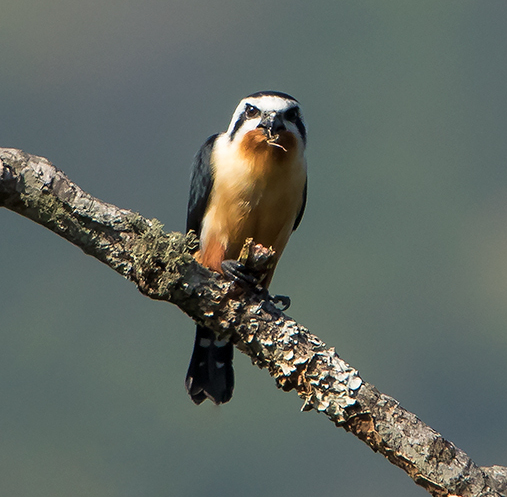
Spot-winged Falconet
Spiziapteryx circumcincta
Order: Falconiformes / Family: Falconidae

Wikimedia Commons
About the Spot-winged Falconet
The Spot-winged Falconet, Spiziapteryx circumcincta, is a fascinating member of the Falconidae family. Known for its small stature yet formidable presence, this raptor inhabits the arid and semi-arid regions of South America, particularly in Argentina, Bolivia, and Paraguay. Typically found in open woodlands, grasslands, and savanna ecosystems, the Spot-winged Falconet thrives in these environments by exploiting its keen hunting skills and adaptability. As an apex predator in its habitat, it plays a crucial role in controlling the population of insects and small vertebrates, maintaining the ecological balance. This species demonstrates unique seasonal behaviors, with some populations undertaking local migrations to adjust to climatic changes and food availability. In the breeding season, the Spot-winged Falconet becomes especially territorial, showcasing its defensive prowess. Its significance extends beyond its ecological role as it provides valuable insights into the adaptation and survival strategies of small raptors in challenging environments. Observing this bird offers a glimpse into the intricate web of life within its habitat, where the Spot-winged Falconet stands as both a hunter and an indicator of ecosystem health. Its presence signals a healthy biodiversity, as it depends on a robust population of prey species. As human activities continue to encroach upon natural habitats, understanding and preserving the ecological role of the Spot-winged Falconet becomes paramount. The bird's adaptability is noteworthy, yet it also faces threats from habitat loss and changes in land use. Conservation efforts must prioritize maintaining the health of its native ecosystems to ensure the survival of this remarkable species and the myriad of life forms it supports.
The Spot-winged Falconet belongs to the family Falconidae, within the order Falconiformes. These birds typically live average 8 years with a maximum recorded of 12 years.
How to Identify a Spot-winged Falconet
Adult Spot-winged Falconets display a distinct plumage pattern that aids in their identification. Their upperparts are primarily dark brown, while their underparts are whitish with a slight buff tinge. The most striking feature is their wings, which exhibit conspicuous white spots that give the species its common name. Juveniles resemble adults but display a generally duller coloration and less pronounced wing spots. Males and females are similar in appearance, with no significant sexual dimorphism observed in plumage. In flight, the Spot-winged Falconet is easily identifiable by its rapid, agile wingbeats and compact silhouette, which differs from larger raptors. Perched, it often adopts an upright posture, accentuating its small size and alert demeanor. This bird can be confused with other small raptors like the American Kestrel; however, its unique wing pattern and habitat preferences help differentiate it. Observers should note the falconet's flight behavior-quick and direct with intermittent glides-which further distinguishes it from other species.
Having trouble telling birds apart? Upload a photo to our bird identification tool for an instant species match.
Spot-winged Falconet Habitat and Range
Preferred Habitat
The Spot-winged Falconet primarily inhabits arid and semi-arid regions, thriving in open woodlands, grasslands, and savannas. It prefers areas with scattered trees and shrubs, which provide hunting perches and nesting sites. This bird is found at elevations ranging from sea level to approximately 2,000 meters, demonstrating its adaptability to various altitudes. Seasonal habitat shifts occur in response to food availability and climatic conditions, with some populations moving locally to exploit different resources. While it is more common in rural and undeveloped areas, the Spot-winged Falconet occasionally ventures into the outskirts of urban environments, particularly where suitable hunting grounds persist.
Geographic Range
The Spot-winged Falconet's range is primarily confined to South America, with established populations in Argentina, Bolivia, and Paraguay. During the breeding season, it remains within these regions, taking advantage of the plentiful prey available during this time. In some areas, populations may exhibit local movements influenced by seasonal changes, although long-distance migrations are not characteristic of the species. The bird tends to concentrate in regions where open habitats are prevalent, leading to population density hotspots in certain parts of its range. Understanding these patterns is crucial for conservation efforts, as it helps identify critical areas for protection and habitat management.
Want to know which birds visit your area? Browse our backyard birds by location guides for region-specific species lists.
What Does the Spot-winged Falconet Eat?
The diet of the Spot-winged Falconet primarily consists of insects, such as large grasshoppers and beetles, making up a significant portion of its food intake. It also preys on small vertebrates, including lizards and small birds, when available. Seasonal variations in diet correspond with prey abundance, with a noticeable increase in insect consumption during warmer months. This bird employs a sit-and-wait hunting technique, often perching on exposed branches or utility lines to scan for prey. Upon spotting a target, the falconet launches a swift, direct attack, using its agility to capture prey mid-air or on the ground. Typically hunting during daylight hours, it adjusts its activity based on prey availability and environmental conditions.
Spot-winged Falconet Behavior and Social Structure
Spot-winged Falconets exhibit solitary or paired behaviors, particularly during the breeding season when they defend territories vigorously. Territorial displays include aerial chases and vocalizations to ward off intruders. Courtship involves aerial displays and prey offerings from males to females, strengthening pair bonds. Outside the breeding season, they may be less territorial, sometimes observed in small family groups. Their response to predators includes rapid flight and evasive maneuvers, relying on speed and agility to escape threats. Daily activity patterns are diurnal, with peak activity in the early morning and late afternoon when prey is most abundant. During midday heat, they often rest in shaded areas.
Spot-winged Falconet Nesting and Reproduction
The Spot-winged Falconet typically chooses to nest in cavities found in trees or sometimes in abandoned woodpecker holes. Nest sites are often located in open areas, providing clear access and visibility. The nest itself consists of minimal materials, relying on the cavity's protection. Clutch size ranges from 3 to 5 eggs, with both parents participating in incubation, which lasts approximately 20 to 22 days. After hatching, the chicks remain in the nest for about 28 to 30 days before fledging. Parental care continues post-fledging, with adults feeding and protecting the young until they become independent. Generally, the species produces one brood per year, although favorable conditions may lead to a second.
Spot-winged Falconet Sounds and Vocalizations
The vocalizations of the Spot-winged Falconet include a series of sharp, high-pitched notes that resemble a rapid 'kik-kik-kik' often used in territorial disputes or alarm situations. Their calls are generally short and repetitive, serving as an effective communication tool between mates and warning signals against potential threats. During the breeding season, their vocal activity increases, particularly at dawn when males assert their presence and territorial claims. Compared to other raptors, their calls are relatively quiet and less varied, focusing instead on efficiency and clarity in communication.
Interesting Facts About the Spot-winged Falconet
- 1The Spot-winged Falconet is one of the smallest raptors in the world, typically measuring just 23-26 cm in length.
- 2Despite its size, the Spot-winged Falconet is a formidable predator, capable of taking down prey larger than itself.
- 3This falconet exhibits remarkable agility, often capturing insects in mid-flight with astonishing precision.
- 4Unlike many raptors, the Spot-winged Falconet occasionally uses man-made structures, such as telephone poles, as hunting perches.
- 5The bird's name reflects the distinctive white spots on its wings, a key feature for identification in the field.
- 6Spot-winged Falconets are monogamous, often forming long-lasting pair bonds that extend beyond a single breeding season.
- 7Their diet is highly varied, adapting to seasonal availability and including insects, reptiles, and small birds.
Spot-winged Falconet Conservation Status
Currently, the Spot-winged Falconet holds a status of Least Concern on the IUCN Red List, reflecting a stable population trend. However, ongoing threats such as habitat destruction due to agriculture and urban expansion pose significant risks to its long-term survival. Conservation efforts focus on protecting native habitats and promoting sustainable land-use practices. Historical population changes remain poorly documented, but habitat preservation remains a priority to prevent potential declines. Conservation initiatives may include community education and the establishment of protected areas to safeguard critical habitats.
Other Falconidae Species


Birds Similar to the Spot-winged Falconet
These species are often confused with the Spot-winged Falconet due to similar appearance or overlapping range.