
Steinbach's Canastero
Asthenes steinbachi
Order: Passeriformes / Family: Furnariidae
Wikimedia Commons
About the Steinbach's Canastero
Steinbach's Canastero (Asthenes steinbachi) is a small passerine bird endemic to the high Andes of South America. This bird belongs to the Furnariidae family, which is known for its remarkable adaptability to various ecological niches. The species plays a crucial role in the ecosystem by aiding in seed dispersal and controlling insect populations. Typically found in the arid and semi-arid high-altitude shrublands of Bolivia and Argentina, this bird thrives at elevations ranging from 2,500 to 4,500 meters. The Steinbach's Canastero is particularly associated with the Yungas forest regions and the dry inter-Andean valleys, where its presence indicates a healthy, unaltered habitat. During the breeding season, which occurs from October to January, Steinbach's Canasteros become more visible and vocal as they establish territories and seek mates. They are most active during the early morning and late afternoon, engaging in foraging and social interactions. As a species, Steinbach's Canastero is integral to the ecological balance, its presence serving as an indicator of the health of its native high-altitude environments.
The Steinbach's Canastero belongs to the family Furnariidae, within the order Passeriformes. These birds typically live 3-5 years with a maximum recorded of 7 years..
How to Identify a Steinbach's Canastero
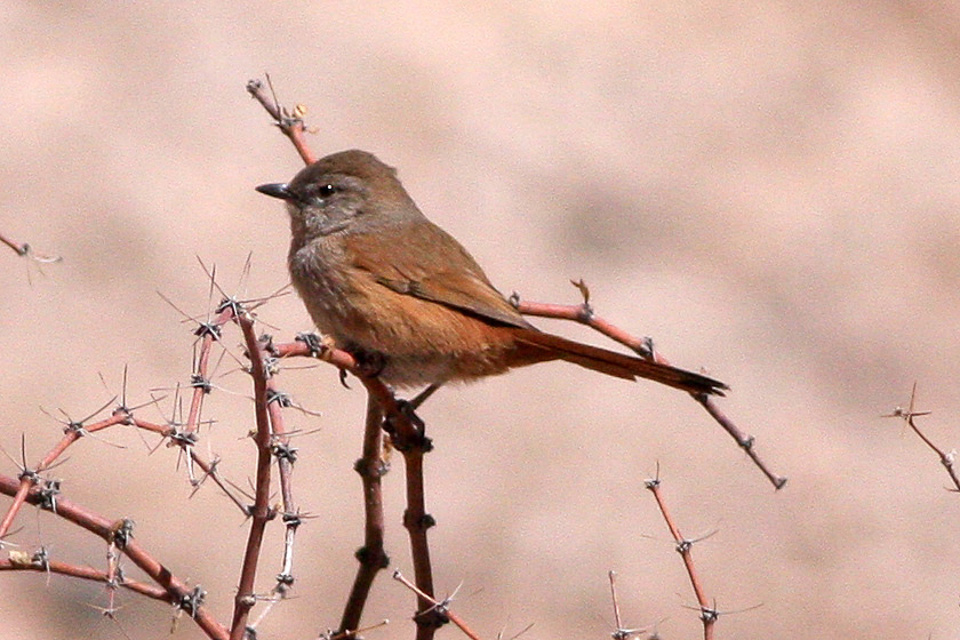
The Steinbach's Canastero has a distinctive appearance that aids in its identification. Adults exhibit a predominantly brown plumage with intricate streaking on the upperparts, a feature that helps in blending with the rocky and shrubby terrain. Their underparts are lighter, often showing a subtle buff or cinnamon hue. Juveniles resemble adults but may have less pronounced streaking and a slightly duller coloration. Both males and females appear similar, making gender differentiation challenging in the field. One distinctive field mark is their long graduated tail, which often appears slightly cocked, a trait shared with other canasteros but more pronounced in this species. While in flight, the Steinbach's Canastero displays a rapid, fluttering pattern with occasional short glides, making it distinguishable from similar species. When perched, it often adopts an upright posture, frequently flicking its tail as a behavioral trait. Confusion with other canasteros can occur, but the combination of habitat, behavior, and subtle plumage details aids in accurate identification.
Having trouble telling birds apart? Upload a photo to our bird identification tool for an instant species match.
Steinbach's Canastero Habitat and Range
Preferred Habitat
Steinbach's Canastero inhabits high-altitude regions, particularly favoring rocky and shrubby areas of the Andes. Its preferred habitats include dry inter-Andean valleys and the edges of Yungas forests. These areas are characterized by sparse vegetation, consisting of hardy shrubs and grasses, which provide both food and nesting sites. The species is typically found between elevations of 2,500 to 4,500 meters, although it may descend slightly during harsh weather conditions. Steinbach's Canastero shows a marked preference for natural habitats over urban or heavily cultivated areas, indicating its reliance on well-preserved ecosystems. Seasonal shifts in habitat use are minimal, reflecting the bird’s adaptation to its niche high-altitude environment.
Geographic Range
The range of Steinbach's Canastero is primarily restricted to the central Andean regions of Bolivia and northern Argentina. In Bolivia, it is frequently observed in the departments of Cochabamba, Chuquisaca, and Potosí. In Argentina, its presence is noted in the northwestern provinces such as Jujuy and Salta. The species is considered non-migratory, with little evidence to suggest long-distance seasonal movements. However, local altitudinal migrations may occur in response to extreme weather conditions or food availability. Population densities tend to be higher in undisturbed shrubland habitats, where the bird's specific ecological needs are met. Despite its relatively limited range, the Steinbach's Canastero is not considered range-restricted due to the significant altitude span it occupies.
Want to know which birds visit your area? Browse our backyard birds by location guides for region-specific species lists.
What Does the Steinbach's Canastero Eat?
The diet of Steinbach's Canastero primarily consists of insects and other small invertebrates, which it skillfully extracts from under rocks and leaf litter using its slender bill. Beetles, ants, and spiders constitute a significant portion of its diet, with occasional consumption of seeds and plant material. Seasonal variations in diet occur, with more plant material ingested during the arid months when insect prey becomes less abundant. Foraging typically takes place in the early morning and late afternoon, aligning with peak insect activity. The bird employs a methodical foraging technique, often seen hopping on the ground or low vegetation, pecking and probing for hidden prey. Prey size varies but typically includes small to medium-sized insects, which are readily available in its high-altitude habitat.
Steinbach's Canastero Behavior and Social Structure
Steinbach's Canastero exhibits solitary or paired social structures, particularly during the breeding season when pairs establish and defend territories. Territorial disputes involve vocalizations and displays, with individuals often seen chasing intruders away. Courtship displays are subtle, involving mutual preening and feeding between mates. Outside the breeding season, small family groups may form, exhibiting loose flocking behavior, especially in areas with abundant food resources. The bird typically demonstrates a cautious approach towards predators, relying on its cryptic plumage and rapid flight to avoid detection. Daily activity patterns include periods of intense foraging interspersed with rest and preening. Vocalizations play an essential role in maintaining social bonds and territory, with calls and songs being most frequent at dawn and dusk.
Steinbach's Canastero Nesting and Reproduction
Steinbach's Canastero constructs its nest in sheltered locations such as rocky crevices or dense shrubbery, using a combination of grasses, twigs, and feathers. The nest is typically cup-shaped, providing a secure environment for the eggs. Clutch size ranges from 2 to 3 eggs, which are incubated by both parents over a period of approximately 14 to 16 days. Once hatched, the chicks remain in the nest for about 18 to 21 days before fledging. Both male and female contribute to feeding and caring for the young, showcasing a cooperative breeding strategy. The species generally raises one brood per year, though favorable conditions may result in a second brood. Nesting success is highly dependent on environmental factors such as weather and food availability.
Steinbach's Canastero Sounds and Vocalizations
The primary song of Steinbach's Canastero consists of a series of rapid, high-pitched notes that rise and fall in pitch, creating a melodious yet somewhat mechanical quality. Call notes are sharp and metallic, often used to communicate between mates or signal alarm. Alarm calls, characterized by a harsher tone, are employed in response to potential threats. During the dawn chorus, the song is more frequent and intense, serving both to establish territory and attract mates. Compared to other canasteros, the sound of Steinbach's Canastero may remind listeners of the repetitive clinking of a small bell, a unique feature aiding in its identification by sound.
Interesting Facts About the Steinbach's Canastero
- 1Steinbach's Canastero is named after the German ornithologist Hans Steinbach, who contributed significantly to South American bird studies.
- 2This bird's long tail, often held cocked, provides excellent balance as it navigates rocky Andean landscapes.
- 3Despite its high-altitude habitat, Steinbach's Canastero shows remarkable resilience to temperature extremes, thriving in both cold and arid conditions.
- 4The intricate brown streaking on its feathers serves as effective camouflage against predators in its rocky environment.
- 5Steinbach's Canastero plays a vital role in its ecosystem by helping to control insect populations, particularly during peak breeding seasons.
- 6Studies indicate that Steinbach's Canastero can live up to 5 years in the wild, a notable lifespan for such a small bird.
- 7The species' preference for undisturbed habitats makes it an important indicator of ecological health in its native range.
Steinbach's Canastero Conservation Status
The IUCN currently lists Steinbach's Canastero as 'Least Concern,' reflecting a stable population trend. However, habitat destruction due to agriculture and infrastructure development poses significant threats. Conservation efforts focus on habitat protection and monitoring population trends to prevent future declines. Historically, the species has maintained stable population levels, although localized declines have occurred in areas experiencing increased human activity. Preservation of high-altitude shrublands and implementation of sustainable land management practices are critical to ensuring the continued survival of this species.


