
Stierling's Wren-Warbler
Calamonastes stierlingi
Order: Passeriformes / Family: Cisticolidae
Wikimedia Commons
About the Stierling's Wren-Warbler
The Stierling's Wren-Warbler (Calamonastes stierlingi) is a small passerine bird belonging to the family Cisticolidae. This bird is primarily found in the woodlands and savannas of southeastern Africa. Despite its small size, it plays a significant role in its ecosystem as both a predator of insects and a prey species for larger birds. Its presence indicates healthy habitats, as it requires specific environmental conditions to thrive. The wren-warbler is most commonly encountered in regions such as Malawi, Mozambique, Zambia, and Zimbabwe, where it inhabits miombo woodlands and other dry savanna landscapes. These birds are relatively sedentary, although they may move locally in response to seasonal changes in food availability and habitat conditions. During the breeding season, which typically occurs after the rains, the Stierling's Wren-Warbler is more vocal and active. The male's song, a series of melodious and repetitive notes, serves both to establish territory and to attract a mate. Outside of the breeding season, the bird is less conspicuous, often foraging quietly in the undergrowth. Ecologically, this species contributes to the control of insect populations, feeding on a variety of small arthropods. Its role as both predator and prey makes it a crucial component of the food web. Conservation of the Stierling's Wren-Warbler's habitat is essential, as changes in land use and climate can directly impact its survival. Efforts to preserve miombo woodlands and other natural habitats are vital for maintaining healthy populations of this and other savanna-dependent species.
The Stierling's Wren-Warbler belongs to the family Cisticolidae, within the order Passeriformes. These birds typically live average lifespan of 3-4 years, with some individuals reaching up to 6 years..
How to Identify a Stierling's Wren-Warbler
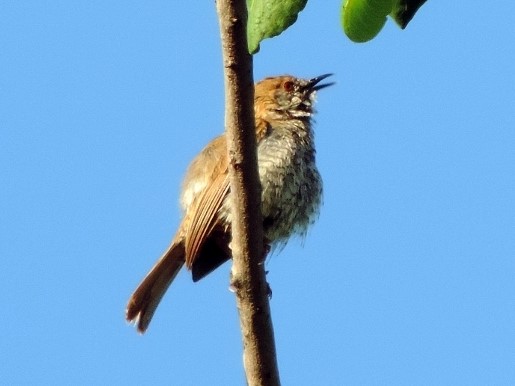
The Stierling's Wren-Warbler is a small bird, measuring about 12 centimeters in length. It exhibits a subtle yet distinctive plumage, with upperparts that are primarily gray-brown and underparts that are paler, often appearing whitish or buff. A key field mark is its faintly striped crown and the slightly warmer brown tinge on its wings and tail. The tail is often held slightly cocked, a characteristic posture that aids identification. Adult males and females are similar in appearance, though the males might display slightly more pronounced coloration during the breeding season. Juvenile birds resemble adults but tend to have duller plumage. It is possible to confuse the Stierling's Wren-Warbler with other similar-sized warblers and cisticolas. However, its unique song, tail posture, and habitat preference help distinguish it from other species. The bird's flight is typically low and undulating, often moving from bush to bush in search of insects. When perched, it often remains motionless, relying on its cryptic plumage to blend with its surroundings.
Having trouble telling birds apart? Upload a photo to our bird identification tool for an instant species match.
Stierling's Wren-Warbler Habitat and Range
Preferred Habitat
Stierling's Wren-Warbler predominantly inhabits dry savanna and miombo woodlands. These habitats are characterized by open grassy areas interspersed with trees and shrubs, providing a mix of cover and open spaces for foraging. The bird is typically found at elevations ranging from 500 to 1500 meters. Its preference for wooded savanna means it is primarily found in rural areas, although it can sometimes be observed near human settlements that encroach on suitable habitats. Unlike many other small birds, the Stierling's Wren-Warbler does not frequent urban environments, relying instead on natural or semi-natural landscapes. Seasonal habitat shifts are minimal, as it tends to remain in regions where food resources and habitat conditions are stable year-round.
Geographic Range
The Stierling's Wren-Warbler's range is concentrated in southeastern Africa. It is resident in countries such as Malawi, Mozambique, Zambia, and Zimbabwe, where it occupies miombo woodland and savanna habitats. The species is not migratory, but it may exhibit local movements in response to environmental conditions, such as rainfall and food availability. Population density is often higher in areas with abundant insect prey and suitable nesting sites. Despite its relatively narrow range, the Stierling's Wren-Warbler can be locally common in appropriate habitats, though it is more often heard than seen due to its elusive nature.
Want to know which birds visit your area? Browse our backyard birds by location guides for region-specific species lists.
What Does the Stierling's Wren-Warbler Eat?
The Stierling's Wren-Warbler primarily feeds on insects and other small arthropods. It hunts by gleaning from leaves and branches, often foraging in the lower to mid-levels of the vegetation. Its diet includes caterpillars, beetles, ants, and spiders, which it captures with quick, darting movements. The bird's foraging technique involves a combination of sight and sound to locate prey, often listening intently before pouncing on its target. During the rainy season, when insect populations peak, the wren-warbler's diet becomes more varied, including a higher proportion of soft-bodied insects like caterpillars. Feeding occurs throughout the day, with peaks in activity during the cooler morning and late afternoon hours.
Stierling's Wren-Warbler Behavior and Social Structure
The Stierling's Wren-Warbler exhibits a range of behaviors adapted to its savanna habitat. It is typically solitary or found in pairs, with each pair maintaining a territory during the breeding season. Territorial boundaries are defended through vocalizations and displays. The male's song is a key component of its territorial behavior, serving to ward off rivals and attract potential mates. Courtship involves a series of displays, including wing and tail flicking, accompanied by soft calls. The species is generally non-migratory, remaining within its range year-round, though individuals may roam locally in search of food. When threatened, the wren-warbler employs a cryptic strategy, freezing and relying on its plumage to blend into its surroundings. Its response to predators includes a series of alarm calls, alerting nearby birds to danger. Daily activities are diurnal, with peaks in activity during the cooler hours of the day.
Stierling's Wren-Warbler Nesting and Reproduction
Nesting for the Stierling's Wren-Warbler involves constructing a cup-shaped nest, typically located in a shrub or low tree. The nest is woven from grass and plant fibers, camouflaged with leaves and other natural materials. Clutch size usually ranges from two to three eggs, which are incubated by the female for approximately 12 to 14 days. Both parents participate in feeding the chicks, which fledge about two weeks after hatching. The fledging period is marked by increased activity and vocalizations as the young develop their flight skills. The species generally raises one brood per year, although in favorable conditions, a second brood may be attempted.
Stierling's Wren-Warbler Sounds and Vocalizations
The primary song of the Stierling's Wren-Warbler is a melodious series of whistles and trills, delivered at a steady pace. Each song typically consists of repeated phrases, often lasting several seconds. The quality is clear and musical, making it a distinctive element of the bird's presence in the savanna. In addition to its song, the wren-warbler produces a variety of call notes, including soft chirps and more urgent alarm calls when disturbed. During the dawn chorus, the wren-warbler's song contributes to the vibrant soundscape, especially during the breeding season when males are most vocal.
Interesting Facts About the Stierling's Wren-Warbler
- 1The Stierling's Wren-Warbler is named after the German zoologist Franz Stierling, who first described the species.
- 2Despite its small size, the bird's song can be heard up to 200 meters away, making it easier to detect by sound than sight.
- 3The species is remarkably adaptive, capable of surviving in areas that experience extreme seasonal variations in temperature and rainfall.
- 4Stierling's Wren-Warbler pairs are known for their strong territorial bonds, often remaining in the same area for years.
- 5The bird's cryptic plumage helps it avoid predators, blending seamlessly with the dry grasses and branches of its savanna habitat.
- 6During the breeding season, the male's song becomes more frequent, a critical component of its courtship and territorial defense strategies.
Stierling's Wren-Warbler Conservation Status
The Stierling's Wren-Warbler is currently listed as Least Concern by the IUCN, with populations considered stable. However, habitat degradation poses a potential threat to its future. Deforestation, agricultural expansion, and changes in land use can reduce suitable habitats, impacting local populations. Conservation efforts focus on protecting miombo woodlands and managing land use to ensure sustainable practices. Historical population data suggest stability over recent decades, though continuous monitoring is essential to detect and address any emerging threats.


