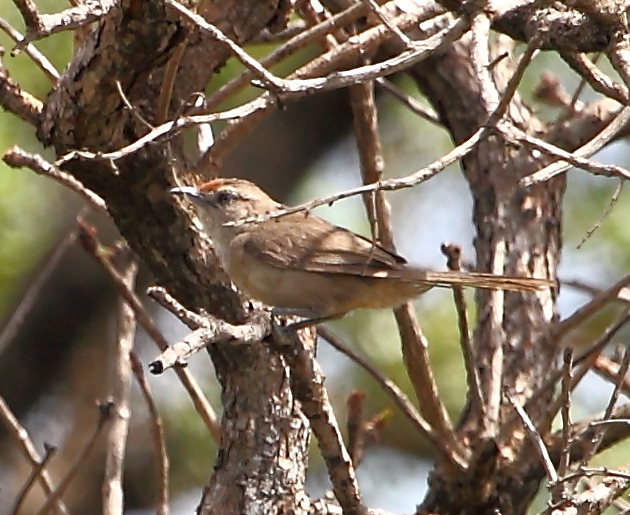
Streak-fronted Thornbird
Phacellodomus striaticeps
Order: Passeriformes / Family: Furnariidae

Wikimedia Commons
About the Streak-fronted Thornbird
The Streak-fronted Thornbird (Phacellodomus striaticeps) is a notable member of the Furnariidae family, recognized for its distinctive streaked head and agile nature. This bird is predominantly found in the arid and semi-arid regions of South America, particularly in countries like Argentina, Bolivia, and Paraguay. It thrives in dry shrublands and forest edges, making use of its environment to forage and nest efficiently. Ecologically, the Streak-fronted Thornbird plays a crucial role in its habitat by engaging in activities that help control insect populations and contribute to seed dispersal. Its presence indicates a healthy and balanced ecosystem. The bird's adaptability to various dry habitats illustrates its resilience and evolutionary success. During the breeding season, which typically spans from July to December, the Streak-fronted Thornbird becomes particularly active, exhibiting increased vocalizations and territorial behaviors as pairs defend their nesting sites. The bird's ecological role extends beyond its immediate environment, influencing the biodiversity of the regions it inhabits. By participating in the control of insect populations, it indirectly supports plant health and growth. Moreover, its foraging habits aid in the dispersal of seeds, further enhancing the ecological dynamics within its habitat. The Streak-fronted Thornbird's adaptability to a range of dry environments underscores its importance within the ecological community, serving as an indicator of environmental health in the areas it inhabits.
The Streak-fronted Thornbird belongs to the family Furnariidae, within the order Passeriformes. These birds typically live 5-6 years with a maximum recorded age of 8 years.
How to Identify a Streak-fronted Thornbird
The Streak-fronted Thornbird can be identified by its medium size, measuring approximately 18-20 cm in length. Its plumage is predominantly brown, with a lighter, streaked front that gives it its name. The streaks on the head are especially prominent, setting it apart from other similar species. Adult birds possess a more pronounced streaking pattern compared to juveniles, which tend to have softer, less distinct markings. Both males and females exhibit similar plumage, making gender differentiation challenging in the field. However, close observation during the breeding season may reveal subtle behavioral differences. In flight, the Streak-fronted Thornbird presents a distinctive silhouette characterized by its relatively short tail and rounded wings. When perched, it often adopts an upright posture, frequently flicking its tail and moving with agility. The bird's small size and active movements can sometimes lead to confusion with other small passerines in its range, such as certain species of wrens and warblers. However, the unique combination of its streaked head and its characteristic vocalizations help observers confirm its identity.
Having trouble telling birds apart? Upload a photo to our bird identification tool for an instant species match.
Streak-fronted Thornbird Habitat and Range
Preferred Habitat
The Streak-fronted Thornbird is typically associated with dry and semi-arid habitats, including shrublands, dry forests, and forest edges. It is often found at elevations ranging from 200 to 2,000 meters above sea level. The bird shows a preference for areas with dense vegetation, such as thorny shrubs and low trees, which provide both food and protection. In regions like the Gran Chaco of Argentina and Bolivia, it thrives in the dry, open woodlands. Although primarily a rural species, the Streak-fronted Thornbird occasionally ventures into urban areas, particularly in parks and gardens that replicate its natural habitat conditions. Seasonal shifts in habitat preference are minimal, as the bird remains largely sedentary throughout the year, relying on the consistent availability of resources in its established territories.
Geographic Range
The Streak-fronted Thornbird's range extends across parts of South America, with its core distribution centered in Argentina, Bolivia, and Paraguay. It occupies regions characterized by dry and semi-arid climates, such as the Chaco and Monte Desert ecosystems. Unlike many passerines, the Streak-fronted Thornbird does not engage in long-distance migrations, opting instead for a more sedentary lifestyle. Its population density is highest in areas where suitable habitats are abundant, such as the Gran Chaco, which provides an extensive range of feeding and nesting opportunities. Despite its limited geographic range, the Streak-fronted Thornbird's adaptability to various dry habitats ensures that it maintains a stable population across its distribution. There are no significant migratory corridors for this species, as it generally remains within its breeding territories year-round.
Want to know which birds visit your area? Browse our backyard birds by location guides for region-specific species lists.
What Does the Streak-fronted Thornbird Eat?
The diet of the Streak-fronted Thornbird primarily consists of insects and other small invertebrates, which it forages for with skill and determination. The bird employs a variety of foraging techniques, including gleaning from foliage and probing into crevices with its sharp bill. Its diet includes beetles, ants, spiders, and occasionally small seeds and fruits, particularly when insect availability decreases during drier months. The Streak-fronted Thornbird's foraging activity peaks during the early morning and late afternoon, coinciding with cooler temperatures and increased prey activity. This foraging schedule allows it to maximize its energy intake while minimizing exposure to the midday heat. The bird's ability to exploit a wide range of food sources contributes to its success in arid environments, where resource availability can be unpredictable.
Streak-fronted Thornbird Behavior and Social Structure
The Streak-fronted Thornbird exhibits a range of behaviors that reflect its adaptability and social nature. It typically forms monogamous pairs that maintain territories year-round, with both partners actively participating in territory defense and nesting. During the breeding season, males engage in elaborate courtship displays, which include vocalizations and physical displays to attract and bond with their mates. The bird's social structure is generally centered around the pair, although small family groups may form outside the breeding season. In response to predators, the Streak-fronted Thornbird exhibits alarm calls and may engage in mobbing behavior to deter threats. Its daily activity patterns include periods of intensive foraging interspersed with rest and preening. This mix of behaviors ensures that the bird remains alert and responsive to changes in its environment.
Streak-fronted Thornbird Nesting and Reproduction
The nest of the Streak-fronted Thornbird is a complex, enclosed structure built primarily from twigs and other plant materials. It is typically located in dense shrubs or low trees, providing concealment and protection. The nest features a side entrance and is lined with softer materials to ensure comfort for the eggs and chicks. A typical clutch consists of two to four eggs, with both parents sharing incubation duties over a period of approximately 15 to 18 days. Once hatched, the chicks remain in the nest for another 18 to 22 days before fledging. Parental roles are clearly defined, with both adults participating in feeding and protecting the young. The Streak-fronted Thornbird may raise one or two broods per year, depending on environmental conditions and resource availability.
Streak-fronted Thornbird Sounds and Vocalizations
The primary song of the Streak-fronted Thornbird is a series of rapid, high-pitched notes delivered with a distinct rhythm and clarity. These vocalizations serve as territorial markers and play a role in courtship. The bird also emits a variety of call notes, including sharp, scolding sounds used in alarm situations. During the dawn chorus, the Streak-fronted Thornbird's song is particularly prominent, contributing to the acoustic landscape of its habitat. Its vocalizations can be likened to a series of short, sharp whistles, easily distinguishable from other bird species in the same area.
Interesting Facts About the Streak-fronted Thornbird
- 1The Streak-fronted Thornbird constructs some of the most elaborate nests in the bird world, often using hundreds of twigs.
- 2Despite its name, the Streak-fronted Thornbird's streaking patterns can vary significantly between individuals.
- 3This bird's adaptability to arid environments makes it a model species for studying ecological resilience.
- 4The Streak-fronted Thornbird's vocalizations contribute significantly to the dawn chorus in its native regions.
- 5It often shares its habitat with other thornbird species, leading to interesting interspecies interactions.
- 6The Streak-fronted Thornbird's nesting success is closely tied to the availability of dense shrub cover.
- 7Its presence in an area is often used as an indicator of environmental health and ecosystem stability.
Streak-fronted Thornbird Conservation Status
The IUCN currently lists the Streak-fronted Thornbird as a species of Least Concern, reflecting its stable population trend. Although it faces localized threats, such as habitat degradation and agricultural expansion, its adaptability to a range of dry habitats has buffered it against significant declines. Conservation efforts focus on habitat preservation and maintaining the ecological integrity of its native regions. Historical population changes have been relatively minor, with the species demonstrating resilience to environmental changes over time.
Other Furnariidae Species


Birds Similar to the Streak-fronted Thornbird
These species are often confused with the Streak-fronted Thornbird due to similar appearance or overlapping range.