
Stub-tailed Spadebill
Platyrinchus cancrominus
Order: Passeriformes / Family: Tyrannidae
Wikimedia Commons
About the Stub-tailed Spadebill
The Stub-tailed Spadebill, or Platyrinchus cancrominus, is a fascinating member of the Tyrannidae family, primarily found in the dense, humid tropical forests of Central America. This small passerine bird is often more easily heard than seen, due to its secretive nature and preference for understory habitats. Its ecological role is significant as an insectivore, contributing to pest control and thus maintaining a balance in its ecosystem. The Stub-tailed Spadebill is commonly found in regions stretching from southern Mexico, through Belize and Guatemala, and into parts of Honduras and Nicaragua. These birds are non-migratory, spending their entire year within these tropical forests. During the breeding season, which typically occurs in the wet months from May to August, the spadebill's activity increases as males establish territories and engage in vocal displays. The Stub-tailed Spadebill fulfills an important niche in its ecosystem, consuming a variety of insects and arthropods. This feeding behavior helps control insect populations, which can otherwise reach pest levels. In turn, the bird serves as prey for larger predators, thus becoming a vital link in the food web. The species' preference for dense forest understories makes it an ideal subject for studying interactions within tropical forest ecosystems. Observing these birds requires patience, as their small size and cryptic behavior often make them challenging to spot amidst the foliage.
The Stub-tailed Spadebill belongs to the family Tyrannidae, within the order Passeriformes. These birds typically live average 4-7 years with some individuals living up to 9 years..
How to Identify a Stub-tailed Spadebill
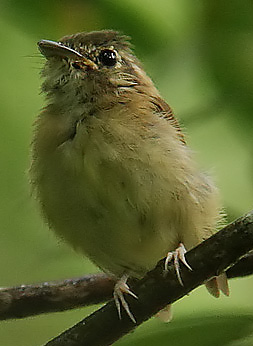
The Stub-tailed Spadebill is easily identified by its unique morphological features. Adults have olive-brown upperparts with a slightly lighter underbelly, providing excellent camouflage in their forest habitat. The most striking feature is the broad, flattened bill, which gives the bird its name. This adaptation is particularly useful for catching insects mid-flight or off foliage. The tail, as the name suggests, is notably stubby, contributing to the bird's distinct profile. Juveniles resemble adults but are slightly lighter in color, with a more pronounced buffy wash on the underparts. Both males and females look alike, making gender differentiation in the field challenging. However, males might appear marginally larger during the breeding season due to their more active and territorial behavior. In flight, the Stub-tailed Spadebill exhibits a short, direct flight pattern, often interrupted by brief hoverings as it inspects leaves for insects. When perched, it is often motionless, blending seamlessly with the twigs and branches.
Having trouble telling birds apart? Upload a photo to our bird identification tool for an instant species match.
Stub-tailed Spadebill Habitat and Range
Preferred Habitat
The Stub-tailed Spadebill thrives in the humid, dense understory of tropical forests. Its preferred habitat includes regions with abundant foliage and minimal human disturbance, typically at elevations ranging from sea level up to 1,200 meters. These birds are predominantly found in lowland tropical forests, often near streams or other water sources, which provide a rich supply of insects. Unlike some other tyrant flycatchers, the Stub-tailed Spadebill rarely ventures into open areas or urban environments. Its reliance on dense forest habitats makes it vulnerable to deforestation and habitat fragmentation.
Geographic Range
The range of the Stub-tailed Spadebill is largely confined to Central America. Its breeding and year-round range spans southern Mexico, Belize, Guatemala, and northern Honduras and Nicaragua. Within these regions, the bird is a resident, consistent with its non-migratory nature. While the species is not known for long-distance migration, it may exhibit some altitudinal movements in response to seasonal changes in food availability. Population density tends to be highest in areas of undisturbed primary forest, where human activity and habitat destruction have been minimal.
Want to know which birds visit your area? Browse our backyard birds by location guides for region-specific species lists.
What Does the Stub-tailed Spadebill Eat?
The diet of the Stub-tailed Spadebill primarily consists of small insects and arthropods. It is an adept forager, employing various techniques to capture prey. These include hawking, where the bird catches insects in mid-air, and gleaning, where it picks insects off leaves and branches. During the wet season, when insect abundance is high, its diet is more varied, including ants, beetles, and small caterpillars. In contrast, the dry season may see a shift to more generalized foraging as insect availability decreases. The spadebill's broad bill is perfectly suited for capturing a wide range of prey sizes, allowing it to exploit different food sources throughout the year.
Stub-tailed Spadebill Behavior and Social Structure
The Stub-tailed Spadebill exhibits solitary or paired behavior, rarely forming flocks. It is territorial, particularly during the breeding season, when males can become aggressive in defending their space. Courtship displays involve vocalizations and aerial maneuvers designed to attract a mate. Daily activity peaks during the early morning and late afternoon, coinciding with periods of insect activity. The bird's response to predators involves remaining motionless and relying on its camouflage to avoid detection. In the presence of a threat, it may employ a short burst of flight to a more concealed location.
Stub-tailed Spadebill Nesting and Reproduction
The nesting behavior of the Stub-tailed Spadebill is quite specialized. Nests are typically constructed as shallow cups placed on low branches or vines, often less than a meter off the ground. The materials used include fine twigs, grass, and spider silk, creating a resilient and concealed structure. Clutch size usually consists of two eggs, which are incubated predominantly by the female for about 16 days. After hatching, both parents participate in feeding the chicks, which fledge approximately 18 days post-hatching. The species typically raises one brood per year, though in some regions, a second brood might be attempted depending on food availability.
Stub-tailed Spadebill Sounds and Vocalizations
The primary vocalization of the Stub-tailed Spadebill is a series of short, sharp whistles that serve as both contact and territorial calls. The rhythm is brisk, with a repetitive quality that can be likened to a high-pitched metronome. During the early morning, the bird may engage in a dawn chorus, where its calls become more frequent and varied. Alarm calls are sharper and more urgent, signaling potential threats to conspecifics. The bird's vocal repertoire is a crucial aspect of its communication, especially within the dense forest understory.
Interesting Facts About the Stub-tailed Spadebill
- 1The Stub-tailed Spadebill's bill is uniquely adapted to capture insects with precision, functioning almost like a pair of tweezers.
- 2Despite its small size, the Stub-tailed Spadebill can consume prey nearly half its own body length, showcasing impressive hunting skills.
- 3The bird's cryptic plumage provides exceptional camouflage, allowing it to remain undetected by predators and birdwatchers alike.
- 4Stub-tailed Spadebills have been observed participating in mixed-species foraging flocks, benefiting from communal vigilance.
- 5Their nests are often so well concealed that they can be overlooked even by experienced ornithologists during field studies.
- 6This species' preference for undisturbed forests highlights the importance of conserving primary forest habitats.
- 7The Stub-tailed Spadebill's vocalizations are a key tool for maintaining territory and attracting mates in dense forest environments.
Stub-tailed Spadebill Conservation Status
According to the IUCN Red List, the Stub-tailed Spadebill is currently classified as Least Concern. However, its population trend is decreasing, primarily due to habitat loss from deforestation and land-use change. Conservation efforts are focused on preserving forest habitats and mitigating the impacts of logging and agricultural expansion. While historical population data is limited, current efforts aim to stabilize populations through protected areas and environmental legislation. Increased awareness and habitat restoration projects are key to ensuring the long-term survival of this species.


