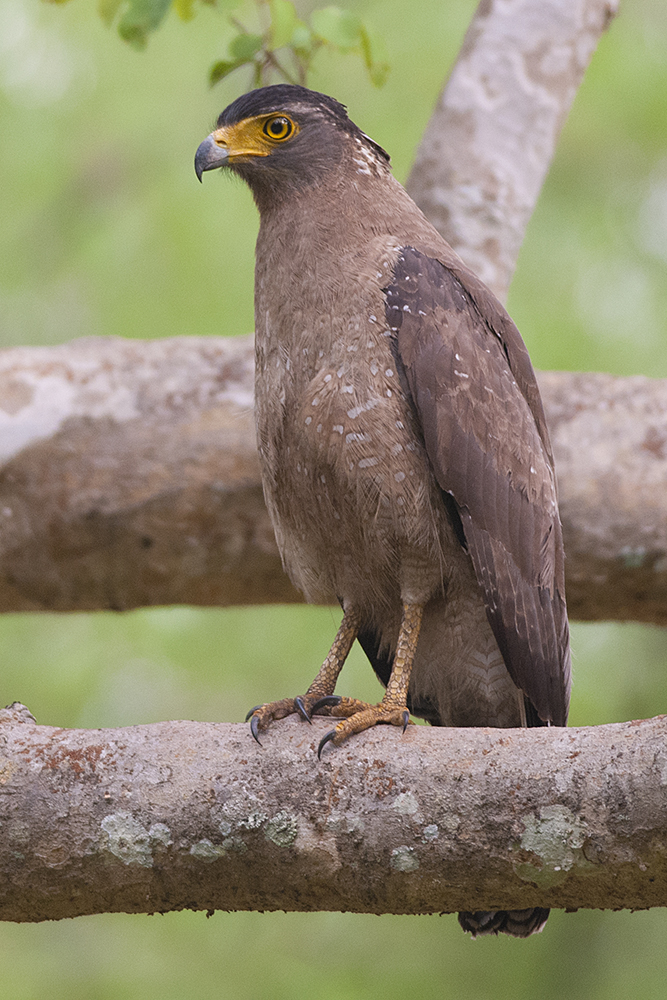
Sulawesi Serpent-Eagle
Spilornis rufipectus
Order: Accipitriformes / Family: Accipitridae

Wikimedia Commons
About the Sulawesi Serpent-Eagle
The Sulawesi Serpent-Eagle (Spilornis rufipectus) is a captivating avian species native to the island of Sulawesi in Indonesia. This medium-sized raptor resides primarily in the dense tropical rainforests that blanket the island, where it plays a crucial role in the ecosystem as both predator and scavenger. The bird's presence helps control the population of snakes and other small vertebrates, maintaining the delicate balance of its habitat.
The Sulawesi Serpent-Eagle bears significant ecological importance due to its niche dietary preferences. It targets reptiles, particularly snakes, which are abundant in the forested landscapes of Sulawesi. As an apex predator in this environment, the serpent-eagle influences the population dynamics of its prey species. This eagle's status as an indicator species reflects the health of the rainforest, signaling changes in biodiversity and ecosystem stability.
In the context of biodiversity, the Sulawesi Serpent-Eagle is emblematic of the unique avian diversity found on the island. Sulawesi's isolation has resulted in a high rate of endemism, with this eagle being one of many species that contribute to the region's distinct ecological character. As a non-migratory bird, the serpent-eagle remains on the island year-round, displaying unique adaptations to the humid, tropical environment. Its ability to thrive in such a specific ecological niche underscores the importance of preserving Sulawesi's natural habitats, which face pressures from deforestation and human encroachment.
The Sulawesi Serpent-Eagle belongs to the family Accipitridae, within the order Accipitriformes. These birds typically live average 10-15 years, with a maximum recorded of 18 years..
How to Identify a Sulawesi Serpent-Eagle
The Sulawesi Serpent-Eagle is easily identified by its striking plumage and distinct characteristics. Adult birds exhibit a rich rufous coloration on their chest, which contrasts beautifully with their darker brown back and wings. Their underparts are marked with bold, dark barring, adding to their unmistakable appearance. The head is adorned with a prominent crest, and the eyes are a piercing yellow, providing a fierce, vigilant look.
Juvenile serpent-eagles differ from adults by having a more muted coloration and less pronounced barring on their underparts. Their crests are not as well developed, and their overall plumage tends to be more uniformly brown with subtle hints of rufous on the chest. As they mature, their plumage transitions into the more vibrant patterns seen in adults.
In flight, the Sulawesi Serpent-Eagle can be recognized by its broad wings and short tail, which create a distinctive silhouette. When perched, they adopt an upright posture, often found surveying their surroundings from a high vantage point. They may be confused with other raptors, but their unique coloration and the combination of physical features generally make identification straightforward.
Having trouble telling birds apart? Upload a photo to our bird identification tool for an instant species match.
Sulawesi Serpent-Eagle Habitat and Range
Preferred Habitat
The Sulawesi Serpent-Eagle inhabits the lush, tropical rainforests of Sulawesi, thriving in areas that offer dense canopy cover and abundant prey. These forests are typically found at elevations ranging from sea level up to 1,500 meters. The serpent-eagle demonstrates a preference for primary forests, although it can occasionally be found in degraded or secondary forests.
Seasonal shifts in habitat are minimal, as this species is non-migratory. However, they may move to different forested areas within their range in search of food or suitable nesting sites. They are rarely seen in urban or heavily populated areas, as their reliance on forest habitats makes such environments unsuitable for their needs.
Their presence is indicative of intact, biodiverse ecosystems, and their habitat requirements underscore the importance of conserving Sulawesi's forested areas against ongoing threats like deforestation.
Geographic Range
The Sulawesi Serpent-Eagle is endemic to Sulawesi, an island in Indonesia, and does not migrate beyond this region. Its range encompasses the entirety of the island, which spans approximately 174,600 square kilometers. Within this area, the serpent-eagle primarily resides in the rainforest regions, although it can inhabit a variety of forested terrains across the island.
Population density is highest in areas where primary forest remains intact, particularly in national parks and protected areas where human disturbance is minimal. However, due to habitat loss, human encroachment, and environmental changes, some populations are forced to adapt to secondary forests, which may support lower densities of the species.
Because they do not exhibit migratory behavior, the Sulawesi Serpent-Eagle remains a year-round resident of its island habitat, making its conservation status heavily dependent on local environmental policies and practices.
Want to know which birds visit your area? Browse our backyard birds by location guides for region-specific species lists.
What Does the Sulawesi Serpent-Eagle Eat?
The diet of the Sulawesi Serpent-Eagle primarily consists of reptiles, with a particular emphasis on snakes. This dietary specialization is reflected in its common name and is a defining characteristic of the species. The serpent-eagle employs a keen sense of vision and stealth to hunt, often perching quietly before swooping down to capture its prey with precision.
In addition to snakes, this raptor also preys on other small vertebrates, including lizards, frogs, and occasionally birds and small mammals. Its diet may vary slightly with seasonal availability, but reptiles consistently form the core component of its intake.
Foraging typically occurs during the day, as the serpent-eagle relies on visual cues to locate prey. It is known to hunt both from a perch and while in flight, demonstrating agility and adaptability in its feeding strategies. Prey size varies, but it generally targets animals that can be easily subdued and consumed without the need for extended struggle.
Sulawesi Serpent-Eagle Behavior and Social Structure
The Sulawesi Serpent-Eagle exhibits a range of fascinating behaviors that are characteristic of its status as a solitary and territorial bird of prey. It typically maintains a large territory, which it defends actively against intruders, particularly during the breeding season. Territorial displays include soaring flights and vocalizations, which serve as both warnings to rivals and signals to potential mates.
Courtship displays are a notable aspect of the serpent-eagle's behavior. During the breeding season, males perform aerial displays that include acrobatic flights and calling to attract females. Once a pair forms, they remain monogamous, often returning to the same nesting sites year after year.
The Sulawesi Serpent-Eagle is primarily a diurnal bird, engaging in most of its activities, such as hunting and territorial defense, during daylight hours. It shows a strong reliance on its keen eyesight to detect prey and potential threats. Social interactions between individuals are rare, except during the breeding season, as these eagles are generally solitary outside of mating and nesting periods.
Sulawesi Serpent-Eagle Nesting and Reproduction
Nesting habits of the Sulawesi Serpent-Eagle are adapted to the dense forest environments of Sulawesi. They typically choose tall trees within their territory to build their nests, preferring locations that offer seclusion and protection from predators. The nests are constructed from sticks and lined with green leaves, providing a sturdy and camouflaged platform for raising young.
The typical clutch size for the Sulawesi Serpent-Eagle is one to two eggs, with both parents involved in incubation and care of the chicks. Incubation lasts approximately 35 to 40 days, during which time the female spends most of her time on the nest, while the male hunts and provides food.
After hatching, the young are dependent on their parents for food and protection. Fledging occurs around 60 to 70 days post-hatching, but juveniles may remain with their parents for several months before becoming fully independent. The species generally raises one brood per year, reflecting the significant investment in each offspring's survival and development.
Sulawesi Serpent-Eagle Sounds and Vocalizations
The Sulawesi Serpent-Eagle's vocalizations are distinctive, characterized by a series of high-pitched, whistling calls. These calls are often described as sharp and penetrating, serving as both communication between mates and territorial signals to rivals.
The primary call is a sequence of repeated notes that rise and fall in pitch, creating a rhythmic pattern that can be heard over considerable distances. Alarm calls are more abrupt and intense, used to alert other birds of potential danger.
During the dawn chorus, the serpent-eagle's calls can be particularly prominent, as they engage in vocal displays to establish territory and attract mates. The sound is reminiscent of a whistle or flute, with a quality that is both musical and assertive.
Interesting Facts About the Sulawesi Serpent-Eagle
- 1The Sulawesi Serpent-Eagle's scientific name, 'Spilornis rufipectus,' refers to its rufous-colored chest, a unique trait among serpent-eagles.
- 2Despite its name, the Sulawesi Serpent-Eagle's diet includes more than just snakes; it also preys on lizards, frogs, and small mammals.
- 3Sulawesi Serpent-Eagles can be observed performing soaring displays during the breeding season, showcasing their aerial agility.
- 4The serpent-eagle plays a crucial role in controlling snake populations within its habitat, highlighting its ecological importance.
- 5This raptor's sharp, whistling call can be heard echoing through the forests, a characteristic sound of its presence.
- 6Sulawesi's isolation has led to a high rate of endemic species, with the serpent-eagle being one of the island's unique avian inhabitants.
- 7The Sulawesi Serpent-Eagle's nesting strategy includes using fresh leaves to line nests, providing both comfort and camouflage.
Sulawesi Serpent-Eagle Conservation Status
The Sulawesi Serpent-Eagle is currently classified as Near Threatened on the IUCN Red List, with its population trend showing signs of decline. The primary threats to this species stem from habitat loss due to deforestation and land conversion for agriculture and development. As forests are cleared, the serpent-eagle's habitat becomes fragmented, leading to reduced breeding success and population pressures. Conservation efforts are underway to protect the remaining forest habitats on Sulawesi, including the establishment of protected areas and national parks. These efforts aim to preserve not only the serpent-eagle but also the broader biodiversity that relies on intact ecosystems. Historical population changes reveal a species that was once more widespread across Sulawesi's forests. As pressures on the environment have increased, the need for targeted conservation strategies has become more urgent to prevent further declines.
Other Accipitridae Species


Birds Similar to the Sulawesi Serpent-Eagle
These species are often confused with the Sulawesi Serpent-Eagle due to similar appearance or overlapping range.