
Sumba Hornbill
Rhyticeros everetti
Order: Bucerotiformes / Family: Bucerotidae
Wikimedia Commons
About the Sumba Hornbill
The Sumba Hornbill, Rhyticeros everetti, is an extraordinary bird native exclusively to the island of Sumba in Indonesia. This species is of significant ecological importance as it plays a crucial role in seed dispersal, particularly in the island's forest ecosystems. The Sumba Hornbill's presence is closely tied to the health of its habitat, which consists primarily of lowland evergreen forests. These birds are large, with males slightly larger than females, and possess prominent casques atop their beaks, a trait that aids in amplifying their calls. This hornbill species is a key component in maintaining the overall biodiversity of Sumba's forests. During the breeding season, which coincides with the island's wet season from November to April, these birds become more territorial, engaging in elaborate courtship displays. Their loud, far-reaching calls resonate through the forest canopy, marking their presence and reinforcing pair bonds. In addition to their role in seed dispersal, Sumba Hornbills help control insect populations by foraging for various arthropods. Their ecological role extends to facilitating forest regeneration, as they transport seeds over considerable distances, promoting genetic diversity among plant species. Outside of the breeding season, the Sumba Hornbill remains a key figure in the forest ecosystem, albeit with less pronounced territorial behavior. These hornbills are typically found in pairs or small family groups, which highlights their social structure. Despite their critical ecological function, the Sumba Hornbill faces numerous threats, primarily due to habitat loss and fragmentation from agricultural expansion and logging. Conservation efforts are essential to preserve this unique species and the delicate balance of Sumba's forest ecosystems.
The Sumba Hornbill belongs to the family Bucerotidae, within the order Bucerotiformes. These birds typically live average 20 years, with some individuals reaching up to 25 years..
How to Identify a Sumba Hornbill
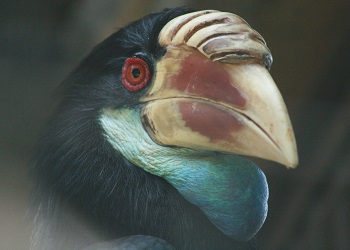
The Sumba Hornbill can be identified by its striking physical features, which include a large, curved bill topped with a prominent casque. The adult plumage of Rhyticeros everetti is predominantly dark, with males exhibiting a glossy black appearance and females showing slightly lighter tones. Both sexes possess white tail feathers, providing a stark contrast to their dark bodies. Juvenile hornbills resemble adults but have less developed casques and more muted plumage colors. In terms of sexual dimorphism, the Sumba Hornbill exhibits differences in bill size and casque development, with males generally having larger and more pronounced casques. When observing these hornbills in flight, their strong, flapping wingbeats and long tail are easily noticeable. Their flight silhouette is characterized by broad wings and a long tail, which aids in maneuverability through dense forest canopies. While perching, the Sumba Hornbill maintains an upright posture, often using its large bill to balance on branches. This species is unlikely to be confused with other hornbills due to its unique range and distinctive casque. However, it is important to note its similarities to other hornbill species found in the region, such as the Sulawesi Hornbill, although the latter lacks the same casque structure.
Having trouble telling birds apart? Upload a photo to our bird identification tool for an instant species match.
Sumba Hornbill Habitat and Range
Preferred Habitat
The Sumba Hornbill thrives in lowland evergreen forests, with a particular preference for undisturbed areas rich in fruit-bearing trees. These forests provide the necessary resources for feeding, nesting, and roosting. The species typically inhabits elevations ranging from sea level to approximately 950 meters. Seasonal habitat shifts are minimal, as the Sumba Hornbill remains within the confines of the island throughout the year. Unlike many other hornbill species, it does not migrate, given its limited range. Urban presence is rare, as these birds prefer the dense, secluded environments of rural forested areas. Their habitat selection is crucial for foraging, as they rely on large trees for nesting and fruit trees for sustenance.
Geographic Range
The Sumba Hornbill is endemic to Sumba, an Indonesian island in the Lesser Sunda chain. Its range is limited to this island, and it does not exhibit migratory behavior. The species occupies forests across Sumba, with population density hotspots typically aligned with the largest remaining forest patches. These areas include the Manupeu Tanah Daru National Park and Laiwangi Wanggameti National Park. Due to their reliance on specific forest habitats, the Sumba Hornbill's range is restricted geographically, making it a species of particular conservation concern. No significant movement patterns or migration corridors exist for this species, as it is a year-round resident of its native island.
Want to know which birds visit your area? Browse our backyard birds by location guides for region-specific species lists.
What Does the Sumba Hornbill Eat?
The diet of the Sumba Hornbill consists primarily of fruits, which constitute the majority of its food intake. The species shows a preference for figs, drupes, and other fruiting trees found in its forest habitat. Seasonal changes in fruit availability influence foraging behavior, with hornbills adjusting their diet according to what is most abundant. In addition to fruit, the Sumba Hornbill also consumes a variety of insects and small invertebrates, which provide essential protein, especially during the breeding season. These birds forage by using their large bills to pluck fruit from trees, often swallowing it whole. Their feeding schedule is typically diurnal, with peak activity in the early morning and late afternoon when cooler temperatures facilitate active foraging.
Sumba Hornbill Behavior and Social Structure
Sumba Hornbills exhibit strong social structures, often forming monogamous pairs or small family groups. They are territorial, especially during the breeding season, when males engage in vocal displays and visual signals to defend their territories. Courtship involves mutual preening and food exchanges, strengthening pair bonds. Flocking behavior is minimal, as these birds primarily maintain small group sizes. In response to predators, Sumba Hornbills rely on their loud calls to alert each other and deter potential threats. Daily activity patterns include morning and afternoon foraging sessions, interspersed with periods of rest and social interaction. Their vocal repertoire plays a vital role in communication, with calls varying between contact, alarm, and territorial signals.
Sumba Hornbill Nesting and Reproduction
The Sumba Hornbill utilizes natural cavities in large trees for nesting, often selecting sites with ample cover to protect from predators. Nest sites are usually found at considerable heights, offering security and access to surrounding food resources. The female usually lays a clutch of 2-3 eggs, which she incubates exclusively while sealed inside the cavity with a paste of mud and droppings, leaving only a narrow slit for the male to deliver food. The incubation period lasts approximately 40 days, after which the chicks hatch. The fledging timeline extends to around 90 days, during which both parents actively participate in feeding and caring for the young. Typically, the Sumba Hornbill produces one brood per year, given the extensive parental investment required.
Sumba Hornbill Sounds and Vocalizations
The Sumba Hornbill's call is a series of loud, resonant honks that echo through its forest habitat. These calls are rhythmic and can be described as a deep, repetitive 'hoo-hoo-hoo' sound, used primarily for communication between mates and to proclaim territory. Call notes vary, with some serving as alarm signals, characterized by a sharper, more urgent tone. During the dawn chorus, these hornbills are particularly vocal, their calls contributing to the cacophony of sounds marking the start of a new day in the forest. Their vocalizations are essential for maintaining pair bonds and coordinating group activities.
Interesting Facts About the Sumba Hornbill
- 1The Sumba Hornbill's casque, a hollow structure on its bill, amplifies its calls, making them audible over great distances.
- 2Unlike many birds, the female Sumba Hornbill seals herself inside the nest cavity during incubation, relying on the male for food.
- 3Sumba Hornbills can consume fruit whole, thanks to their strong, curved bills, which are adept at handling large items.
- 4These hornbills play a vital role in forest ecology by dispersing seeds through their droppings, aiding in plant regeneration.
- 5Sumba Hornbills have a relatively small range, restricted to the island of Sumba, making habitat protection crucial for their conservation.
Sumba Hornbill Conservation Status
The Sumba Hornbill is currently classified as Vulnerable on the IUCN Red List, with its population trend showing a decline. The primary threats to its survival include habitat destruction due to logging and agricultural expansion, which reduce the available nesting and feeding sites. Conservation efforts focus on habitat protection and restoration, particularly within national parks and other protected areas. Historical population changes reflect a decrease in numbers, attributed to increasing human encroachment. Advocacy for sustainable land-use practices and increased awareness are crucial for the long-term survival of this species.
Other Bucerotidae Species


Birds Similar to the Sumba Hornbill
These species are often confused with the Sumba Hornbill due to similar appearance or overlapping range.
