
Swallow Tanager
Tersina caerulea
Order: Passeriformes / Family: Thraupidae
Wikimedia Commons
About the Swallow Tanager
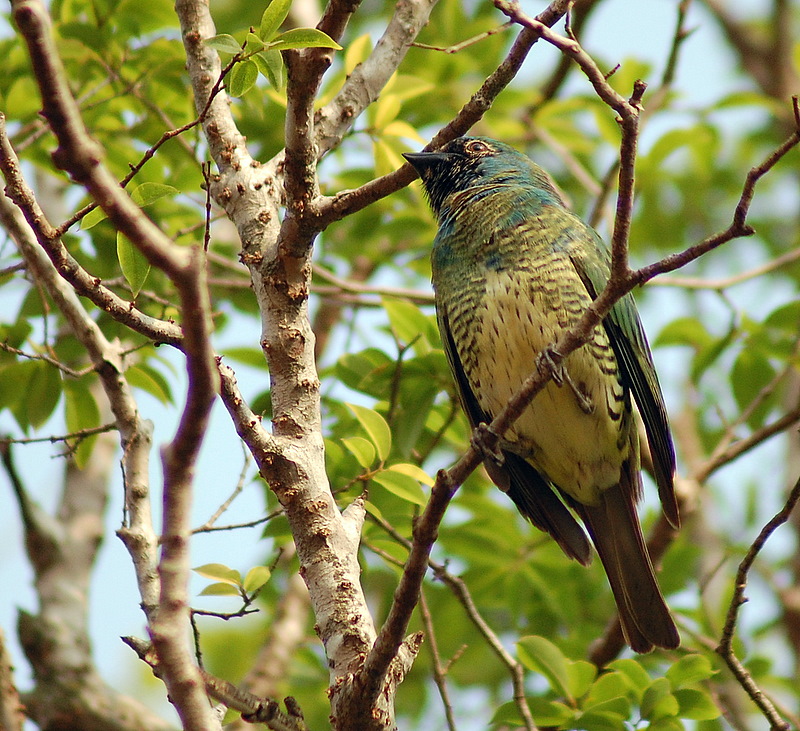
The Swallow Tanager (Tersina caerulea) is a striking member of the Thraupidae family, predominantly found in the tropical regions of South America. Its vibrant turquoise-blue plumage distinguishes it from other tanagers, making it a favorite among bird watchers. The species inhabits a range of wooded environments, including humid forests, open woodlands, and secondary growth areas. These birds play a critical ecological role as seed dispersers and pollinators due to their frugivorous diet. Swallow Tanagers are known for their seasonal movements, often driven by the availability of fruiting trees. During the wet season, they are more dispersed, foraging across various forest types. While they are not considered migratory, some populations exhibit altitudinal movements, descending to lower elevations during the cooler months. In countries like Brazil and Bolivia, the Swallow Tanager is widespread and relatively common. In the Andes, their presence is more patchy, restricted to forested valleys. The bird has a stable population trend, although habitat destruction poses a potential threat. The Swallow Tanager's unique behaviors and ecological contributions make it an integral part of the Neotropical avian community.
The Swallow Tanager belongs to the family Thraupidae, within the order Passeriformes. These birds typically live average 5-6 years with a maximum recorded of 10 years..
How to Identify a Swallow Tanager
The adult male Swallow Tanager is unmistakable with its bright turquoise-blue body, contrasted by black wings and tail. The females and juveniles differ significantly, displaying a more subdued greenish-blue hue. Females also exhibit faint streaking on the underparts, which is absent in males. Both sexes possess a short, conical bill suited for their frugivorous diet. In flight, the Swallow Tanager's silhouette is reminiscent of swallows, with a slender body and pointed wings, but their flight is more buoyant and less erratic. When perched, they display an upright posture, often choosing exposed branches from where they can spot potential food sources. While they might be confused with other blue tanagers, such as the Blue-and-white Tanager, the Swallow Tanager's unique coloration and flight pattern help distinguish it.
Having trouble telling birds apart? Upload a photo to our bird identification tool for an instant species match.
Swallow Tanager Habitat and Range
Preferred Habitat
The Swallow Tanager inhabits a variety of tropical and subtropical forest habitats. These birds are commonly found in humid lowland forests and prefer the edges and clearings where fruit is abundant. They can also be found in secondary growth forests, plantations, and even parklands within urban areas, although they typically avoid densely populated regions. Elevation-wise, they are typically seen from sea level up to 2,000 meters, descending to lower elevations during cooler months. Their adaptability to different forest types makes them a resilient species, often thriving in disturbed habitats where fruiting trees are plentiful.
Geographic Range
The Swallow Tanager's range extends throughout much of central and northern South America. They are widely distributed in countries such as Brazil, Peru, Bolivia, Paraguay, and the northern regions of Argentina. They are found as far north as Colombia and Venezuela. Though not a migratory species, some populations exhibit local movements influenced by fruit availability and seasonal climate changes. These movements are more pronounced in the Amazon Basin and the Atlantic Forest, where their presence can be highly localized depending on the time of year. Population density is highest in regions with abundant fruiting trees.
Want to know which birds visit your area? Browse our backyard birds by location guides for region-specific species lists.
What Does the Swallow Tanager Eat?
Swallow Tanagers primarily consume fruit, making them important seed dispersers in their habitats. Their diet includes a wide variety of berries and small fruits, which they forage by gleaning from tree branches and foliage. During certain seasons, they supplement their diet with insects, which provide necessary proteins. This opportunistic feeding behavior allows them to adapt to seasonal changes in fruit availability. They tend to feed in the early morning and late afternoon, periods when fruiting trees are most active. The birds often forage in small flocks, maximizing their efficiency in locating food sources.
Swallow Tanager Behavior and Social Structure
Swallow Tanagers exhibit a social structure characterized by small flocks, typically composed of family groups. These flocks are not highly territorial, allowing them to forage over large areas. During breeding season, males display vibrant courtship behaviors, using their striking plumage to attract females. Pairs often engage in synchronized flights and vocalizations. Flocking behavior is more pronounced outside the breeding season, when they join mixed-species flocks to exploit food resources efficiently. Swallow Tanagers are diurnal, with activity peaking during early morning and late afternoon. They exhibit vigilance against predators, with alarm calls and rapid dispersal upon sensing threats.
Swallow Tanager Nesting and Reproduction
The Swallow Tanager chooses natural cavities in trees, rock crevices, or even abandoned woodpecker holes for nesting. The nest is typically lined with fine vegetation and feathers to provide insulation and comfort. Clutch size generally ranges from two to three eggs. Both parents participate in incubation, which lasts about 14 to 16 days. After hatching, the chicks are altricial and rely heavily on parental care. Fledging occurs approximately 18 to 21 days post-hatching, with both parents actively feeding the young. Swallow Tanagers may raise one or two broods per year depending on food availability.
Swallow Tanager Sounds and Vocalizations
The primary song of the Swallow Tanager is a series of high-pitched, melodious notes that are often described as sweet and warbling. These songs serve to establish territory and attract mates during the breeding season. Their call notes are simpler, consisting of soft 'chip' sounds used for communication within flocks. Alarm calls are sharper and faster, serving as a warning to nearby birds. Swallow Tanagers are not known for a dawn chorus, but males sing more frequently during early morning hours when social interactions peak.
Interesting Facts About the Swallow Tanager
- 1The Swallow Tanager can be found at elevations up to 2,000 meters, showcasing impressive adaptability.
- 2Despite their vivid color, Swallow Tanagers are cryptic when foraging in the canopy, blending with the foliage.
- 3The Swallow Tanager's flight is not as erratic as true swallows, yet its buoyant style is distinctive.
- 4Swallow Tanagers occasionally participate in mixed-species flocks, enhancing their foraging success.
- 5Their diet shift to insects during breeding season provides essential proteins for chick development.
- 6Swallow Tanagers are capable of rapid local movements in response to fruit availability.
- 7In urban parklands, they can adapt to human presence, often seen foraging in exotic fruit trees.
Swallow Tanager Conservation Status
The IUCN lists the Swallow Tanager as a species of Least Concern, indicating a stable population. However, ongoing habitat destruction, particularly deforestation in the Amazon and Atlantic Forests, poses a long-term threat. Conservation efforts focus on habitat preservation and the establishment of protected areas. Historically, the Swallow Tanager has maintained a stable population, thanks to its adaptability and wide range. Continued monitoring and habitat conservation are essential to ensure its future stability.


