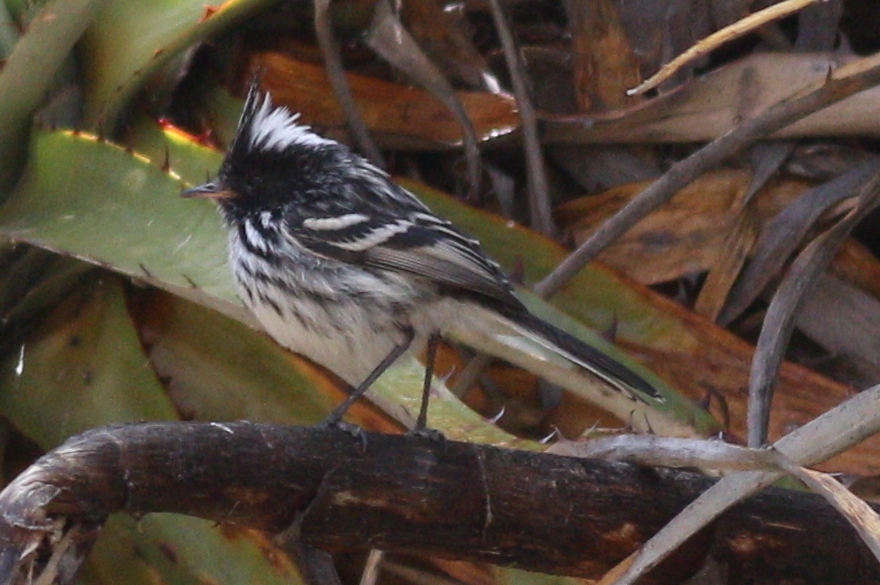
Tufted Tit-Tyrant
Anairetes parulus
Order: Passeriformes / Family: Tyrannidae

Wikimedia Commons
About the Tufted Tit-Tyrant
The Tufted Tit-Tyrant (Anairetes parulus) is a small passerine bird renowned for its agile movements and distinctive crest. Found predominantly in South America, this species occupies a range of habitats from the high Andes to coastal regions. It thrives in a variety of environments including shrubby grasslands, open woodlands, and even urban areas. Its adaptability to different habitats speaks volumes about its ecological role as an insectivore, contributing to pest control in both natural and man-made landscapes. This bird's ability to thrive at altitudes from sea level to over 4,000 meters highlights its versatility. During the breeding season, typically spanning from September to December, the Tufted Tit-Tyrant exhibits heightened territorial behaviors, often seen defending its chosen area with vigor. In the non-breeding season, it may form small, loose flocks, indicating a shift from territorial to more social habits. The presence of the Tufted Tit-Tyrant in both dry and moist forests shows its role in various ecosystems, where it helps maintain insect populations in check. Ecologically, it plays a significant role in food webs, acting as both predator and prey. Its wide distribution across countries like Argentina, Chile, and Bolivia underscores its importance and adaptability. As climates and habitats change, the Tufted Tit-Tyrant’s ability to adjust its range and behaviors will be crucial for its continued success.
The Tufted Tit-Tyrant belongs to the family Tyrannidae, within the order Passeriformes. These birds typically live typically around 5-8 years, with some individuals reaching up to 10 years..
How to Identify a Tufted Tit-Tyrant
The Tufted Tit-Tyrant is easily identified by its small size, approximately 10-11 centimeters in length, and its distinct crest. Adult plumage is predominantly gray with olive tones, providing excellent camouflage among foliage. Its underparts are lighter, with a subtle white throat and belly. Juvenile birds resemble adults but may display slightly duller plumage. Males and females exhibit similar coloration, making sex differentiation challenging in the field. One distinguishing feature is the presence of white wing bars, which are particularly visible in flight. The bird's flight is characterized by quick, darting movements, often interspersed with short glides. When perched, it often holds its tail cocked, adding to its distinctive silhouette. Similar species, like the Plain-crowned Tit-Spinetail, may cause confusion, but the Tufted Tit-Tyrant’s unique crest and wing pattern help differentiate it. Its curious and active nature often draws attention, making it a favorite among birdwatchers.
Having trouble telling birds apart? Upload a photo to our bird identification tool for an instant species match.
Tufted Tit-Tyrant Habitat and Range
Preferred Habitat
The Tufted Tit-Tyrant inhabits a wide range of habitats across South America. It is commonly found in shrubby grasslands and open woodlands, often at elevations ranging from sea level to over 4,000 meters. In the Andes, it prefers areas with scattered bushes and small trees, providing ample opportunities for foraging and nesting. This bird adapts to both rural and urban environments, frequently seen in gardens and parks, particularly in Chile and Argentina. Seasonal habitat shifts occur, with some populations moving to lower elevations during colder months. Its presence in diverse habitats, from arid regions to humid forests, highlights its ecological adaptability.
Geographic Range
The Tufted Tit-Tyrant is widely distributed across South America, with its range extending from central Argentina and Chile in the south to Bolivia and Peru in the north. It inhabits both the eastern and western slopes of the Andes, showcasing its adaptability to different climate conditions. During the breeding season, they are more concentrated in the highlands, while in winter, some populations may descend to lower altitudes. Countries like Chile and Argentina are hotspots for this species, where it is commonly found in suitable habitats. Despite its wide range, the bird does not exhibit long-distance migratory behavior, although local movements in response to seasonal changes in weather and food availability are common.
Want to know which birds visit your area? Browse our backyard birds by location guides for region-specific species lists.
What Does the Tufted Tit-Tyrant Eat?
The diet of the Tufted Tit-Tyrant consists mainly of insects and other small arthropods, which it actively forages among foliage and branches. Its agile nature allows it to catch prey mid-air or glean from leaves and bark. During the breeding season, when the demand for protein is high, insects form the primary food source. In the non-breeding season, it may also consume seeds and berries, although these form a minor part of its diet. Prey size is typically small, with the bird favoring ants, beetles, and caterpillars. Foraging occurs throughout the day, with peaks in activity during the morning and late afternoon.
Tufted Tit-Tyrant Behavior and Social Structure
The Tufted Tit-Tyrant exhibits a range of behaviors that are both intriguing and vital for its survival. It is generally a social bird, often seen in pairs or small groups, particularly outside the breeding season. During breeding, it becomes more territorial, with males vigorously defending their chosen areas. Courtship involves acrobatic flights and vocalizations, with the male displaying its crest prominently. Flocking is common in the non-breeding season, with groups foraging together and moving through their habitat in search of food. When faced with predators, these birds rely on their agility and speed to escape, often diving into dense cover for safety. Daily activities are concentrated in the early morning and late afternoon, with midday often spent resting or preening.
Tufted Tit-Tyrant Nesting and Reproduction
The Tufted Tit-Tyrant constructs its nest using a variety of materials including twigs, grasses, and moss. Nests are typically cup-shaped and located in dense shrubbery or small trees, providing protection from predators. The female lays a clutch of 2-3 eggs, which she incubates for about 15-17 days. Both parents participate in feeding the chicks, which fledge approximately 16-18 days after hatching. Parental roles are shared, with both male and female actively involved in feeding and protecting the young. The species typically raises one to two broods per year, depending on environmental conditions.
Tufted Tit-Tyrant Sounds and Vocalizations
The Tufted Tit-Tyrant's song is a series of high-pitched, rapid notes, often described as a 'tit-tit-tit' sound, repeated frequently during the breeding season. Its calls are sharper and more abrupt, serving as communication signals within pairs or groups. Alarm calls are louder and more insistent, often used to warn of approaching predators. During the dawn chorus, the Tufted Tit-Tyrant’s vocalizations contribute to the vibrant soundscape of their habitat. Their song and calls are distinctive, aiding in identification even when the bird is not visible.
Interesting Facts About the Tufted Tit-Tyrant
- 1The Tufted Tit-Tyrant can be found at elevations as high as 4,000 meters, making it one of the highest dwelling tyrant flycatchers.
- 2Despite its small size, the Tufted Tit-Tyrant exhibits bold behaviors, often challenging larger birds that encroach on its territory.
- 3The bird's distinctive crest is not just for display; it is used in communication and courtship displays, aiding in mate attraction.
- 4The Tufted Tit-Tyrant has adapted to urban environments, frequently visiting gardens and parks where it can find ample food and nesting sites.
- 5Although primarily insectivorous, the Tufted Tit-Tyrant occasionally supplements its diet with seeds and berries, particularly during winter months.
- 6The species shows remarkable adaptability, occupying habitats ranging from arid regions to humid forests, and even urban landscapes.
- 7Courtship involves not only vocalizations but also acrobatic displays, with males showing off their agility and crest to attract females.
Tufted Tit-Tyrant Conservation Status
The Tufted Tit-Tyrant is currently listed as Least Concern by the IUCN, with a stable population trend. Despite its wide range, habitat destruction poses a potential threat, particularly in regions facing urban expansion and deforestation. Conservation efforts focus on habitat preservation and ensuring sustainable land use practices. Historical data suggest that the population has remained relatively stable, owing to its adaptability and broad range. Continued monitoring and habitat conservation are essential to maintain its status.
Other Tyrannidae Species


Birds Similar to the Tufted Tit-Tyrant
These species are often confused with the Tufted Tit-Tyrant due to similar appearance or overlapping range.