
Variable Indigobird
Vidua funerea
Order: Passeriformes / Family: Viduidae
Wikimedia Commons
About the Variable Indigobird
The Variable Indigobird, Vidua funerea, is a fascinating member of the Viduidae family, known for its striking appearance and unique biological behaviors. This small passerine bird is primarily found in sub-Saharan Africa, with significant populations in countries such as Zimbabwe, Botswana, and South Africa. It thrives in open woodland and savanna regions, often near water bodies. The Variable Indigobird exhibits a remarkable ecological role due to its brood parasitic behavior. It lays its eggs in the nests of other species, primarily the Red-billed Firefinch, relying on these host birds to raise its young. This parasitic relationship affects the population dynamics of both species, highlighting the complex interactions within ecosystems where the Variable Indigobird is present.
The adaptability of the Variable Indigobird to various habitats has allowed it to maintain a stable population across its range. It contributes to the biodiversity of its environment by engaging in specific ecological interactions, such as seed dispersal through its diet. During the breeding season, which aligns with the rainy season in most of its range, the Variable Indigobird's presence becomes more pronounced as it actively seeks out nests of its host species. This seasonal behavior ensures that the young indigobirds have a consistent food supply, as the host parents are busy feeding their own offspring as well as the parasitic young.
In addition to its ecological role, the Variable Indigobird is of interest to ornithologists due to its complex vocal repertoire. This bird is a master mimic, often imitating the calls of its host species to blend in seamlessly. This vocal mimicry is not just for show; it plays a crucial part in its reproductive strategy, as the ability to mimic host calls is believed to aid in the successful parasitism of nests. Understanding the behaviors and adaptations of the Variable Indigobird offers insight into the evolutionary strategies of brood parasitism and the intricate balance of its ecological niche.
The Variable Indigobird belongs to the family Viduidae, within the order Passeriformes. These birds typically live average 3-5 years, with a maximum recorded of 7 years..
How to Identify a Variable Indigobird
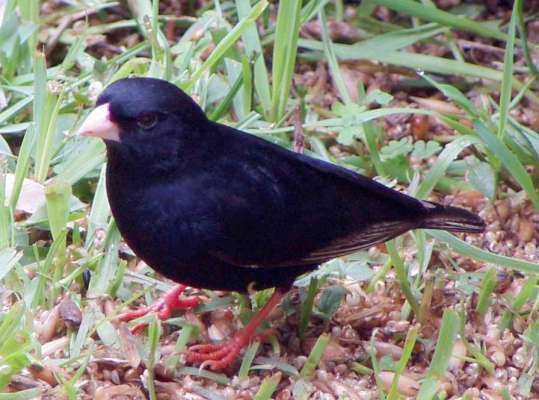
Adult Variable Indigobirds are characterized by their glossy black plumage, which can appear iridescent in direct sunlight. This striking coloration makes them relatively easy to identify compared to other small passerines. Males and females exhibit similar plumage, although males are often slightly more iridescent. Juveniles, however, differ significantly, showing a more subdued brownish plumage, which helps them blend into their surroundings. This cryptic coloration is advantageous during their vulnerable early stages of life.
While male Variable Indigobirds are often confused with other indigobird species, close inspection reveals subtle differences. For example, they lack the white wing patches found in some related species. In flight, Variable Indigobirds display a distinct silhouette with a short, square tail and relatively pointed wings. Their flight is rapid and direct, often accompanied by a series of fast, undulating movements.
When perched, these birds often maintain an upright posture, which accentuates their slender build. Observing their behavior, such as singing and mimicry, can also aid in proper identification. This bird's propensity to mimic the calls of its host species not only assists in distinguishing it from similar species but also offers fascinating insights into its reproductive strategies.
Having trouble telling birds apart? Upload a photo to our bird identification tool for an instant species match.
Variable Indigobird Habitat and Range
Preferred Habitat
The Variable Indigobird predominantly inhabits open woodlands, savannas, and grasslands, showing a preference for areas near water sources. These habitats provide ample opportunities for encountering their host species, the Red-billed Firefinch. Elevation does not significantly constrain their presence, as they are found from lowland areas to moderate elevations.
During the breeding season, Variable Indigobirds may expand their range within suitable habitats to ensure access to available nests for parasitism. While generally more prevalent in rural and semi-rural settings, they can occasionally be found on the outskirts of urban areas, especially where suitable habitats persist. This adaptability allows them to exploit a variety of ecological niches without becoming overly specialized to any single type of environment.
Geographic Range
The Variable Indigobird's range extends across much of sub-Saharan Africa, with established populations in countries like Zimbabwe, Botswana, Namibia, and South Africa. Within these regions, they are primarily found in areas populated by their host species. The presence of Red-billed Firefinches largely dictates their breeding distribution, as successful reproduction depends on parasitizing the nests of these and occasionally other estrildid finches.
These birds do not engage in long-distance migrations. Instead, they exhibit local movements in response to seasonal changes in food availability and breeding opportunities. Population densities are typically highest in regions where host species are abundant, but they can also occur in lower densities in peripheral areas where suitable conditions persist. This localized movement pattern ensures that the Variable Indigobird can exploit resources efficiently within its range.
Want to know which birds visit your area? Browse our backyard birds by location guides for region-specific species lists.
What Does the Variable Indigobird Eat?
The diet of the Variable Indigobird primarily consists of small seeds, which it forages on the ground or among low vegetation. It exhibits opportunistic feeding habits, often taking advantage of abundant food resources during the rainy season. As a secondary food source, Variable Indigobirds may consume small insects and other invertebrates, particularly when feeding young.
Their foraging technique involves hopping along the ground or through low shrubs, using their sharp, conical bills to pick seeds and insects. During the breeding season, when energy demands are higher, they may increase their intake of protein-rich insects to support their reproductive activities. The Variable Indigobird's feeding schedule is diurnal, with peak activity occurring during the cooler morning and late afternoon hours, avoiding the intense midday heat.
Variable Indigobird Behavior and Social Structure
Variable Indigobirds exhibit intriguing social and reproductive behaviors. They are generally solitary or found in pairs outside the breeding season. During the breeding season, males become highly territorial, displaying aggressive behavior towards intruders and engaging in elaborate courtship displays to attract females. These displays often include singing and mimicking the calls of host species, showcasing their vocal prowess.
Courtship involves both visual and auditory elements, with males performing flight displays and vocalizations to entice females. Once a female selects a mate, she will lay her eggs in the nests of chosen host species. Variable Indigobirds do not form large flocks; instead, they maintain a dispersed social structure. Their response to predators is typically cautious, with quick, evasive flights to nearby cover.
Daily activity patterns revolve around foraging and territorial defense, with peak vocal activity occurring during early morning hours. This dawn chorus serves both as a territorial proclamation and a means to attract potential mates.
Variable Indigobird Nesting and Reproduction
The Variable Indigobird does not build its own nests. Instead, it is a brood parasite, relying on the nests of other species, particularly the Red-billed Firefinch. Females lay eggs that closely mimic the appearance of the host's eggs, both in color and size. This remarkable adaptation increases the likelihood that host parents will accept and incubate the parasitic eggs.
A typical clutch consists of 2-4 eggs, which the host parents incubate for about 12-14 days. After hatching, the young indigobirds are fed by the host parents alongside their own chicks. Fledging occurs approximately 18-21 days after hatching, with young birds remaining dependent on their foster parents for several more weeks.
Variable Indigobirds may attempt multiple broods within a breeding season, taking advantage of the availability of host nests and suitable weather conditions. The female's role in selecting and parasitizing nests is crucial for reproductive success, while the male's role involves defending the territory and attracting mates.
Variable Indigobird Sounds and Vocalizations
The Variable Indigobird is renowned for its complex vocalizations, which include a variety of song patterns and calls. Its primary song consists of a series of high-pitched, rapid notes interspersed with mimicry of host species' calls. This mimicry serves as both a territorial and courtship signal.
In addition to its primary song, the Variable Indigobird produces a range of call notes, including sharp 'chip' sounds that serve as alarm calls when predators are near. The dawn chorus of the Variable Indigobird is particularly notable, with males actively singing to establish and defend territories. The quality of their mimicry and the variety of vocalizations can be compared to a skilled musician, capable of adapting to different acoustic environments.
Interesting Facts About the Variable Indigobird
- 1Variable Indigobirds are expert mimics, not only imitating the calls of their host species but sometimes copying other birds in their environment.
- 2These birds rely solely on brood parasitism, never building their own nests or raising their young, a strategy shared by only a few bird species.
- 3The eggs of the Variable Indigobird closely resemble those of their host species, a crucial adaptation for successful parasitism.
- 4Males are territorial during the breeding season, often engaging in aerial displays and vocal battles with rivals.
- 5Their scientific name, Vidua funerea, reflects their somber, almost funereal black plumage.
- 6Variable Indigobirds can influence the population dynamics of their host species, leading to complex ecological interactions.
- 7Despite their parasitic lifestyle, these birds play a role in seed dispersal, contributing to their ecosystem's health.
Variable Indigobird Conservation Status
According to the IUCN, the Variable Indigobird is currently listed as Least Concern, with stable population trends. Its adaptability to various habitats and reliance on common host species have contributed to its resilience. However, habitat loss due to agricultural expansion and urbanization poses potential threats to localized populations. Conservation efforts focus on preserving suitable habitats and ensuring the availability of host species. Maintaining the ecological balance of savanna and woodland regions is vital for the continued success of the Variable Indigobird. Historically, population changes have been more influenced by fluctuations in host species numbers rather than direct threats to the indigobirds themselves.

