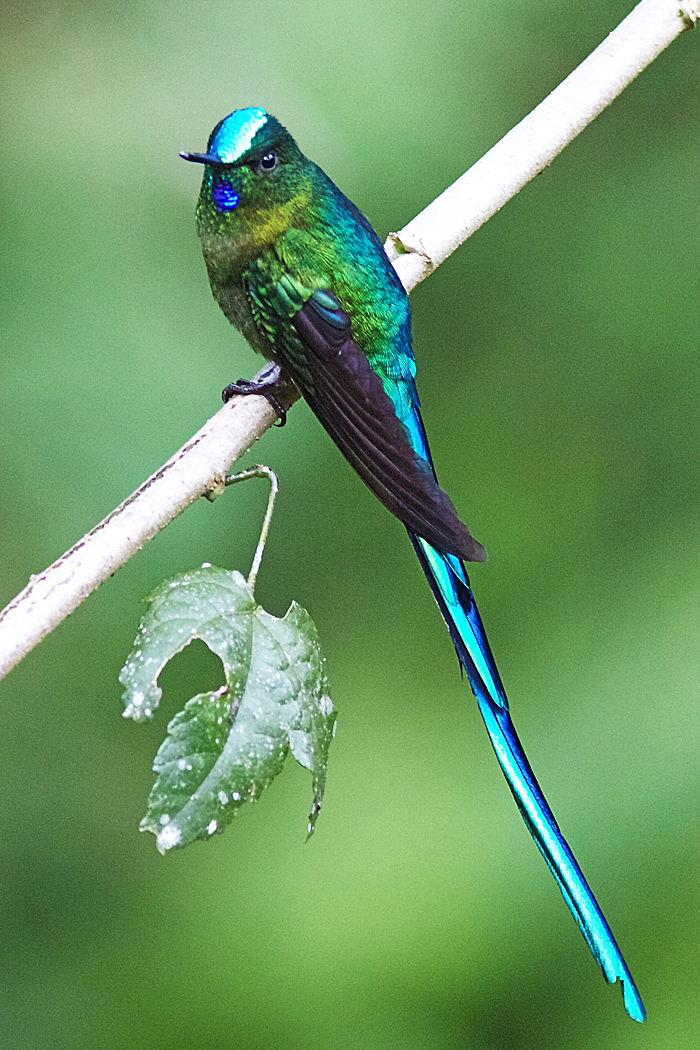
Violet-tailed Sylph
Aglaiocercus coelestis
Order: Apodiformes / Family: Trochilidae

Wikimedia Commons
About the Violet-tailed Sylph
The Violet-tailed Sylph (Aglaiocercus coelestis) captures the attention of bird enthusiasts with its splendid iridescent plumage and striking tail. Inhabiting the Andean slopes of Colombia and Ecuador, this hummingbird thrives in humid montane forests, often at elevations ranging from 1,200 to 2,300 meters. As a member of the Trochilidae family, the Violet-tailed Sylph plays a vital role in pollination, contributing to the health and diversity of its ecosystem. Its range primarily encompasses the Chocó bioregion, a hotspot for biodiversity where the humid, dense forest provides a perfect environment for its survival. Throughout the year, this species exhibits little migratory movement, maintaining a stable presence in its preferred habitats.
The ecological significance of the Violet-tailed Sylph cannot be overstated. By feeding on nectar, it not only sustains itself but also facilitates the cross-pollination of various flowering plants. This hummingbird species exhibits a mutualistic relationship with several plant species, ensuring both its own survival and the propagation of flora within its habitat. During seasonal shifts, while the bird remains largely sedentary, it may adjust its foraging strategies or altitudinal range slightly in response to the availability of floral resources. The Violet-tailed Sylph's fidelity to its montane forest environment highlights its niche specialization and adaptation to these unique ecological conditions.
Moreover, the Violet-tailed Sylph's presence serves as an indicator of forest health. Its reliance on intact forest ecosystems underscores the importance of conservation efforts aimed at preserving these critical habitats. Deforestation and habitat degradation pose significant threats, making conservation initiatives vital for ensuring the continued survival of this and other species within the Chocó bioregion. As a species emblematic of the rich biodiversity of the Andean forests, the Violet-tailed Sylph captures both the imagination and concern of ornithologists and conservationists alike.
The Violet-tailed Sylph belongs to the family Trochilidae, within the order Apodiformes. These birds typically live average 4-6 years with a maximum recorded lifespan of 8 years..
How to Identify a Violet-tailed Sylph
The Violet-tailed Sylph is a medium-sized hummingbird with a body length of approximately 18 cm, including its elongated tail. Adult males possess an iridescent green head and back, with a vibrant violet-blue tail that can extend up to 12 cm beyond the body, a feature distinguishing it from other hummingbirds. Their underparts are a mix of shiny green and bluish hues, creating a striking contrast with the tail. Females, in contrast, exhibit more subdued coloration, with a shorter tail and more uniform green on their upperparts, lacking the iridescent sheen seen in males.
Juvenile Violet-tailed Sylphs resemble females but with less pronounced iridescence and slightly shorter tails. This species may be confused with others like the Long-tailed Sylph (Aglaiocercus kingii); however, the latter has a longer tail and more extensive blue on the underparts. In flight, the Violet-tailed Sylph displays rapid wing beats typical of hummingbirds, but its lengthy tail adds a unique elegance to its silhouette. When perched, it often holds its tail slightly fanned, enhancing its visual prominence.
The Violet-tailed Sylph's distinct coloration and tail length make it relatively easy to identify once observed in its natural range. While males and females differ in vibrancy, both sexes share the characteristic long tail, an adaptation likely influenced by sexual selection pressures. This sexual dimorphism plays a role in mate attraction and territorial displays, further reinforcing the differences between the genders.
Having trouble telling birds apart? Upload a photo to our bird identification tool for an instant species match.
Violet-tailed Sylph Habitat and Range
Preferred Habitat
The Violet-tailed Sylph thrives in humid montane forests and subtropical or tropical moist lowland forests, favoring environments rich in flowering plants that provide nectar. These birds typically inhabit elevations between 1,200 and 2,300 meters, where the forest canopy offers abundant foraging opportunities and shelter. The species shows a preference for areas with dense vegetation, often found flitting among the understory or along forest edges.
While primarily found in rural forested regions, the Violet-tailed Sylph occasionally ventures into semi-urbanized areas where suitable floral resources are available. Seasonal shifts in habitat use occur in response to changes in floral abundance, although these shifts tend to be minor, reflecting the species' largely sedentary nature. The presence of this hummingbird in diverse habitats underscores its adaptability within its preferred ecological niche.
Geographic Range
The breeding and resident range of the Violet-tailed Sylph extends across the Andean slopes of Colombia and Ecuador, particularly concentrated in the Chocó bioregion. This region, known for its high biodiversity, provides the ideal conditions for the species' survival, with its consistent humidity and floral diversity. Population densities are highest in areas where pristine forest habitats remain intact, as these offer the most reliable nectar sources and nesting sites.
Unlike many other hummingbird species, the Violet-tailed Sylph is not migratory, spending its entire life cycle within its established range. This lack of migratory behavior reflects the abundance of resources available in its habitat, as well as the stability of environmental conditions throughout the year. While its range is relatively localized, the bird's presence is an important indicator of healthy montane forest ecosystems in these regions.
Want to know which birds visit your area? Browse our backyard birds by location guides for region-specific species lists.
What Does the Violet-tailed Sylph Eat?
The diet of the Violet-tailed Sylph primarily consists of nectar from a variety of flowering plants, including those from the genera Besleria, Palicourea, and Heliconia. These plants provide the high-energy food source necessary to sustain the bird's rapid metabolism. Seasonal changes affect the availability of specific flowers, prompting the bird to adjust its foraging patterns accordingly.
In addition to nectar, the Violet-tailed Sylph supplements its diet with small insects and spiders, which provide essential proteins and nutrients. The bird typically forages by hovering in front of flowers, using its specialized bill to access nectar while simultaneously pollinating the plant. It also occasionally gleans insects from foliage or captures them in mid-air, demonstrating a versatile foraging strategy. The feeding schedule of this hummingbird aligns with peak floral availability, often resulting in increased activity during the early morning and late afternoon when flowers are most abundant.
Want to attract Violet-tailed Sylphs to your yard? See our recommended feeders and seed types for the best results.
Violet-tailed Sylph Behavior and Social Structure
Violet-tailed Sylphs exhibit solitary and territorial behaviors, often defending feeding territories vigorously against intruders. Males frequently engage in aerial displays to establish dominance and attract mates, showcasing their elongated tails as part of these courtship rituals. These displays involve rapid, agile maneuvers, often accompanied by vocalizations that announce their presence and readiness to defend their territory.
During the breeding season, males may become particularly aggressive, engaging in chases and physical confrontations with rivals. While generally solitary, these hummingbirds occasionally forage in proximity to others when floral resources are abundant, temporarily setting aside territorial disputes. The Violet-tailed Sylph's daily activities are largely dictated by the availability of food, with peak activity occurring during dawn and dusk when nectar resources are most accessible.
In response to predators, the Violet-tailed Sylph relies on its agility and speed to escape potential threats. Its small size and rapid movements make it a challenging target for larger predators, and its keen awareness of its surroundings often allows it to detect and evade danger effectively. This adaptability and defensive behavior contribute to its survival in the dense forests it calls home.
Violet-tailed Sylph Nesting and Reproduction
The Violet-tailed Sylph constructs its nest with care, selecting locations that offer both security and proximity to food sources. Nests are typically built on slender branches or twigs, often concealed by foliage to protect from predators. The nest is a small cup-like structure, intricately woven from plant fibers, moss, and spider silk, providing both strength and flexibility.
Females lay a clutch of two white eggs, which they incubate alone for about 15 to 18 days. During this period, the male's role is primarily to defend the territory and ensure the nest remains undisturbed. Once the eggs hatch, the female continues to take on the primary role of feeding and caring for the chicks. Fledging occurs approximately 20 to 25 days after hatching, with the young birds remaining dependent on the mother for food until they can forage independently.
Typically, the Violet-tailed Sylph produces one or two broods per year, depending on food availability and environmental conditions. The nesting cycle underscores the species' reliance on stable habitats, as successful reproduction hinges on the availability of resources and the absence of significant disturbances within the environment.
Violet-tailed Sylph Sounds and Vocalizations
The vocalizations of the Violet-tailed Sylph are relatively understated compared to its vibrant appearance. Its primary song consists of a series of high-pitched, rapid chips and trills, often delivered in a rhythmic pattern that can echo through the forest canopy. These sounds serve both as territorial markers and mating calls.
In addition to its song, the Violet-tailed Sylph produces a variety of call notes, including a sharp 'tik' and softer 'tseep' sounds, which it uses to communicate with mates and signal alarm when predators are near. During the dawn chorus, its vocalizations blend with those of other forest-dwelling birds, creating a symphony that heralds the start of a new day. The subtlety of its calls may contrast with the more raucous sounds of other species, yet they play a crucial role in the bird's behavioral repertoire.
Interesting Facts About the Violet-tailed Sylph
- 1The Violet-tailed Sylph's tail can be up to twice the length of its body, a feature that helps it in courtship displays.
- 2Despite their small size, Violet-tailed Sylphs flap their wings up to 80 times per second while hovering.
- 3The species is an important pollinator for many native Andean plants, making it crucial for maintaining biodiversity.
- 4Violet-tailed Sylphs can consume up to twice their body weight in nectar and insects daily to fuel their high metabolism.
- 5Unlike many birds, the Violet-tailed Sylph does not undertake long migrations, remaining in the same region year-round.
- 6The hummingbird's iridescent plumage is not from pigments but due to the microscopic structure of its feathers.
- 7The Violet-tailed Sylph is named for its striking violet tail, a trait that sets it apart from other hummingbirds.
Violet-tailed Sylph Conservation Status
The International Union for Conservation of Nature (IUCN) currently lists the Violet-tailed Sylph as a species of Least Concern, thanks to its relatively stable population and wide distribution within its range. However, ongoing deforestation and habitat fragmentation in the Andean regions of Colombia and Ecuador pose significant threats to its long-term survival. These activities reduce the availability of suitable habitats, impacting the species' ability to forage and reproduce effectively. Conservation efforts focused on preserving montane forest habitats are critical for maintaining the Violet-tailed Sylph's population. Initiatives aimed at reforestation and sustainable land management practices can contribute to habitat restoration, offering hope for the future of this and other cohabiting species. Monitoring population trends and habitat conditions remains essential, as changes could signal the need for more targeted conservation strategies.
Attracting Violet-tailed Sylphs to Your Feeder
The Violet-tailed Sylph is a regular visitor to backyard bird feeders across its range. At the Eye On The Fly feeding station, we observe Violet-tailed Sylphs regularly and capture footage with our feeder cameras.
Other Trochilidae Species


Birds Similar to the Violet-tailed Sylph
These species are often confused with the Violet-tailed Sylph due to similar appearance or overlapping range.