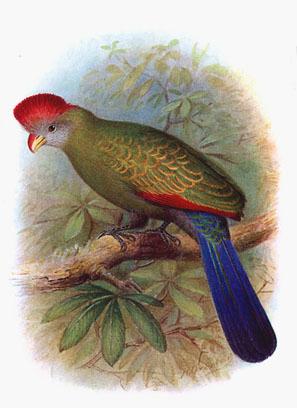
Violet Turaco
Musophaga violacea
Order: Musophagiformes / Family: Musophagidae

Wikimedia Commons
About the Violet Turaco
The Violet Turaco, scientifically known as Musophaga violacea, is a remarkable bird belonging to the family Musophagidae. This species is known for its vibrant plumage and distinctive vocalizations. Found primarily in West Africa, the Violet Turaco inhabits countries such as Senegal, Gambia, Nigeria, and Ghana. It thrives in dense forests and woodland areas, where it plays a significant role in seed dispersal, contributing to the maintenance of its ecosystem's biodiversity. This bird's presence in the canopy layer of forests aids in the distribution of seeds from the fruits it consumes, promoting plant regeneration. The Violet Turaco is not migratory, residing year-round in its range, though it may exhibit local movements in response to food availability. Its striking appearance, characterized by a deep violet body and bright yellow bill, makes it a target for birdwatchers and researchers alike. This species is integral to the ecological fabric of its habitat, as it interacts with other wildlife and plants, maintaining the health and diversity of the ecosystem. During the breeding season, which coincides with the rainy season, the Violet Turaco becomes particularly active. The increased availability of food resources supports its reproductive activities. The bird's courtship displays and vocalizations become more pronounced during this time, as it competes for mates and establishes nesting territories. As a frugivorous bird, the Violet Turaco helps in controlling the plant species composition within its habitat. Its diet consists mainly of fruits, but it also consumes leaves, flowers, and invertebrates when necessary. By dispersing seeds over wide areas, the Violet Turaco aids in the spread of plant species, which in turn supports a diverse array of organisms that depend on these plants for survival. The ecological significance of the Violet Turaco cannot be overstated, as it contributes to a balanced and sustainable ecosystem.
The Violet Turaco belongs to the family Musophagidae, within the order Musophagiformes. These birds typically live up to 10 years in the wild, with some reaching 15 years in captivity..
How to Identify a Violet Turaco
Adult Violet Turacos are striking with a primarily violet body and a bright green crest that stands out against the rich plumage. The bill is a vivid yellow with a red tip, and the eyes are encircled by a bright red eye-ring. Juveniles mirror the adults in color but have a more subdued plumage and lack the full development of the crest. Males and females are similar in appearance, making it difficult to differentiate them in the field. However, subtle size differences can sometimes be noticed, with males being slightly larger. Unlike many other birds, the Violet Turaco's plumage does not change seasonally, providing a consistent identification marker year-round. The bird's silhouette in flight is characterized by broad, rounded wings and a long tail. When perched, the Violet Turaco often adopts a horizontal posture, displaying its crest prominently. Confusion may arise with other turaco species, yet the Violet Turaco's unique coloration and eye-catching crest provide clear distinguishing features.
Having trouble telling birds apart? Upload a photo to our bird identification tool for an instant species match.
Violet Turaco Habitat and Range
Preferred Habitat
The Violet Turaco thrives in the dense forests and woodlands of West Africa. It prefers habitats with thick canopy cover, such as tropical rainforests and riverine woodlands. This bird is typically found at elevations ranging from sea level to 1,000 meters. Although it primarily inhabits forested areas, the Violet Turaco can occasionally be seen in adjacent savanna regions where forest patches persist. Seasonal changes in habitat are minimal, as the bird remains within its range throughout the year. In urban settings, it is less common but may appear in large parks or botanical gardens where suitable vegetation is present.
Geographic Range
The breeding and residential range of the Violet Turaco extends across several West African countries, including Senegal, Gambia, Guinea-Bissau, Sierra Leone, Liberia, Ivory Coast, Ghana, Togo, Benin, Nigeria, and parts of Cameroon. It does not participate in long-distance migrations but may move locally in response to food availability, particularly during the dry season. The population density is highest in regions with abundant fruit resources, such as the rainforests of Ghana and Nigeria. The bird is less common in areas where deforestation has reduced suitable habitat.
Want to know which birds visit your area? Browse our backyard birds by location guides for region-specific species lists.
What Does the Violet Turaco Eat?
The Violet Turaco primarily feeds on a variety of fruits, which constitute the bulk of its diet. It favors figs, berries, and the fruits of the oil palm tree. The bird's strong, curved bill is well-adapted for plucking and consuming these food items. During the dry season, when fruits may be less abundant, the Violet Turaco supplements its diet with young leaves, flowers, and occasionally insects or small invertebrates. This adaptability in diet helps it survive in varying conditions. Foraging typically occurs in the early morning and late afternoon, with the bird actively moving through the canopy in search of food. The Violet Turaco's role as a frugivore is vital, as it aids in seed dispersal, promoting forest regeneration.
Violet Turaco Behavior and Social Structure
The Violet Turaco exhibits a social structure that includes small family groups, often seen foraging together in the forest canopy. These groups consist of a dominant pair with their offspring. The bird is territorial and will vigorously defend its feeding and nesting areas from intruders. Courtship displays involve synchronized movements and vocal duets between pairs, strengthening pair bonds. These displays are most frequent during the breeding season. The Violet Turaco's daily activities include foraging in the morning and late afternoon, with periods of rest and preening during the hottest parts of the day. In response to predators, the turaco relies on its agility and the dense foliage for cover. Alarm calls are sharp and distinctive, warning other birds of danger. Flocking behavior is observed outside the breeding season when birds may gather in loose groups around abundant food sources.
Violet Turaco Nesting and Reproduction
The Violet Turaco constructs a loose, platform-like nest made of twigs and leaves, usually positioned in the fork of a tree branch. The nest is often located at a height of 5 to 15 meters above the ground, providing protection from ground predators. The clutch size typically consists of two to three eggs. Both parents share incubation duties over a period of about 21 to 23 days. After hatching, the chicks remain in the nest for approximately four to five weeks before fledging. Parental care extends beyond fledging, as the young are fed and protected by both adults. The Violet Turaco generally produces one to two broods per year, depending on food availability and environmental conditions.
Violet Turaco Sounds and Vocalizations
The primary song of the Violet Turaco is a series of deep, resonant calls that can be described as 'kaw kaw kaw,' with a rhythm that rises and falls in pitch. These vocalizations serve both territorial and communication purposes. The bird also emits sharp, single-note calls as alarms when predators are nearby. During the dawn chorus, the Violet Turaco's calls can be heard echoing through the forest, adding to the rich tapestry of sounds in its habitat. Compared to other forest birds, its calls are relatively loud and carry over long distances.
Interesting Facts About the Violet Turaco
- 1The Violet Turaco's striking color is due to unique pigments called turacins, found only in turacos.
- 2Despite their vivid appearance, Violet Turacos blend well into leafy canopies, aiding their survival.
- 3These birds can live up to 20 years in captivity, showcasing their resilience and adaptability.
- 4The Violet Turaco's loud calls help keep family groups connected in dense forest environments.
- 5Unlike many birds, turacos possess semi-zygodactylous feet, aiding in their arboreal lifestyle.
- 6The turaco's diet plays a crucial role in seed dispersal, aiding in forest regeneration and biodiversity.
- 7Violet Turacos are often targets for illegal pet trade due to their striking appearance.
Violet Turaco Conservation Status
The Violet Turaco is currently classified as Least Concern by the IUCN, with a stable population trend. However, habitat destruction due to logging and agricultural expansion poses significant threats to its natural environment. Conservation efforts focus on preserving forest habitats and promoting sustainable land use practices. Historical population changes have been minimal, but continued deforestation could impact local populations. Efforts to protect key habitats are crucial to ensuring the long-term survival of this species.
Other Musophagidae Species


Birds Similar to the Violet Turaco
These species are often confused with the Violet Turaco due to similar appearance or overlapping range.