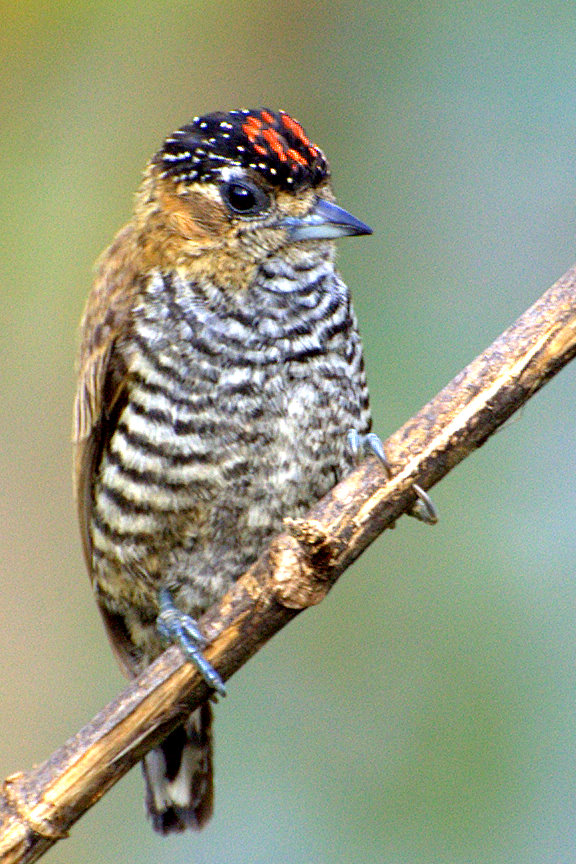
White-bellied Piculet
Picumnus spilogaster
Order: Piciformes / Family: Picidae

Wikimedia Commons
About the White-bellied Piculet
The White-bellied Piculet (Picumnus spilogaster) is a small woodpecker-like bird that inhabits tropical regions, primarily in South America. Its white underparts starkly contrast its darker, olive-green upperparts, making it easily recognizable in dense foliage. This species thrives in the humid forests of the Amazon Basin, where it plays a crucial ecological role as both predator and prey. By feeding on insects and other arthropods, the White-bellied Piculet helps control pest populations and maintain the delicate balance within its ecosystem. In addition to its ecological contributions, this bird adds vibrant life and sound to its environment, often heard before being seen due to its distinctive calls.
The White-bellied Piculet is significant not only for its ecological roles but also for its contribution to local biodiversity. Its presence indicates a healthy forest ecosystem, as it requires specific habitat conditions for foraging and nesting. This bird is also of interest to ornithologists and bird watchers, who appreciate its unique behaviors and vibrant plumage. Birding tours in countries like Brazil, Peru, and Bolivia often include sighting this species as a highlight.
Seasonally, the White-bellied Piculet exhibits some behavioral shifts, though it remains largely resident throughout its range. During the breeding season, it becomes more vocal and territorial, with males engaging in drumming displays to establish dominance and attract mates. Outside the breeding season, these birds may be observed in small family groups or mixed-species flocks, which offer protection against predators and increase foraging efficiency. Such behaviors underscore the piculet's adaptability and social nature, which are important aspects of its survival strategy in the wild.
The White-bellied Piculet belongs to the family Picidae, within the order Piciformes. These birds typically live average 5 years, with a maximum recorded of 8 years..
How to Identify a White-bellied Piculet
Adult White-bellied Piculets are small, measuring about 9 to 10 centimeters in length. Their plumage is characterized by olive-green upperparts and a striking white belly, which is their most distinguishing feature. A closer examination reveals a speckled appearance on their head, with males displaying a slight reddish tinge on the crown, a feature absent in females. Juveniles resemble adults but often have duller plumage and less distinct markings. Unlike larger woodpeckers, piculets lack a chisel-like bill, instead having a short, powerful beak suitable for their insectivorous diet.
In flight, the White-bellied Piculet presents a swift, undulating pattern typical of many woodpecker species. While perched, this bird maintains an upright posture, often clinging to small branches or slender tree trunks. The absence of prominent facial markings helps distinguish it from similar species in overlapping ranges, such as the White-barred Piculet, which has a more prominent barred pattern on its back.
Field identification of the White-bellied Piculet also benefits from its vocalizations. Its calls are sharp and metallic, often delivered in rapid succession. This bird's presence is often betrayed by its drumming on branches or small twigs, a behavior used in communication and territorial displays.
Having trouble telling birds apart? Upload a photo to our bird identification tool for an instant species match.
White-bellied Piculet Habitat and Range
Preferred Habitat
The White-bellied Piculet inhabits a range of forest types, including lowland tropical rainforests, forest edges, and secondary growth. It prefers areas with abundant undergrowth and dense canopy cover, which provide ample foraging opportunities. Typically found at elevations up to 1,500 meters, this species shows a preference for regions with high humidity and consistent rainfall.
While primarily a forest dweller, the White-bellied Piculet can adapt to degraded habitats, including plantations and gardens, especially when these areas retain some tree cover. Unlike some forest-dependent birds, it can tolerate moderate habitat fragmentation, which allows it to persist in rural and semi-urban areas, where it may occupy parks and large gardens.
Seasonally, the White-bellied Piculet does not exhibit significant habitat shifts, as it remains largely resident throughout its range. However, during dry seasons, it may venture closer to water sources or more humid microhabitats within its territory, ensuring access to its insect prey.
Geographic Range
The White-bellied Piculet is primarily found in the northern and central parts of South America. Its range includes countries such as Brazil, Peru, and Bolivia, with a particular concentration in the Amazon Basin. This region offers the ideal conditions for its survival, with vast stretches of suitable forest habitat. In Brazil, the piculet is commonly observed in the states of Amazonas and Acre, while in Peru, it is found in the departments of Loreto and Ucayali. Bolivia's Beni and Pando departments also host this species.
As a non-migratory bird, the White-bellied Piculet's range remains stable throughout the year, though its density may vary locally depending on habitat quality and availability. Population hotspots often coincide with areas of well-preserved rainforest, where the species can be quite numerous. In contrast, regions with extensive deforestation or habitat degradation may see reduced populations or local absences.
Despite its limited migratory behavior, the White-bellied Piculet can be found in a variety of forested environments within its range, making it a familiar sight to those exploring the rich biodiversity of the Amazonian lowlands.
Want to know which birds visit your area? Browse our backyard birds by location guides for region-specific species lists.
What Does the White-bellied Piculet Eat?
The White-bellied Piculet's diet primarily consists of insects and other small arthropods. It forages on tree trunks and branches, using its short beak to probe crevices and bark surfaces. Common prey includes ants, beetles, and spiders, which it skillfully extracts from their hiding places. During the wet season, when insect abundance peaks, the piculet's diet becomes more varied, incorporating a wider range of prey items.
In addition to insects, the White-bellied Piculet occasionally consumes plant material, such as fruit or seeds, though these items form a minor component of its diet. Foraging behavior is active and deliberate, often involving short flights between feeding sites and methodical exploration of potential prey locations.
This bird feeds throughout the day, with peaks in activity during the cooler morning and late afternoon hours. Its feeding schedule and technique allow it to exploit the vertical stratification of the forest, accessing prey that might be unavailable to other insectivores. This adaptability in diet and foraging strategy underpins the piculet's success in diverse habitats, from pristine rainforests to more disturbed environments.
White-bellied Piculet Behavior and Social Structure
The White-bellied Piculet exhibits a range of behaviors that reflect its adaptability and social nature. Typically solitary or found in pairs during the breeding season, it becomes more sociable outside this period, often forming small family groups or joining mixed-species flocks. These associations provide enhanced protection against predators and increase the efficiency of foraging.
Territorial behavior is pronounced during the breeding season, with males engaging in drumming displays on resonant surfaces to assert dominance and attract mates. These displays involve rapid tapping that serves both as a territorial warning and a courtship signal. Males may also engage in aerial displays and wing flicking to further court females.
Daily activity patterns of the White-bellied Piculet include active foraging interspersed with periods of rest and preening. As a diurnal bird, it is most active during daylight hours, with a noticeable peak in activity during the early morning and late afternoon. Its response to predators includes alarm calls and taking cover within dense foliage. This behavior helps it avoid detection by larger birds of prey and other potential threats.
White-bellied Piculet Nesting and Reproduction
The White-bellied Piculet nests primarily in cavities excavated in dead wood or soft bark, often at a height of 1 to 5 meters above the ground. Both male and female participate in the excavation of the nest hole, using their beaks to chip away at the wood. The nest cavity is typically unlined, relying on its structure for insulation and protection.
Clutch size generally ranges from 2 to 4 eggs, which are white and slightly glossy. Both parents share incubation duties, which last approximately 12 to 14 days. After hatching, the nestlings are altricial, requiring extensive parental care. Both parents contribute to feeding the young, delivering a diet rich in insects to ensure rapid growth.
The fledging period lasts about 18 to 21 days, after which the young leave the nest but remain dependent on their parents for several weeks as they learn to forage independently. The White-bellied Piculet typically raises one brood per year, though favorable conditions may occasionally allow for a second.
White-bellied Piculet Sounds and Vocalizations
The primary song of the White-bellied Piculet consists of a series of sharp, metallic notes delivered in rapid succession. This song is both a territorial declaration and a courtship display, often heard during the early morning hours. The rhythm is consistent and somewhat resembles the sound of distant tapping on metal, though softer in tone.
Call notes are simpler, often used to maintain contact between mates or family groups. These calls are short, sharp, and repeated at irregular intervals. When alarmed, the White-bellied Piculet emits a high-pitched, rapid trill that serves as a warning to other birds in the vicinity.
The dawn chorus of this species is particularly vibrant in forested areas, where its calls mingle with those of other avian residents, creating a complex tapestry of sound that characterizes the early morning hours in the rainforest.
Interesting Facts About the White-bellied Piculet
- 1The White-bellied Piculet is one of the smallest members of the Picidae family, measuring only about 9 to 10 centimeters in length.
- 2Unlike larger woodpeckers, piculets have no tail feathers stiff enough for support, relying on trees' natural contours for stability.
- 3White-bellied Piculets can be quite vocal; their calls have been likened to the sound of a small, rapid metal hammer.
- 4Males and females often cooperate in nest building, a process that can take several days to complete.
- 5This species is adept at clinging to small branches and twigs, thanks to its lightweight body and strong feet.
- 6Despite being primarily insectivorous, the White-bellied Piculet occasionally supplements its diet with fruits found in its forest habitat.
- 7The piculet's name derives from its diminutive size, with 'piculet' meaning 'small woodpecker' in reference to its family.
White-bellied Piculet Conservation Status
The White-bellied Piculet is currently listed as Least Concern by the IUCN, with a stable population trend. However, habitat loss due to deforestation and land conversion for agriculture poses a significant threat to its long-term survival. Conservation efforts focus on preserving large tracts of primary forest and promoting sustainable land-use practices that protect biodiversity. Historically, the population of the White-bellied Piculet has remained fairly constant, benefiting from the vast and relatively undisturbed expanses of the Amazon rainforest. However, as human activities continue to encroach on these habitats, ongoing monitoring of population trends is essential to ensure this species remains abundant and widespread. Conservation organizations work to raise awareness about the importance of preserving tropical forests, not only for the White-bellied Piculet but for the myriad species that share its environment. By supporting these efforts, it is possible to maintain healthy ecosystems that support diverse avian populations.
Other Picidae Species


Birds Similar to the White-bellied Piculet
These species are often confused with the White-bellied Piculet due to similar appearance or overlapping range.