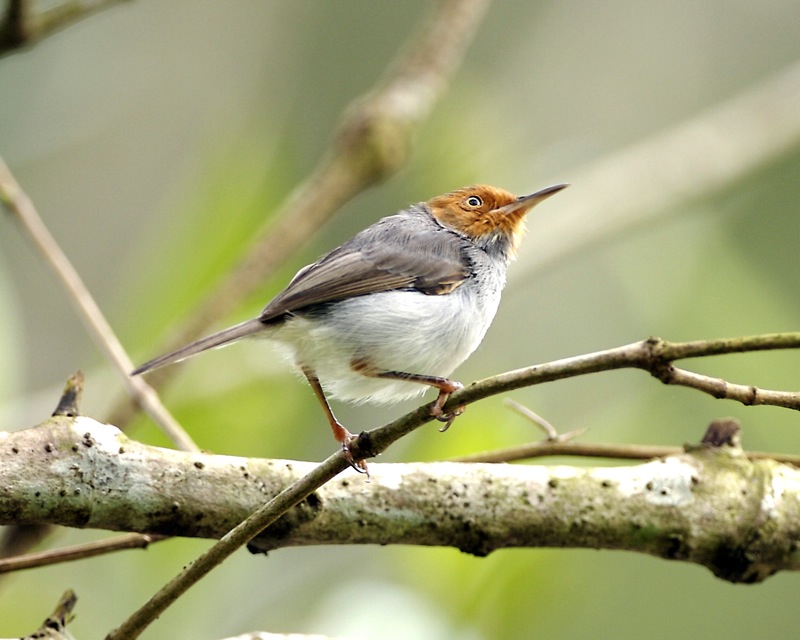
White-browed Tailorbird
Orthotomus nigriceps
Order: Passeriformes / Family: Cisticolidae

Wikimedia Commons
About the White-browed Tailorbird
The White-browed Tailorbird (Orthotomus nigriceps) is a small, active passerine belonging to the family Cisticolidae. Found primarily in the tropical regions of Southeast Asia, this bird is notable for its unique sewing behavior, using plant fibers to stitch leaves together into a rudimentary nest. This species thrives in dense undergrowth of lowland forests, often preferring secondary growth and edges where insects are abundant. The White-browed Tailorbird plays a crucial role in its ecosystem by controlling insect populations, particularly in the Philippines, where it is most commonly observed. This bird is non-migratory, residing year-round in its preferred habitats, which include the islands of Borneo, Java, and Sumatra. During different seasons, the White-browed Tailorbird's behavior can vary. In breeding seasons, it becomes more vocal and territorial, whereas in non-breeding periods, it may form loose associations with other small bird species to forage. The ecological role of this avian species extends to seed dispersal, albeit inadvertently, as it forages through the forest underbrush. The White-browed Tailorbird's adaptability to partially disturbed habitats makes it an important indicator of forest health and succession status in these regions.
The White-browed Tailorbird belongs to the family Cisticolidae, within the order Passeriformes. These birds typically live average 4-6 years with a maximum recorded of 8 years..
How to Identify a White-browed Tailorbird
Adult White-browed Tailorbirds are small, measuring about 12 centimeters in length, with a predominantly olive-green plumage that provides excellent camouflage in their forest habitat. The most striking feature is the prominent white eyebrow stripe, contrasting with their dark nigriceps or blackish cap. Juveniles resemble adults but have a slightly duller coloration and less pronounced eyebrow. Males and females are similar in appearance, making gender identification in the field challenging. One might confuse this species with the Common Tailorbird, but the latter lacks the distinct white eyebrow of the White-browed Tailorbird. When in flight, the bird's rounded wings and short tail become evident, though it is more often seen hopping among branches or skulking in dense foliage. Its posture while perching is typically upright, with slight tail flicks, which are characteristic of tailorbirds.
Having trouble telling birds apart? Upload a photo to our bird identification tool for an instant species match.
White-browed Tailorbird Habitat and Range
Preferred Habitat
The White-browed Tailorbird inhabits a variety of forested environments, favoring dense secondary growth, thickets, and forest edges. It is typically found from sea level to elevations of about 1500 meters, though it is more common in lowland areas. Unlike some other forest birds, it can adapt to disturbed habitats, often occupying gardens and plantations near forested areas. This adaptability allows it to persist in regions where deforestation has occurred, provided that some undergrowth remains. There is no significant seasonal shift in habitat preference, as this species is non-migratory. While primarily a forest dweller, the White-browed Tailorbird can occasionally be found in semi-urban areas where suitable vegetation exists, although it remains less common in heavily urbanized settings.
Geographic Range
The White-browed Tailorbird's range is geographically restricted to Southeast Asia, predominantly the Philippines and parts of Borneo, Java, and Sumatra. It is a resident species, showing little to no migratory behavior. Within its range, population densities are highest in forested lowland areas, where the dense undergrowth provides ample foraging and nesting opportunities. Despite its relatively limited geographic range, the bird is locally common, particularly in regions with suitable habitat. In the Philippines, it occupies a variety of islands, each hosting slightly different subspecies adapted to local conditions. The absence of migration corridors underscores its dependence on the availability of local resources and habitat conservation.
Want to know which birds visit your area? Browse our backyard birds by location guides for region-specific species lists.
What Does the White-browed Tailorbird Eat?
The White-browed Tailorbird primarily feeds on insects and other small invertebrates, which it gleans from foliage and branches. Its diet includes caterpillars, beetles, and spiders, with occasional consumption of small fruits and seeds. During the breeding season, when energy demands are higher, the bird may increase its feeding frequency, targeting protein-rich prey to support chick rearing. Foraging mainly occurs during the cooler parts of the day, such as early morning and late afternoon, minimizing exposure to predators and heat. Its foraging technique involves active hopping and probing in the underbrush, often accompanied by tail flicking and wing flicking to flush out hidden prey. The White-browed Tailorbird's diet is seasonally consistent, as it does not migrate and thus remains in ecosystems where insect availability is relatively stable year-round.
White-browed Tailorbird Behavior and Social Structure
The White-browed Tailorbird exhibits a complex social structure, often forming monogamous pairs for life. Territorial by nature, males sing from elevated perches to assert dominance and deter intruders, particularly during the breeding season. Courtship displays involve mutual preening and synchronized movements, strengthening the pair bond. Unlike many other bird species, the White-browed Tailorbird does not typically form large flocks, although it may associate with mixed-species foraging groups during non-breeding times. Its response to predators includes alarm calls and seeking cover in dense vegetation. Daily activities are structured around foraging and maintaining territory, with peak activity occurring during the early morning and late afternoon when ambient temperatures are favorable. The bird's small size makes it vulnerable to a range of predators, thus vigilance and quick reflexes are essential for survival.
White-browed Tailorbird Nesting and Reproduction
The nesting behavior of the White-browed Tailorbird is particularly fascinating, as it constructs its nest by sewing leaves together with plant fibers. This ingenious technique creates a hidden pocket in which the nest is built. Nests are typically located 1 to 3 meters above the ground in dense foliage, providing protection from predators. A typical clutch consists of 2 to 4 eggs, with both parents sharing incubation duties over a period of about 12 to 14 days. Once hatched, the chicks remain in the nest for approximately 10 to 12 days before fledging. Both parents actively feed and care for the young, with frequent feeding trips required to satisfy the growing nestlings' demands. The White-browed Tailorbird typically raises one or two broods per year, depending on food availability and environmental conditions.
White-browed Tailorbird Sounds and Vocalizations
The primary song of the White-browed Tailorbird is a series of sharp, high-pitched notes that rise and fall in a rhythmic pattern. This vocalization serves as both a territorial signal and a mating call during the breeding season. The bird also produces a variety of call notes, including soft ‘chip’ sounds used for communication between mates and more urgent alarm calls to warn of predators. At dawn, the tailorbird often participates in the chorus, adding its distinct voice to the symphony of forest sounds. These vocalizations are critical for maintaining territory and social bonds, as visibility in dense habitat is limited. The song's quality and rhythm might be likened to the rapid tapping of a typewriter, which reflects its mechanical precision.
Interesting Facts About the White-browed Tailorbird
- 1The White-browed Tailorbird gets its name from its unique nesting behavior, sewing leaves together to create a hidden nest.
- 2Despite its small size, the White-browed Tailorbird plays a crucial role in controlling insect populations in its habitat.
- 3This bird is non-migratory, residing year-round in the same area, which makes it highly dependent on local environmental conditions.
- 4The White-browed Tailorbird's song is often compared to the sound of a typewriter due to its rhythmic, mechanical cadence.
- 5Both male and female White-browed Tailorbirds participate in nesting duties, showcasing strong parental cooperation.
- 6Its adaptable nature allows the White-browed Tailorbird to thrive in both primary and secondary forest growth, unlike many forest-dependent species.
- 7The bird's distinctive white eyebrow is a key field mark that helps birdwatchers distinguish it from similar species.
White-browed Tailorbird Conservation Status
The White-browed Tailorbird is currently classified as Least Concern by the IUCN, with a stable population trend. While habitat loss due to deforestation poses a potential threat, the species' adaptability to secondary growth and edge habitats has mitigated significant declines. Ongoing conservation efforts focus on preserving forested areas and promoting sustainable land use practices in Southeast Asia. Historical population data suggests stability, though continued monitoring is essential to detect any future changes. Community-based conservation initiatives, coupled with habitat restoration projects, aim to ensure the bird's continued survival in its native regions.
Other Cisticolidae Species


Birds Similar to the White-browed Tailorbird
These species are often confused with the White-browed Tailorbird due to similar appearance or overlapping range.