
White-browed Tit
Poecile superciliosus
Order: Passeriformes / Family: Paridae
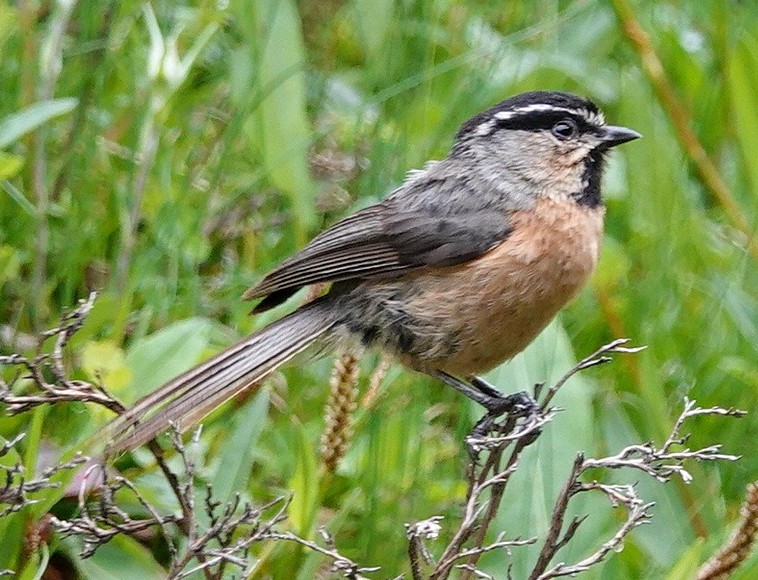
Wikimedia Commons
About the White-browed Tit
The White-browed Tit, or Poecile superciliosus, is a small passerine bird renowned for its striking white eyebrow, which contrasts sharply with its dark head. This species is primarily found in the high-altitude coniferous forests of central Asia, particularly in regions such as the Himalayas and the Tibetan Plateau. Its ecological role is significant, as it helps control insect populations and contributes to the dispersal of seeds. This tit is a year-round resident in its range, showing little migratory behavior. During breeding season, it becomes particularly active, engaging in elaborate courtship displays and vocalizations to establish territories and attract mates. As an integral part of its ecosystem, the White-browed Tit interacts with a variety of other species, including predators and competitors. The presence of this bird often indicates a healthy, undisturbed forest environment, as it tends to avoid areas with significant human activity. Despite its preference for remote habitats, the White-browed Tit has adapted well to its environment, displaying a broad range of behaviors that ensure its survival throughout the year. In winter, it may form mixed-species flocks with other tits and small passerines, enhancing its foraging efficiency while reducing the risk of predation. The White-browed Tit's adaptability and resilience make it a fascinating subject for ornithologists and bird enthusiasts alike, offering insights into the complex dynamics of high-altitude avian communities.
The White-browed Tit belongs to the family Paridae, within the order Passeriformes. These birds typically live typically 2-4 years, with a maximum recorded of 6 years..
How to Identify a White-browed Tit
The White-browed Tit is easily identified by its distinctive white eyebrow stripe, which runs from the base of the beak over the eye, contrasting with its dark crown and nape. Its back is a soft brown, while the underparts are a lighter gray, creating a subtle yet elegant appearance. Juvenile birds often exhibit a less pronounced eyebrow and slightly duller plumage compared to adults. Males and females are similar in appearance, though males may have slightly more vivid coloration. In flight, the White-browed Tit displays a compact silhouette with relatively short, rounded wings and a medium-length tail. When perched, it often adopts a slightly hunched posture, typical of many tit species. Compared to similar species, such as the Willow Tit or the Marsh Tit, the White-browed Tit's prominent eyebrow and preference for higher altitudes help distinguish it. Observers should note its cheerful, active behavior and distinctive calls when attempting to identify this bird in the field.
Having trouble telling birds apart? Upload a photo to our bird identification tool for an instant species match.
White-browed Tit Habitat and Range
Preferred Habitat
The White-browed Tit predominantly inhabits high-altitude coniferous forests, often in areas dominated by pine, spruce, or fir trees. These forests, located at elevations ranging from 2,500 to 4,500 meters, provide the dense cover and abundant food sources that the tit requires. While primarily found in remote mountain regions, it may occasionally venture into adjacent shrublands or open woodlands, particularly outside of the breeding season. Seasonal habitat shifts are minimal, as the White-browed Tit is generally a year-round resident within its range. Urban presence is rare due to its preference for undisturbed natural environments.
Geographic Range
The White-browed Tit's breeding range is concentrated in the high-altitude regions of central Asia, including the Himalayas, the Tibetan Plateau, and parts of northern China and Mongolia. This species does not undertake long-distance migrations, remaining within its mountainous range throughout the year. Population density tends to be highest in areas with extensive forest cover and minimal human disturbance. While its distribution is somewhat limited by its habitat preferences, the White-browed Tit is relatively widespread within its specific ecological niche.
Want to know which birds visit your area? Browse our backyard birds by location guides for region-specific species lists.
What Does the White-browed Tit Eat?
The diet of the White-browed Tit consists primarily of insects and other small invertebrates, which it gleans from foliage and bark. During the breeding season, its diet is heavily insectivorous, as it requires the high protein content to support egg production and chick rearing. In the winter months, when insects are less abundant, the tit supplements its diet with seeds and plant material. Foraging typically occurs from early morning to late afternoon, with the bird employing a variety of techniques such as hovering, gleaning, and probing to locate food. Prey size is generally small, with the tit targeting insects up to 10 millimeters in length.
White-browed Tit Behavior and Social Structure
The White-browed Tit exhibits a range of fascinating behaviors related to its social structure, territoriality, and daily activities. This tit is typically monogamous, forming long-term pair bonds that persist across breeding seasons. During courtship, males engage in elaborate displays, including singing, wing flapping, and food offerings to attract females. Territorial behavior becomes pronounced during the breeding season, with pairs vigorously defending their nesting sites from intruders. Outside of the breeding season, the White-browed Tit often joins mixed-species flocks, which can enhance foraging success and provide protection from predators. These flocks tend to be most active during the early morning and late afternoon, coinciding with peak feeding times. The tit's response to predators involves a combination of alarm calls and evasive maneuvers, such as diving into dense cover to escape detection.
White-browed Tit Nesting and Reproduction
White-browed Tits construct their nests in tree cavities, often selecting sites in dead or decaying wood to minimize competition and predation risks. The nest itself is composed of moss, feathers, and plant fibers, creating a soft, insulating environment for the eggs. Typically, the clutch size ranges from 4 to 6 eggs, which the female incubates for about 14 to 16 days. Both parents participate in feeding the chicks, which fledge approximately 18 to 20 days after hatching. The number of broods per year is usually limited to one, given the short breeding season at high altitudes.
White-browed Tit Sounds and Vocalizations
The primary song of the White-browed Tit is a series of clear, melodious notes delivered in a rhythmic pattern. This song, often heard during the breeding season, serves to establish territory and attract mates. Call notes are short and sharp, used for communication between individuals within a flock. Alarm calls are more urgent and higher-pitched, serving as a warning signal to other birds when predators are nearby. The tit participates in the dawn chorus, its song blending with those of other high-altitude forest birds.
Interesting Facts About the White-browed Tit
- 1The White-browed Tit is one of the few bird species that reside year-round at elevations above 3,000 meters.
- 2Despite its remote habitat, the White-browed Tit is known for its curious nature and may approach humans in its territory.
- 3During harsh winters, the White-browed Tit can lose up to 10% of its body weight overnight due to the extreme cold.
- 4The White-browed Tit's distinctive song can carry over long distances, helping it maintain territory in dense forests.
- 5Unlike many other tit species, the White-browed Tit does not cache food, relying instead on its ability to find resources year-round.
White-browed Tit Conservation Status
The White-browed Tit is currently classified as Least Concern by the IUCN, with stable population trends across its range. However, primary threats include habitat loss due to deforestation and climate change, which could alter the availability of suitable habitats. Conservation efforts focus on preserving intact forest ecosystems and monitoring population trends to ensure the species remains secure. Historically, the White-browed Tit has maintained stable populations due to its adaptability and the remoteness of its habitat.


