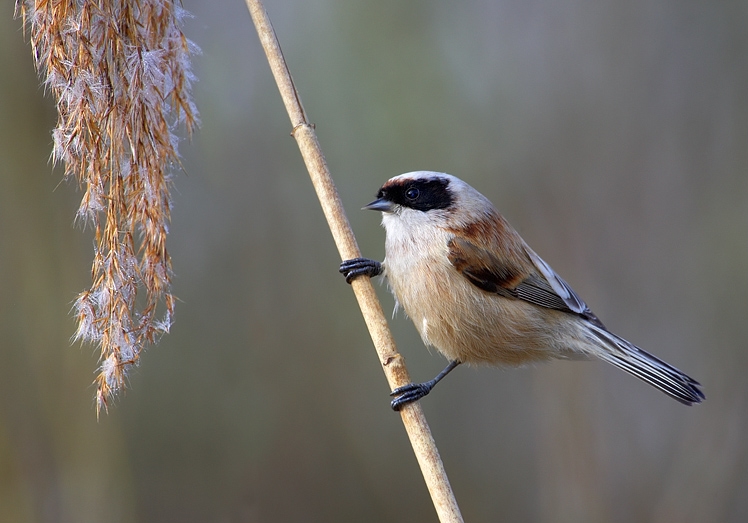
White-crowned Penduline-Tit
Remiz coronatus
Order: Passeriformes / Family: Remizidae

Wikimedia Commons
About the White-crowned Penduline-Tit
The White-crowned Penduline-Tit (Remiz coronatus) is a small passerine bird belonging to the Remizidae family, known for its agile and acrobatic foraging methods. This species thrives in the arid and semi-arid regions of Central Asia, favoring open areas with scattered shrubs and trees. Found primarily in Kazakhstan, Uzbekistan, Turkmenistan, and parts of Iran, the bird is an essential component of these ecosystems due to its role in insect control and plant pollination. During the breeding season, which spans from April to July, these birds establish territories and construct intriguing nests using plant fibers and down. Their intricate nest-building is not only a marvel of avian architecture but also plays a critical role in protecting their young from predators and harsh environmental conditions. As a primarily insectivorous species, the White-crowned Penduline-Tit contributes significantly to maintaining insect population balance. In winter, they may adapt their diet to include seeds and plant matter, showcasing their ecological versatility. The bird's preference for open spaces with sparse vegetation makes it an indicator species for habitat health, often signaling changes in land use or climatic conditions. Their presence in areas like the Kyzylkum Desert and the plains around the Aral Sea underscores their adaptation to challenging environments. Seasonal movements are observed as these birds may shift to slightly more vegetated areas during the non-breeding season. Their ecological role extends beyond mere survival, as they contribute to the health and sustainability of their native habitats.
The White-crowned Penduline-Tit belongs to the family Remizidae, within the order Passeriformes. These birds typically live average 2-3 years with a max recorded of 5 years.
How to Identify a White-crowned Penduline-Tit
The White-crowned Penduline-Tit is a petite bird, roughly 10-11 cm in length, with a wingspan reaching 17 cm. Its most prominent feature is the striking white crown that contrasts sharply with its black mask, extending across the eyes and down to the nape. The upperparts are primarily a warm reddish-brown, transitioning to a paler buff on the underparts. Males and females appear similar, though males may exhibit slightly more pronounced coloration. Juveniles resemble adults but typically have a duller overall tone and a less defined mask. The bird's small, compact size and distinctive head pattern make it relatively easy to identify, even from a distance. In flight, its short wings and tail give it a somewhat fluttery appearance, which can be a helpful clue for identification. While perched, the bird often adopts a horizontal posture, clinging acrobatically to twigs or stems as it searches for food. Confusion may arise with other penduline-tits, but the white crown is a definitive marker. Observers should note the contrasting black-and-white head pattern, which sets it apart from similar species.
Having trouble telling birds apart? Upload a photo to our bird identification tool for an instant species match.
White-crowned Penduline-Tit Habitat and Range
Preferred Habitat
The White-crowned Penduline-Tit thrives in arid and semi-arid habitats, including deserts, shrublands, and open woodlands. It is frequently found in the Kyzylkum and Karakum Deserts, as well as the scrubby plains surrounding the Aral Sea. This species prefers areas with scattered shrubs and trees, such as tamarisk and saxaul, where it can find both shelter and food. It typically inhabits elevations from sea level up to 1000 meters, although it may venture higher in search of favorable conditions. During winter, these birds might migrate to areas with denser vegetation, such as riparian woodlands, to exploit available resources. The White-crowned Penduline-Tit can adapt to urban fringes where suitable habitat features exist, though it predominantly remains a rural species.
Geographic Range
The White-crowned Penduline-Tit occupies a range primarily within Central Asia. Its breeding range includes large swathes of Kazakhstan, Uzbekistan, Turkmenistan, and northern Iran. Within these countries, it tends to be more populous in regions with suitable arid landscapes. During the non-breeding season, some populations may migrate short distances to slightly more vegetated or moist areas, though they generally remain within the same regional range. The species does not undertake long migratory journeys, instead exhibiting localized movements in response to environmental conditions. Population density tends to be higher in regions like the Kyzylkum Desert and the Karakum Desert, where they can find ample feeding opportunities and suitable nesting sites. The bird's range reflects its preference for open, dry habitats, with isolated populations occasionally reported in adjacent areas as vagrants.
Want to know which birds visit your area? Browse our backyard birds by location guides for region-specific species lists.
What Does the White-crowned Penduline-Tit Eat?
The diet of the White-crowned Penduline-Tit is predominantly insectivorous, focusing on small insects and arachnids, which it gleans from foliage and bark. During the breeding season, the demand for protein-rich food increases, leading these birds to target caterpillars, beetles, and other larvae. Their foraging strategy involves acrobatic maneuvers, often seen hanging upside down as they meticulously inspect leaves and branches. In the winter months, when insect availability declines, the White-crowned Penduline-Tit adapts by incorporating seeds and plant matter into its diet. This seasonal flexibility allows them to sustain themselves when insect prey becomes scarce. They typically forage in pairs or small family groups, using their sharp eyesight to locate food. The diversity in their diet not only supports their survival but also aids in the control of pest populations within their habitat.
White-crowned Penduline-Tit Behavior and Social Structure
The White-crowned Penduline-Tit exhibits complex social behavior, particularly during the breeding season when pairs establish territories and display strong site fidelity. These birds are monogamous, with pairs often remaining together for multiple breeding seasons. Territorial disputes are common, with males engaging in vocal displays and aerial chases to ward off intruders. Courtship involves a series of intricate displays, including wing fluttering and tail fanning, accompanied by soft calls. Outside the breeding season, they may form small flocks, which provide protection against predators through increased vigilance. These flocks often include family groups or neighboring pairs, emphasizing the bird's social nature. Daily activity patterns revolve around foraging, with peak activity occurring in the early morning and late afternoon. In response to predators, such as raptors or snakes, the birds employ a variety of alarm calls and distraction displays to protect their nests and young.
White-crowned Penduline-Tit Nesting and Reproduction
The nesting habits of the White-crowned Penduline-Tit are both fascinating and elaborate, involving the construction of a purse-like nest suspended from branches. These nests are crafted from plant fibers, down, and other soft materials, intricately woven together to form a secure and insulated environment for their young. Nests are typically positioned in dense shrubs or low trees, at heights ranging from 1 to 5 meters above the ground. The clutch size usually ranges from four to seven eggs, which are incubated primarily by the female while the male assists in provisioning. The incubation period lasts approximately 14-16 days, followed by a fledging period of another 14 days during which both parents actively feed and care for the nestlings. This species may produce two broods per year under favorable conditions, maximizing their reproductive success in the challenging environments they inhabit.
White-crowned Penduline-Tit Sounds and Vocalizations
The White-crowned Penduline-Tit produces a delicate and melodic song, characterized by a series of high-pitched whistles and trills. These vocalizations serve both territorial and mating purposes, often delivered from elevated perches to carry across their open habitats. Call notes are soft and lisping, frequently described as 'tsee' or 'tsee-tsee,' which are used for maintaining contact between pairs or family groups. Alarm calls are sharper and more urgent, designed to alert conspecifics to potential threats. During the dawn chorus, males are particularly vocal, asserting their presence and the boundaries of their territory. The song's quality and rhythm can vary slightly among individuals, but it remains a distinctive feature for identifying this species in the field.
Interesting Facts About the White-crowned Penduline-Tit
- 1The White-crowned Penduline-Tit builds one of the most complex nests among small birds, taking up to three weeks to complete.
- 2Their nests are often lined with spider webs, which provide both flexibility and strength to the structure.
- 3Despite their small size, they can produce a surprising array of vocalizations, each serving different communicative purposes.
- 4These birds display a remarkable ability to adapt their diet, shifting from insects to seeds as seasonal availability changes.
- 5The White-crowned Penduline-Tit can hang upside down while foraging, a behavior that aids in reaching difficult spots.
- 6During courtship, males perform a unique display of hopping and fluttering wings to attract a mate.
- 7They are known to be meticulous in nest construction, often using over 1,000 individual fibers to complete a single nest.
White-crowned Penduline-Tit Conservation Status
The White-crowned Penduline-Tit currently holds a conservation status of Least Concern according to the IUCN Red List, with populations generally considered stable across its range. Primary threats include habitat loss due to agricultural expansion and land conversion, which may lead to localized declines. Conservation efforts focus on habitat preservation and management, ensuring that key breeding and feeding areas remain intact. Historical population data suggest that the species has maintained relatively stable numbers, although monitoring continues to ensure that any emerging threats are swiftly addressed. Collaboration with local communities and conservation organizations aims to promote sustainable land use practices that benefit both the birds and local ecosystems.
Other Remizidae Species


Birds Similar to the White-crowned Penduline-Tit
These species are often confused with the White-crowned Penduline-Tit due to similar appearance or overlapping range.