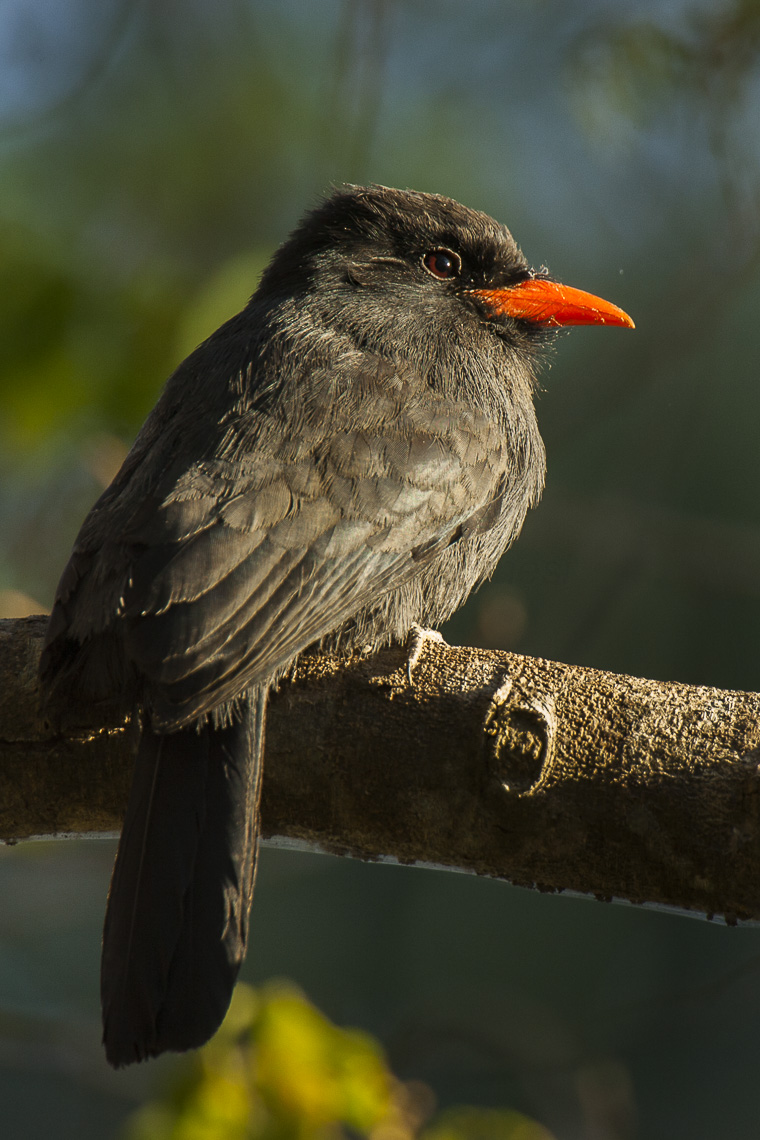
White-fronted Nunbird
Monasa morphoeus
Order: Piciformes / Family: Bucconidae

Wikimedia Commons
About the White-fronted Nunbird
The White-fronted Nunbird (Monasa morphoeus) is a captivating member of the Bucconidae family, known for its striking appearance and significant presence in tropical ecosystems. Found primarily in the lowland forests of Central and South America, this bird plays a crucial role in maintaining ecological balance within its habitat. Its range extends from southern Mexico through Central America, reaching as far south as Bolivia and Brazil. The White-fronted Nunbird thrives in humid tropical forests, often favoring areas with dense foliage where it can find ample cover and prey.
As an insectivorous bird, the White-fronted Nunbird helps control insect populations, thereby contributing to the health of its forest ecosystem. Its diet mainly consists of large insects, such as grasshoppers and beetles, which it catches deftly with its strong, slightly curved bill. The physical attributes of the White-fronted Nunbird, particularly its robust bill and agile flight, are well-suited for its insect-hunting lifestyle.
Throughout the year, this species remains relatively sedentary, seldom migrating far from its established territories. During the breeding season, which typically coincides with the rainy months, the White-fronted Nunbird becomes more territorial, vigorously defending its chosen nesting area. Outside of the breeding period, these birds are often observed in small family groups, moving through the forest in search of food. The White-fronted Nunbird's presence is a vibrant and integral aspect of the biodiversity within its range, highlighting its importance in the broader ecological tapestry of tropical forests.
The White-fronted Nunbird belongs to the family Bucconidae, within the order Piciformes. These birds typically live average 5-7 years, with a maximum recorded of 10 years..
How to Identify a White-fronted Nunbird
The White-fronted Nunbird is easily recognized by its predominantly black plumage, which contrasts sharply with its white forehead and facial patch. Adult birds exhibit a robust physique, measuring approximately 25-28 centimeters in length, which places them in the medium size class. Their red-orange bill adds another distinctive element to their appearance, aiding in identification.
Juvenile White-fronted Nunbirds resemble adults but may display slightly duller plumage and less pronounced white markings on their forehead. Males and females appear similar, making sex differentiation in the field challenging without observing behavior or vocalizations. When perched, these birds often sit upright, with their tail slightly cocked, a posture characteristic of the Bucconidae family.
In flight, the White-fronted Nunbird's broad wings and direct flight pattern are notable, though they are more often observed perched within the shaded understory or mid-canopy. These features, combined with their unique coloration, make them relatively easy to distinguish from other species within their range, though they may occasionally be confused with other nunbird species that lack the distinctive white forehead patch.
Having trouble telling birds apart? Upload a photo to our bird identification tool for an instant species match.
White-fronted Nunbird Habitat and Range
Preferred Habitat
Preferring tropical rainforests, the White-fronted Nunbird thrives in areas with dense canopy cover and abundant insect life. They are most frequently found in lowland forests, typically at elevations up to 1000 meters, though they may occasionally venture into foothill forests. These birds are adaptable within their preferred habitat, residing in both primary and secondary forests, provided there is sufficient cover and food availability.
While predominantly forest-dwelling, the White-fronted Nunbird may also be encountered in forest edges or clearings but generally avoids open areas. Unlike some bird species that adapt to urban environments, the White-fronted Nunbird remains firmly rooted in its forest habitat, reflecting its reliance on the complex ecosystem found there.
Geographic Range
The range of the White-fronted Nunbird spans a broad area across Central and South America. It is found from southern Mexico, through countries such as Belize, Guatemala, Honduras, and Nicaragua, extending into Costa Rica and Panama. In South America, its distribution includes Colombia, Ecuador, Peru, Bolivia, and western Brazil.
The bird is non-migratory, typically residing year-round within its established range. Unlike many other species, the White-fronted Nunbird does not undertake long-distance migrations, though it may exhibit local movements in response to food availability or breeding requirements. Population densities can be variable, with higher concentrations in undisturbed forest regions where insect prey is abundant.
Want to know which birds visit your area? Browse our backyard birds by location guides for region-specific species lists.
What Does the White-fronted Nunbird Eat?
The diet of the White-fronted Nunbird is primarily composed of large arthropods, including grasshoppers, beetles, and other insects that thrive in tropical forest environments. This bird employs a sit-and-wait strategy, perching quietly before swooping down to capture prey with precision. Its strong bill is well-adapted for grasping and consuming its insect prey.
Seasonal variations in diet are primarily influenced by the availability of different insect species, which can fluctuate with changes in weather and vegetation cycles. During the rainy season, the abundance of insects may lead to more active foraging behavior, while the dry season might require the birds to expand their foraging range slightly. Despite these variations, insects remain the cornerstone of the White-fronted Nunbird's diet throughout the year.
White-fronted Nunbird Behavior and Social Structure
White-fronted Nunbirds exhibit a range of fascinating behaviors, indicative of their social and territorial nature. These birds are often seen in small family groups, which maintain close-knit interactions as they move through their forest habitats. The strong family bonds are evident in their cooperative behaviors, such as group foraging and communal defense of territory.
Territoriality becomes more pronounced during the breeding season when pairs can be highly vocal in defending their nesting sites from intruders. Their calls serve both as a deterrent to rival pairs and a means of reinforcing pair bonds. As primarily diurnal creatures, White-fronted Nunbirds are most active during the daylight hours, often pausing to rest during the hottest parts of the day.
In response to predators, White-fronted Nunbirds rely on their cryptic coloration and dense canopy cover to avoid detection. When threatened, they may emit alarm calls to alert other group members and retreat to thicker foliage for protection. This combination of sociality and cautious behavior underscores their adaptive strategies for survival in the diverse ecosystems they inhabit.
White-fronted Nunbird Nesting and Reproduction
The nesting habits of the White-fronted Nunbird reflect their preference for secluded, protected environments. They typically nest in tree cavities, which offer shelter and security from potential predators. The selection of nesting sites often involves both members of the pair, with an emphasis on choosing cavities that are well-hidden within the forest's mid to lower canopy.
A typical clutch consists of 2 to 3 eggs, which are incubated over a period of approximately 18 to 20 days. Both parents share the responsibilities of incubation and feeding the young, demonstrating a strong partnership in raising their offspring. After hatching, the fledglings remain in the nest for about 25 to 30 days, during which they are entirely dependent on their parents for food and protection.
The White-fronted Nunbird usually raises one brood per year, though breeding success can be influenced by environmental conditions and food availability. Their nesting practices highlight their reliance on undisturbed forest habitats, which provide the necessary resources for successful reproduction.
White-fronted Nunbird Sounds and Vocalizations
The vocalizations of the White-fronted Nunbird are notable for their rhythmic and repetitive quality. The primary song consists of a series of clear, whistle-like notes that increase in tempo, creating a distinctive pattern. These calls are often used to establish territory and communicate between mates.
Apart from their song, White-fronted Nunbirds produce a variety of call notes, including sharp, alarmed chirps when disturbed or threatened. During the early morning hours, their vocal activity is heightened, contributing to the vibrant dawn chorus typical of tropical forests. Their calls, while not as complex as those of some songbirds, are crucial for maintaining social bonds and signaling presence within their habitat.
Interesting Facts About the White-fronted Nunbird
- 1The White-fronted Nunbird belongs to the puffbird family, known for their stocky build and large heads.
- 2Despite their striking coloration, White-fronted Nunbirds are adept at blending into the dark understory of tropical forests.
- 3Their name 'nunbird' comes from the bird's black plumage, reminiscent of a nun's habit.
- 4White-fronted Nunbirds have a unique flight pattern, characterized by short glides and rapid wing beats.
- 5These birds rarely migrate, preferring to remain within the same forested areas throughout their lives.
- 6White-fronted Nunbirds are often seen perching quietly, waiting to ambush passing insects with their powerful bills.
- 7The species' range covers a remarkable diversity of forest habitats, from Mexico to Brazil.
White-fronted Nunbird Conservation Status
The White-fronted Nunbird is currently listed as a species of Least Concern by the IUCN. While its population trend is stable, habitat destruction poses a significant threat to its long-term survival. Deforestation for agriculture and urban development continues to reduce the extent of suitable habitats across its range. Conservation efforts focus on preserving large tracts of intact forest, which are essential for the species' survival. Protected areas and national parks play a crucial role in safeguarding the habitats of the White-fronted Nunbird, ensuring that they remain viable for future generations. Continued monitoring and habitat protection are necessary to maintain stable populations of this remarkable bird.
Other Bucconidae Species


Birds Similar to the White-fronted Nunbird
These species are often confused with the White-fronted Nunbird due to similar appearance or overlapping range.