
White-necklaced Partridge
Arborophila gingica
Order: Galliformes / Family: Phasianidae
Wikimedia Commons
About the White-necklaced Partridge
The White-necklaced Partridge (Arborophila gingica) is an often overlooked yet fascinating member of the Phasianidae family, native to the lush subtropical forests of southeastern China. This bird's presence in the rich biodiversity of the region underscores its importance as both a seed disperser and an insectivore, playing a vital role in the ecological dynamics of its habitat. Its range primarily includes the provinces of Fujian, Zhejiang, and Jiangxi, where it thrives in dense forest undergrowth, favoring areas that offer ample cover and rich leaf litter. The White-necklaced Partridge exhibits a sedentary lifestyle, showing little to no migratory behavior, which means its survival heavily depends on the conservation of its forest environment. Seasonal behaviors reflect the changing availability of food resources. During the breeding season, spanning from March to June, these birds become more vocal and territorial, engaging in elaborate courting rituals. Outside the breeding season, they are less conspicuous, relying on their cryptic plumage to blend into their surroundings. As a ground-dwelling bird, the White-necklaced Partridge contributes significantly to the seed dispersal of various plant species, thus maintaining forest health and regeneration. Additionally, by preying on insects and small invertebrates, it helps control pest populations, which can have cascading effects on the entire ecosystem. Its presence in subtropical forests also makes it an indicator species, reflecting the overall health of these habitats. The ecological role of Arborophila gingica extends to its interactions with other wildlife. Predators like snakes, small mammals, and birds of prey rely on the White-necklaced Partridge as a food source, making it a crucial link in the food web. Moreover, due to its relatively stable population within its limited range, it provides a reliable study focus for scientists monitoring forest ecosystem changes due to human impact and climate shifts.
The White-necklaced Partridge belongs to the family Phasianidae, within the order Galliformes. These birds typically live average 5-7 years, with a maximum recorded of 10 years..
How to Identify a White-necklaced Partridge
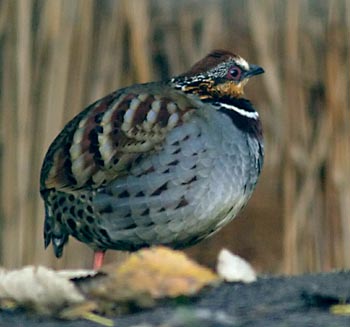
The White-necklaced Partridge is easily recognizable by its distinctive white neck ring, which sharply contrasts with its otherwise mottled brown and gray plumage. Adults typically exhibit a rich chestnut crown and a face marked with black and white streaks. Their underparts are pale with intricate barring, providing excellent camouflage against the forest floor. Males and females are similar in appearance, though males often display a slightly more pronounced coloration. Juveniles resemble adults but show duller plumage, lacking the full intensity of the adult's neck ring and facial markings. In flight, the White-necklaced Partridge reveals rounded wings and a short tail, typical of ground-dwelling partridges adapted for quick bursts of flight rather than sustained soaring. Its perching posture is seldom observed, as the bird primarily dwells on the ground, where it forages and nests. Confusion with similar species like the Bar-backed Partridge (Arborophila brunneopectus) can occur, but the White-necklaced Partridge's more prominent neck ring and distinct habitat preferences assist in accurate identification.
Having trouble telling birds apart? Upload a photo to our bird identification tool for an instant species match.
White-necklaced Partridge Habitat and Range
Preferred Habitat
The White-necklaced Partridge primarily inhabits evergreen and semi-evergreen forests in southeastern China. It favors dense undergrowth within subtropical woodlands, where it finds ample cover and abundant food resources. These forests, often located at elevations ranging from 200 to 1,500 meters, provide the ideal conditions for this ground-dwelling bird. Unlike many avian species, the White-necklaced Partridge shows little inclination towards urban or peri-urban areas, remaining firmly rooted in its forested habitat. Seasonal habitat shifts are minimal, as the species does not migrate, instead relying on the forest's natural seasonal cycles to meet its needs.
Geographic Range
The White-necklaced Partridge has a limited range, confined to the southeastern provinces of China, such as Fujian, Zhejiang, and Jiangxi. Its presence is most concentrated within these regions, where suitable forest habitats prevail. The bird's distribution does not extend significantly beyond this range, as it is a non-migratory species with no known migration corridors. Within its range, population densities can vary, with higher concentrations in areas offering optimal habitat conditions, such as mature forests with rich undergrowth. The bird's sedentary nature and habitat specificity make its range relatively stable, though subject to pressures from habitat loss and fragmentation.
Want to know which birds visit your area? Browse our backyard birds by location guides for region-specific species lists.
What Does the White-necklaced Partridge Eat?
The diet of the White-necklaced Partridge consists primarily of seeds, fruits, and small invertebrates, reflecting its omnivorous nature. It forages on the forest floor, using its beak to sift through leaf litter and soil in search of food. Seasonal changes in diet are evident, with a higher reliance on seeds and fruits during the post-breeding season when these resources are abundant. In contrast, insects and other invertebrates become more prominent in the diet during the breeding season, providing the necessary protein for reproductive success. Typical prey includes ants, beetles, and small worms, which the bird captures using quick, precise movements. Its foraging activity peaks during the early morning and late afternoon, coinciding with cooler temperatures and reduced predator presence.
White-necklaced Partridge Behavior and Social Structure
The White-necklaced Partridge exhibits a solitary or small group social structure, often seen in pairs or small family groups rather than large flocks. Territorial behavior becomes pronounced during the breeding season, with males establishing and defending territories through vocal displays and physical presence. Courtship involves a combination of vocalizations and physical displays, with males showcasing their plumage and engaging in ritualized movements to attract females. These birds exhibit a crepuscular activity pattern, being most active during dawn and dusk when they forage and engage in social interactions. In response to predators, the White-necklaced Partridge uses a combination of stealth and quick, low flights to escape, relying on its camouflaged plumage to remain undetected. The bird's daily routine includes periods of foraging interspersed with rest and preening, maintaining its plumage in optimal condition.
White-necklaced Partridge Nesting and Reproduction
The nesting habits of the White-necklaced Partridge involve ground nests, typically concealed within dense vegetation or underbrush to minimize detection by predators. Nests are rudimentary, consisting of shallow scrapes lined with leaves and other vegetation. The clutch size generally ranges from four to six eggs, with incubation carried out primarily by the female over approximately 18 to 21 days. Once hatched, chicks are precocial, leaving the nest shortly after birth and being guided by both parents. Fledging occurs roughly three to four weeks post-hatching, during which time the young develop the necessary skills for survival. The White-necklaced Partridge typically raises one to two broods per year, depending on environmental conditions and food availability.
White-necklaced Partridge Sounds and Vocalizations
The White-necklaced Partridge produces a series of melodious whistles and trills, often used in territorial and mating displays. Its primary song consists of a rhythmic sequence of rising and falling notes, creating a distinctive musical quality that can carry over considerable distances. Call notes include short, sharp 'kee-kee' sounds, serving as contact calls between paired birds or family groups. Alarm calls are harsher and more abrupt, designed to alert others to the presence of potential threats. During the breeding season, the dawn chorus features prominently, with males utilizing their vocalizations to establish territory and attract mates. The bird's vocal repertoire, while not vast, provides a critical means of communication within its densely vegetated habitat.
Interesting Facts About the White-necklaced Partridge
- 1The White-necklaced Partridge can live up to 10 years in the wild, longer than many other ground-dwelling birds.
- 2During courtship, the male White-necklaced Partridge performs a unique dance, including head bobbing and wing fluttering.
- 3Despite their small size, White-necklaced Partridges can fly short distances at speeds up to 40 km/h to escape predators.
- 4The White-necklaced Partridge's call can be heard up to 500 meters away in dense forest habitats.
- 5White-necklaced Partridges play a crucial role in seed dispersal, aiding in the propagation of various forest plants.
- 6The species was first described scientifically in the mid-19th century, highlighting the rich biodiversity of southeastern China.
- 7While predominantly terrestrial, White-necklaced Partridges are capable of roosting in low branches if threatened.
White-necklaced Partridge Conservation Status
The White-necklaced Partridge is currently classified as Near Threatened on the IUCN Red List, with populations showing a declining trend due to habitat destruction and fragmentation. Primary threats include deforestation for agriculture and urban development, which reduce available habitat and increase isolation of remaining populations. Conservation efforts focus on habitat preservation and restoration, employing strategies such as protected area designation and sustainable forestry practices. Historical data indicate that populations were more widespread prior to significant habitat alteration in the 20th century. Continued conservation initiatives are essential to prevent further decline and to ensure the species' long-term survival.


