
White-whiskered Hermit
Phaethornis yaruqui
Order: Apodiformes / Family: Trochilidae
Wikimedia Commons
About the White-whiskered Hermit
The White-whiskered Hermit (Phaethornis yaruqui) is an exquisite hummingbird species endemic to the lush, humid forests of South America. With a curved bill perfectly adapted for extracting nectar from tubular flowers, it plays a crucial role in pollination within its ecosystem. This species is predominantly found in the lowland rainforests of Colombia, Ecuador, and northern Peru. These regions, characterized by high humidity and dense vegetation, provide the ideal environment for the White-whiskered Hermit to thrive. The hermit's ecological significance extends beyond pollination, as it also serves as an indicator of forest health. Its presence signifies a vibrant, undisturbed habitat, as it tends to avoid heavily degraded areas. Apart from its foraging activities, this hummingbird exhibits fascinating seasonal behaviors. During the breeding season, which generally occurs in the wetter months, the White-whiskered Hermit becomes more territorial, actively defending feeding and nesting sites. Outside of breeding, it may engage in altitudinal migrations, moving to different elevations in response to food availability and climate conditions. The White-whiskered Hermit is a vital part of the tropical forest ecosystem, contributing to the intricate web of life that sustains these biodiverse regions.
The White-whiskered Hermit belongs to the family Trochilidae, within the order Apodiformes. These birds typically live average 3-5 years, with a maximum recorded up to 9 years..
How to Identify a White-whiskered Hermit
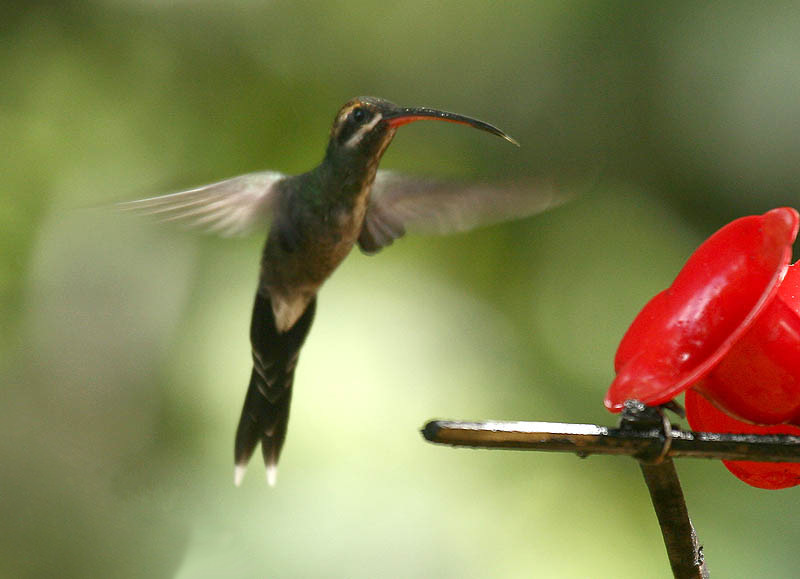
The White-whiskered Hermit features a striking appearance that aids in its identification. Adults have a predominantly olive-green upper body, while the underparts are a more muted grayish tone. The most notable feature is the white streak or 'whisker' running from the base of the bill, below the eye, and down the sides of the neck. This distinctive marking sets the species apart from similar hummingbirds. Juveniles resemble adults but may have slightly duller plumage and less pronounced whiskers. Males and females are similar in appearance, though males may display slightly brighter plumage during the breeding season. In flight, the hermit's silhouette is characterized by its long, slightly decurved bill and a tail with distinctive white tips. When perching, it assumes a relaxed posture, often resting on thin branches or vines. Confusion with other species, such as the Tawny-bellied Hermit, can occur, but the White-whiskered Hermit is distinguished by its more prominent facial markings and specific range.
Having trouble telling birds apart? Upload a photo to our bird identification tool for an instant species match.
White-whiskered Hermit Habitat and Range
Preferred Habitat
The White-whiskered Hermit inhabits tropical lowland rainforests, often found in areas with dense understory vegetation. Such environments, rich in flowering plants, provide ample foraging opportunities for nectar. It often frequents forest edges, clearings, and secondary growth, where flowering plants are abundant. Elevations range from sea level up to 1,500 meters, though the species is most numerous at lower altitudes. Seasonal habitat shifts may occur, with movements to slightly higher altitudes during the dry season when food becomes scarce. The hermit is less common in urban areas, preferring remote, undisturbed habitats that support a diverse floral community.
Geographic Range
The White-whiskered Hermit has a range concentrated in the northwestern part of South America. Its breeding range spans the humid lowland forests of Colombia, Ecuador, and northern Peru. The species does not undertake long-distance migrations, but it may engage in local altitudinal movements, especially in response to seasonal changes in food availability. Areas such as the Chocó region in Colombia and coastal Ecuador are known hotspots for the species, with significant populations thriving in these biodiverse areas. Despite its limited range, the hermit maintains stable populations due to the relative inaccessibility of its preferred habitat.
Want to know which birds visit your area? Browse our backyard birds by location guides for region-specific species lists.
What Does the White-whiskered Hermit Eat?
The diet of the White-whiskered Hermit primarily consists of nectar from a wide variety of tubular flowers. It exhibits a preference for plant species such as Heliconia and Costus, which are abundant in its habitat. To supplement its diet, it also consumes small insects and spiders, providing essential proteins. Seasonal variations in flower blooming patterns influence its feeding habits, leading to shifts in diet focus throughout the year. Foraging typically occurs during the early morning and late afternoon, taking advantage of cooler temperatures and increased flower availability. The hermit uses its long bill and specialized tongue to access nectar deep within flowers, employing a hovering technique that allows it to remain stationary in front of blossoms.
White-whiskered Hermit Behavior and Social Structure
The White-whiskered Hermit displays a solitary and territorial nature, especially pronounced during the breeding season. Males establish and defend territories rich in flowering plants, using aggressive displays to ward off intruders. Courtship involves elaborate aerial displays, where males showcase their agility and speed. Outside the breeding season, the hermit is less territorial, though it may still defend preferred feeding areas from conspecifics. It exhibits a crepuscular activity pattern, with peaks in feeding during dawn and dusk when flower nectar is most abundant. Interaction with predators is minimal, as its small size and rapid flight make it a challenging target. Nevertheless, it remains vigilant, often retreating to dense foliage when threatened.
White-whiskered Hermit Nesting and Reproduction
The White-whiskered Hermit builds a unique nest, typically a cup-like structure suspended from the underside of large leaves or attached to thin branches. The nest construction utilizes a combination of plant fibers, spider silk, and moss, providing both camouflage and stability. Nesting sites are often chosen in areas with high humidity and abundant foliage for protection. The clutch size typically consists of two white eggs, which the female incubates alone for about 15-18 days. After hatching, the chicks remain in the nest for approximately 20-25 days before fledging. The female assumes sole responsibility for feeding and caring for the young. The species generally raises one or two broods per year, depending on food availability and environmental conditions.
White-whiskered Hermit Sounds and Vocalizations
The White-whiskered Hermit produces a series of high-pitched, rapid notes that form its primary song. The rhythm is generally a repetitive sequence of 'tseep-tseep-tseep' sounds, delivered in quick succession. These vocalizations serve both in territorial defense and mate attraction. In addition to its song, the hermit emits sharp call notes when disturbed or alarmed, which can escalate to a more intense chatter during aggressive interactions. While not as melodious as some other hummingbird species, its vocalizations play a crucial role in communication within its dense forest habitat.
Interesting Facts About the White-whiskered Hermit
- 1The White-whiskered Hermit's heart beats up to 1,260 times per minute, a necessity for its high-energy lifestyle.
- 2Despite its small size, the White-whiskered Hermit can travel at speeds of up to 30 miles per hour during flight.
- 3The White-whiskered Hermit can consume up to twice its body weight in nectar and insects daily.
- 4Its long bill is specially adapted to extract nectar from flowers that many other birds cannot access, showcasing co-evolution with plants.
- 5The White-whiskered Hermit uses spider silk for nest construction, which provides both elasticity and strength to the structure.
White-whiskered Hermit Conservation Status
The White-whiskered Hermit currently holds a status of Least Concern on the IUCN Red List. Its population trend appears stable, with no major declines reported. However, habitat destruction due to logging and agricultural expansion poses potential threats. Conservation efforts focus on habitat preservation and protected areas management. Historical data suggests the population has remained relatively constant, benefiting from the inaccessibility of its preferred environments.


