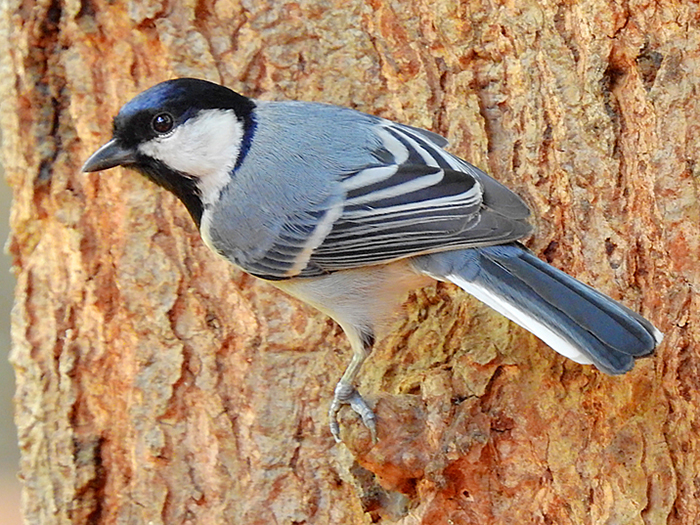
White-winged Black Tit
Parus leucomelas
Order: Passeriformes / Family: Paridae

Wikimedia Commons
About the White-winged Black Tit
The White-winged Black Tit (Parus leucomelas) is a small, charismatic bird that captivates birdwatchers with its distinct plumage and vivacious behavior. This species belongs to the family Paridae and is predominantly found across sub-Saharan Africa. Known for its adaptability, the White-winged Black Tit occupies a range of habitats from open woodlands and savannas to scrublands and gardens. Its presence is particularly noted in countries like Zambia, Zimbabwe, and Botswana, where it thrives in both rural and suburban environments. The ecological significance of the White-winged Black Tit is underscored by its role in controlling insect populations, thereby maintaining ecological balance in its habitat. During different seasons, this bird exhibits intriguing behavioral shifts. For instance, in the breeding season, which typically spans from August to November, the White-winged Black Tit becomes particularly active in nest-building and rearing young. Outside the breeding months, these tits often exhibit more solitary or small group behaviors, focusing on foraging and territory maintenance. The White-winged Black Tit's adaptability to various environments makes it an invaluable species for studying ecological interactions and the impacts of habitat change. Its ability to thrive in both natural and altered landscapes demonstrates an impressive resilience, reflecting the dynamic nature of avian ecology in Africa. This bird not only contributes to the biodiversity of the regions it inhabits but also serves as a flagship species for avian conservation efforts in these areas. Observing the White-winged Black Tit in its natural habitat offers insights into the complex web of relationships that sustain ecological systems across sub-Saharan Africa, highlighting the intricate balance between species and their environments.
The White-winged Black Tit belongs to the family Paridae, within the order Passeriformes. These birds typically live average 2-3 years, with a maximum recorded of 5 years..
How to Identify a White-winged Black Tit
The White-winged Black Tit is easily identified by its striking black and white plumage. Adults possess a predominantly black body with distinct white wing patches that are conspicuous during flight. The head is also black, but the cheeks and underparts are contrastingly white, enhancing its bold appearance. In terms of size, this bird measures about 14 centimeters in length, with a wingspan ranging from 20 to 23 centimeters. Juvenile White-winged Black Tits differ slightly in plumage, often displaying duller colors and less pronounced wing patches compared to adults. While males and females are similar in appearance, the females may have slightly less vibrant plumage. In the field, the White-winged Black Tit can be confused with the Southern Black Tit (Melaniparus niger), but the latter lacks the prominent white wing patches. Observers can also distinguish the White-winged Black Tit by its perching posture, often seen with a slight forward lean, a characteristic of many tit species. Its flight is quick and agile, making it a delightful sight as it flits between trees in search of food.
Having trouble telling birds apart? Upload a photo to our bird identification tool for an instant species match.
White-winged Black Tit Habitat and Range
Preferred Habitat
The White-winged Black Tit inhabits a range of environments, primarily favoring open woodlands and savannas where acacia trees are prevalent. This bird can also be found in scrublands and secondary growth forests, indicating its adaptability to various vegetative structures. It is known to live at elevations ranging from sea level up to about 2,000 meters, although it generally prefers lower elevations. During the non-breeding season, the White-winged Black Tit may venture into more urban settings, often visiting gardens and parks where suitable tree cover is present. Despite the seasonal changes, the bird maintains a preference for areas with abundant tree cover that provide ample foraging opportunities.
Geographic Range
The White-winged Black Tit is a resident breeder in sub-Saharan Africa, with its range extending from Angola and Namibia in the west to Tanzania and Mozambique in the east. It is particularly abundant in Zambia, Zimbabwe, and northern Botswana. This species does not undertake long-distance migrations but may exhibit local movements in response to food availability and breeding conditions. Within its range, population densities are generally higher in regions with a mix of woodland and open areas, where its preferred habitats are most prevalent. The White-winged Black Tit's stability in these regions contributes to its classification as a species of least concern, reflecting a widespread and relatively stable population.
Want to know which birds visit your area? Browse our backyard birds by location guides for region-specific species lists.
What Does the White-winged Black Tit Eat?
The diet of the White-winged Black Tit is primarily insectivorous, consisting mainly of caterpillars, beetles, and other small invertebrates. This bird employs a variety of foraging techniques, including gleaning insects from leaves and bark, as well as hawking for flying insects. During the breeding season, the demand for protein-rich food increases, causing these birds to focus more on invertebrates. Outside of the breeding season, the White-winged Black Tit may also consume seeds and small fruits, although these constitute a minor part of its diet. Its feeding schedule is diurnal, with peak activity observed during the early morning and late afternoon hours when insects are most active.
Want to attract White-winged Black Tits to your yard? See our recommended feeders and seed types for the best results.
White-winged Black Tit Behavior and Social Structure
The White-winged Black Tit exhibits a range of behaviors that reflect its social and territorial nature. These birds are generally seen in pairs or small family groups, although larger flocks may form during non-breeding seasons. They are highly territorial, with pairs vigorously defending their nesting and feeding areas against intruders. Courtship displays involve both vocalizations and physical displays, such as wing-flicking and tail-spreading, to strengthen pair bonds. When faced with predators, White-winged Black Tits employ alarm calls to alert other birds of potential danger. Their daily activity patterns include periods of intense foraging interspersed with rest and preening.
White-winged Black Tit Nesting and Reproduction
Nesting for the White-winged Black Tit involves constructing cup-shaped nests, often located in tree cavities or abandoned woodpecker holes. These nests are lined with soft materials such as feathers and fur to provide insulation and comfort for the eggs and hatchlings. The clutch size typically ranges from 3 to 5 eggs, which the female incubates for about 14 days. After hatching, both parents partake in feeding and caring for the young, which fledge after approximately 18 to 20 days. The White-winged Black Tit typically raises one or two broods per year, depending on environmental conditions and food availability.
White-winged Black Tit Sounds and Vocalizations
The vocalizations of the White-winged Black Tit are varied, with its primary song being a series of clear, repetitive whistles that rise and fall in pitch. These songs serve both territorial and mate-attraction purposes. In addition to its song, the bird produces a variety of call notes, including a sharp 'chick-chick' sound used as an alarm call when predators are nearby. During the dawn chorus, the White-winged Black Tit can be heard vocalizing prominently, contributing to the vibrant acoustic landscape of its habitat.
Interesting Facts About the White-winged Black Tit
- 1The White-winged Black Tit is known for its acrobatic foraging style, often hanging upside down to reach insects.
- 2During the breeding season, the White-winged Black Tit's territory can span up to 1 hectare.
- 3White-winged Black Tits sometimes join mixed-species flocks, enhancing their foraging efficiency and predator vigilance.
- 4This species can adapt to both natural and disturbed habitats, showcasing its ecological versatility.
- 5The White-winged Black Tit's white wing patches are especially visible during flight, aiding in species identification.
- 6These birds have a cooperative breeding system, with older siblings sometimes helping to raise new broods.
- 7White-winged Black Tits communicate with over ten distinct vocalizations, each serving a unique purpose.
White-winged Black Tit Conservation Status
The White-winged Black Tit is currently listed as a species of least concern by the IUCN due to its wide distribution and stable population numbers. However, habitat destruction and fragmentation pose ongoing threats to its habitat, particularly in areas undergoing agricultural expansion and urban development. Conservation efforts focus on preserving natural habitats and promoting sustainable land-use practices. Historically, the population has remained stable, though localized declines have been observed in regions with significant environmental changes.
Attracting White-winged Black Tits to Your Feeder
The White-winged Black Tit is a regular visitor to backyard bird feeders across its range. At the Eye On The Fly feeding station, we observe White-winged Black Tits regularly and capture footage with our feeder cameras.
Other Paridae Species


Birds Similar to the White-winged Black Tit
These species are often confused with the White-winged Black Tit due to similar appearance or overlapping range.