
Yellow-billed Pintail
Anas georgica
Order: Anseriformes / Family: Anatidae
Wikimedia Commons
About the Yellow-billed Pintail
The Yellow-billed Pintail (Anas georgica) is a versatile waterfowl species within the family Anatidae and the order Anseriformes. This medium-sized duck is native to South America, where it inhabits a range of aquatic environments. It is most commonly found in countries like Argentina, Chile, and Uruguay, thriving in both freshwater and saltwater habitats. The Yellow-billed Pintail is a species of significant ecological importance, playing a role in the control of aquatic vegetation and serving as prey for larger predators.
In terms of its ecological role, the Yellow-billed Pintail contributes to the health of its habitat by feeding on aquatic plants and insects, thus maintaining a balanced ecosystem. The bird's population is currently stable, with no immediate threats leading to significant declines. However, habitat destruction poses a potential risk to its continued stability.
Seasonal behaviors of the Yellow-billed Pintail include localized migrations in response to changes in water levels and food availability. During the breeding season, these ducks can be seen in larger numbers around shallow lakes and marshes where they build nests. As winter approaches, they may move to coastal estuaries or larger lakes that remain unfrozen. The adaptability of the Yellow-billed Pintail to various wetland habitats underscores its resilience and ecological versatility.
The Yellow-billed Pintail belongs to the family Anatidae, within the order Anseriformes. These birds typically live average 10 years with a maximum recorded of 14 years.
How to Identify a Yellow-billed Pintail
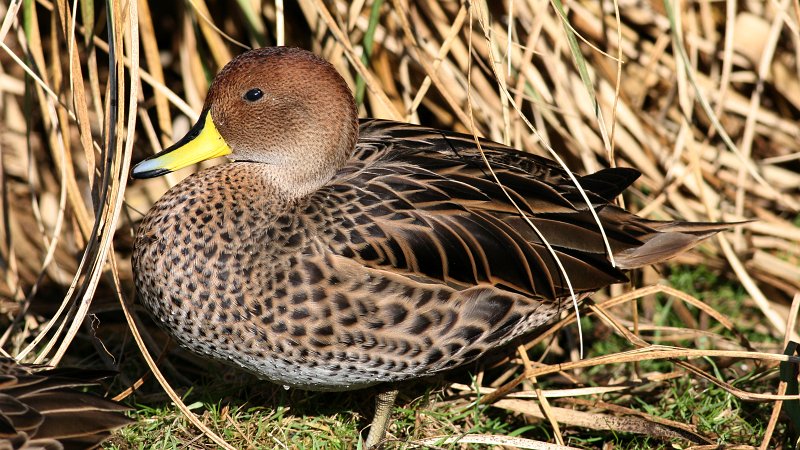
The Yellow-billed Pintail is recognizable by its medium size, typically measuring around 45-58 cm in length. Adults display a mottled brown plumage that provides excellent camouflage in their natural habitat. The most distinguishing feature is the bright yellow bill, which sets it apart from other pintail species.
Juvenile Yellow-billed Pintails are similar in appearance to adults but exhibit more subdued coloration. The females tend to be less vibrant than males, displaying duller plumage overall. This sexual dimorphism aids in nesting and brooding, where the more camouflaged females stay with the nest while the males may be more visible.
In flight, the Yellow-billed Pintail's silhouette is characterized by a slender neck and elongated tail, features common among pintails. Their flight is swift and agile, often performed in flocks. Perching posture is typically upright, with a relaxed demeanor when at rest. While some confusion might occur with other brown ducks, the yellow bill provides a reliable field mark.
Having trouble telling birds apart? Upload a photo to our bird identification tool for an instant species match.
Yellow-billed Pintail Habitat and Range
Preferred Habitat
The Yellow-billed Pintail thrives in a variety of wetland habitats, including freshwater lakes, marshes, and coastal estuaries. They are found at elevations ranging from sea level to approximately 4,000 meters in the Andean regions. In particular, the high-altitude wetlands of the Andes serve as crucial habitats during certain times of the year.
These pintails also occupy agricultural fields and rice paddies, demonstrating adaptability to human-altered landscapes. Seasonal habitat shifts occur as the birds move from high-altitude breeding grounds to lower-altitude wintering areas, where milder climates are more accommodating. While predominantly found in rural wetland areas, they occasionally venture into urban parks with suitable ponds, showcasing their ability to exploit various environments.
Geographic Range
The Yellow-billed Pintail has a widespread distribution in South America, primarily breeding in southern regions such as Patagonia in Argentina and Chile. During the breeding season, their range extends into central and northern Argentina as well as parts of Uruguay.
In winter, the pintails may migrate northward within the continent to find more hospitable climates and food sources. The species does not undertake extensive long-distance migrations, instead showing localized movements within its range.
Throughout its range, population densities can vary, with higher concentrations often found in regions boasting abundant wetland habitats. Notable hotspots for the Yellow-billed Pintail include the wetlands of the Pampas in Argentina and the expansive salt flats of northern Chile.
Want to know which birds visit your area? Browse our backyard birds by location guides for region-specific species lists.
What Does the Yellow-billed Pintail Eat?
The diet of the Yellow-billed Pintail consists primarily of aquatic vegetation, seeds, and small invertebrates. During the breeding season, they may consume a higher proportion of insects and other protein-rich sources to support reproductive efforts.
Foraging occurs in shallow waters where they dabble or upend to reach submerged food. The size of prey items generally includes small snails, aquatic insects, and plant material within a few centimeters. Feeding typically takes place during daylight hours, with peak activity in the early morning and late afternoon.
Seasonal dietary shifts are influenced by the availability of food sources, with a preference for protein-rich diets during the breeding season and a more varied diet in non-breeding times.
Yellow-billed Pintail Behavior and Social Structure
The Yellow-billed Pintail exhibits a social structure that often involves forming small flocks outside the breeding season. These flocks provide safety in numbers and facilitate efficient foraging.
During the breeding season, the species displays territorial behavior, with males engaging in courtship displays characterized by head-bobbing and vocalizations to attract females. Pair bonds form for the duration of the breeding cycle, although they are not necessarily lifelong.
The pintails' response to predators includes taking flight quickly or seeking cover among reeds and grasses. Daily activity patterns revolve around foraging and social interactions, with periods of rest during midday. The species adapts well to changing conditions, demonstrating resilience and flexibility in its behaviors.
Yellow-billed Pintail Nesting and Reproduction
The Yellow-billed Pintail nests in well-concealed locations near water, often utilizing dense vegetation to hide their nests from predators. Nests are typically constructed from grasses and feathers, forming a shallow bowl.
The female lays a clutch of 5-9 eggs, which she incubates for approximately 24-26 days. During this period, the male remains nearby to guard the territory and provide protection.
After hatching, the ducklings are precocial, leaving the nest within hours to follow the mother to water. They fledge roughly 45-60 days post-hatching, gaining independence shortly thereafter. Generally, the Yellow-billed Pintail produces one brood per year, although favorable conditions may allow for a second.
Yellow-billed Pintail Sounds and Vocalizations
The primary vocalizations of the Yellow-billed Pintail include a series of soft, whistling sounds. The male's call is a distinctive 'wheezy' whistle, often repeated during courtship displays.
Females produce a quieter, more guttural quacking sound, which serves as a contact call within family groups. Alarm calls are sharp and abrupt, designed to alert others to potential threats.
During the dawn chorus, Yellow-billed Pintails may join other waterfowl in vocalizing, creating a tapestry of sounds over wetland habitats. Their vocal repertoire, while not as extensive as songbirds, plays an essential role in communication and mate attraction.
Interesting Facts About the Yellow-billed Pintail
- 1The Yellow-billed Pintail has a highly adaptable diet that allows it to thrive in diverse environments, from high-altitude lakes to lowland marshes.
- 2Unlike many migratory birds, the Yellow-billed Pintail tends to exhibit localized movements rather than long-distance migrations.
- 3The species can be found at elevations up to 4,000 meters, particularly in the Andean regions of South America.
- 4Yellow-billed Pintails often form mixed-species flocks with other ducks, enhancing their foraging and predator detection capabilities.
- 5The unique yellow bill of the Yellow-billed Pintail serves not only as a field mark but may also play a role in mate selection during the breeding season.
- 6These pintails are known to exploit human-altered landscapes like rice paddies, showcasing their adaptability to changing environments.
- 7The Yellow-billed Pintail's feeding technique involves dabbling and upending, allowing access to a variety of food sources within wetland habitats.
Yellow-billed Pintail Conservation Status
Currently, the Yellow-billed Pintail is listed as Least Concern on the IUCN Red List, with a stable population trend. Despite its status, habitat loss due to wetland drainage and agricultural expansion poses ongoing threats. Conservation efforts focus on habitat preservation and management, with initiatives to protect critical wetland areas in South America. Historically, the population has remained relatively stable, though periodic fluctuations occur due to environmental changes. Continued monitoring and conservation actions aim to ensure the species remains resilient against future challenges, safeguarding its role in the ecosystem.


