
Yellow-breasted Flowerpecker
Prionochilus maculatus
Order: Passeriformes / Family: Dicaeidae
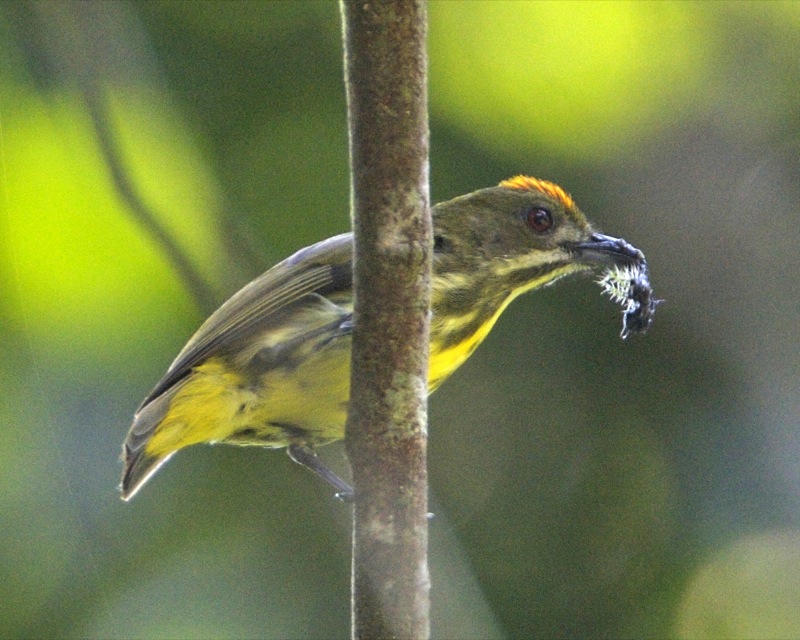
Wikimedia Commons
About the Yellow-breasted Flowerpecker
The Yellow-breasted Flowerpecker, scientifically known as Prionochilus maculatus, is a small, colorful bird belonging to the family Dicaeidae. This species is a quintessential inhabitant of the dense, moist forests of Southeast Asia, with a range that includes countries such as Malaysia, Indonesia, Thailand, and the Philippines. Its presence is a key indicator of healthy forest ecosystems, as it plays a significant role in the pollination of various tropical plants and dispersal of seeds. The bird’s ecological role as a pollinator enhances biodiversity, contributing to the intricate web of life within these lush habitats. During the breeding season, which typically coincides with the rainy months, the Yellow-breasted Flowerpecker becomes more vocal and active, marking territory and seeking mates with its high-pitched calls. Its breeding habits are closely tied to the availability of food resources, which fluctuate with seasonal changes in the forest. This bird is a vital component of its ecosystem, supporting the reproductive cycles of numerous plant species. The Yellow-breasted Flowerpecker's significance extends beyond its ecological role; it is also an important species for birdwatchers and researchers studying the dynamics of tropical forest avifauna. The bird’s vibrant plumage and vocalizations make it a favorite among birdwatchers, while its ecological contributions are of interest to conservationists and ecologists. As forest habitats face increasing threats from deforestation and human encroachment, understanding and conserving species like the Yellow-breasted Flowerpecker becomes ever more crucial. Its presence in primary and secondary forests highlights the need for preserving these areas to maintain biodiversity and ecological balance. The bird's adaptability to different forest types, including logged and secondary growth areas, shows its resilience; however, its dependence on forest habitats underscores the need for conservation efforts to ensure the survival of both the species and its environment.
The Yellow-breasted Flowerpecker belongs to the family Dicaeidae, within the order Passeriformes. These birds typically live typically 5-7 years, with a maximum recorded of 10 years..
How to Identify a Yellow-breasted Flowerpecker
The Yellow-breasted Flowerpecker is a compact bird, typically measuring about 9 to 10 centimeters in length. Adult males display a striking yellow breast complemented by a dark, bluish-black head and back, creating a vivid contrast that makes identification straightforward. Females and juveniles, while similar in size, exhibit duller plumage; their yellow breast is less vibrant, and their overall color scheme is more subdued, with a greenish tinge on the back. This sexual dimorphism is typical in the species, aiding in quick differentiation between males and females. The bird's underparts are a bright yellow, and its wings and tail feature subtle white markings, which can be observed during flight. Its small, stout bill is well-adapted to its diet, assisting in the consumption of various fruits and nectar. In terms of behavior, the Yellow-breasted Flowerpecker is often seen flitting energetically through the forest canopy, its rapid, undulating flight pattern characteristic of the flowerpecker family. When perched, it maintains a slightly upright posture, often in a position that allows it to survey its surroundings for food and potential threats. While confusion with other flowerpeckers may occur, the Yellow-breasted Flowerpecker's distinct coloration and size generally aid in accurate identification.
Having trouble telling birds apart? Upload a photo to our bird identification tool for an instant species match.
Yellow-breasted Flowerpecker Habitat and Range
Preferred Habitat
The Yellow-breasted Flowerpecker thrives in tropical and subtropical moist broadleaf forests, favoring primary forests but also inhabiting secondary growth and forest edges. These birds are most abundant at elevations ranging from sea level to about 1,200 meters, though they can occasionally be found at higher altitudes. They are adaptable to various forest types, including evergreen and semi-deciduous forests, but they show a preference for dense, humid environments with abundant fruiting trees and flowering plants. Seasonal shifts may occur, with the birds moving to different forest strata or areas in response to food availability. While they are primarily found in rural forested areas, the Yellow-breasted Flowerpecker can sometimes be observed in more urbanized regions where pockets of suitable habitat persist, such as botanical gardens or parks with native vegetation. Despite their adaptability, these birds are most commonly associated with undisturbed forest environments, highlighting their reliance on healthy, intact ecosystems.
Geographic Range
The Yellow-breasted Flowerpecker is a resident species across much of Southeast Asia, with its range encompassing the Malay Peninsula, Borneo, Sumatra, and Java, as well as the southern regions of Thailand and the Philippines. It is not a migratory bird, instead showing a largely sedentary lifestyle, although some local movements may occur in response to food availability or breeding conditions. Population density hotspots are often found in the lowland rainforests of Borneo and Sumatra, where the species benefits from the rich biodiversity and abundance of fruiting plants. In the Philippines, the bird's range extends across various islands, where it occupies suitable forest habitats. While its range is relatively stable, habitat destruction poses a significant threat, potentially leading to range contractions in areas experiencing deforestation. Conservation efforts focused on preserving forest habitats are critical to maintaining the distribution and population of this vibrant species.
Want to know which birds visit your area? Browse our backyard birds by location guides for region-specific species lists.
What Does the Yellow-breasted Flowerpecker Eat?
The diet of the Yellow-breasted Flowerpecker primarily consists of small fruits and berries, with a particular preference for mistletoe berries, which play a crucial role in their diet and seed dispersal activities. Nectar also forms a significant part of their dietary intake, and the bird's specialized tongue aids in efficient nectar extraction from flowers. Insects and other small arthropods supplement their diet, especially during the breeding season when the demand for protein increases. This opportunistic feeding strategy allows them to adapt to seasonal variations in food availability within their forest habitats. The birds typically forage in the upper canopy, moving rapidly between fruiting trees and flowering plants. Their feeding schedule is diurnal, with peak activity occurring in the early morning and late afternoon when food resources are most accessible. The Yellow-breasted Flowerpecker's role as a seed disperser and pollinator underscores its importance in maintaining the health and diversity of tropical forest ecosystems.
Yellow-breasted Flowerpecker Behavior and Social Structure
The Yellow-breasted Flowerpecker exhibits a predominantly solitary or paired lifestyle, particularly outside of the breeding season. Their territorial behavior becomes more pronounced during the breeding season, with males actively defending their chosen areas through vocal displays and occasional physical confrontations with rival males. Courtship displays are subtle but include a series of soft calls and plumage displays aimed at attracting females. While primarily solitary, these birds may join mixed-species foraging flocks, especially when food resources are abundant. Such associations allow them to capitalize on a wider range of feeding opportunities while benefiting from the vigilance of other species against predators. The Yellow-breasted Flowerpecker's daily activity patterns revolve around foraging and resting, with periods of increased vocal activity in the early morning and late afternoon. In response to predators, these birds rely on their small size and agile flight to evade capture, often taking refuge in dense foliage. Their resilience and adaptability to changing environmental conditions are key factors in their survival within dynamic forest ecosystems.
Yellow-breasted Flowerpecker Nesting and Reproduction
The nesting habits of the Yellow-breasted Flowerpecker are typical of the Dicaeidae family, with the construction of small, cup-shaped nests using fine plant fibers, spider webs, and moss. These nests are often located in the dense foliage of shrubs or small trees, providing camouflage and protection from predators. The preferred height for nest placement is usually between 1 and 5 meters above the ground, ensuring accessibility and safety. A typical clutch consists of 2 to 3 eggs, which are incubated by both parents over a period of approximately 12 to 14 days. Once hatched, the chicks are fed a diet rich in insects and fruits, with both parents sharing feeding duties. The fledging period lasts around 14 to 17 days, during which time the young birds remain dependent on parental care and protection. The Yellow-breasted Flowerpecker typically raises one or two broods per year, depending on environmental conditions and resource availability.
Yellow-breasted Flowerpecker Sounds and Vocalizations
The vocalizations of the Yellow-breasted Flowerpecker are characterized by a series of high-pitched, rapid notes that resemble a soft 'tseet-tseet-tseet.' These calls serve multiple purposes, including territory establishment, mate attraction, and communication with conspecifics. Their song, while not as elaborate as those of some other passerines, is distinctive enough to aid in identification. During the dawn chorus, males are particularly vocal, using their calls to assert territorial boundaries and deter rivals. In addition to their primary song, Yellow-breasted Flowerpeckers produce various call notes and alarm calls in response to perceived threats. These alarm calls are typically sharp and short, alerting nearby birds to the presence of predators. The auditory presence of this species is an integral part of the soundscape in the tropical forests they inhabit.
Interesting Facts About the Yellow-breasted Flowerpecker
- 1The Yellow-breasted Flowerpecker can digest mistletoe berries, aiding in the spread of these parasitic plants.
- 2Despite its small size, the Yellow-breasted Flowerpecker plays a crucial role in seed dispersal, impacting over 20 plant species.
- 3Studies show that the Yellow-breasted Flowerpecker's song consists of over 10 distinct notes, varying in pitch and rhythm.
- 4The Yellow-breasted Flowerpecker's diet includes over 30 different plant species, highlighting its adaptability.
- 5This species has been observed participating in mixed-species flocks with up to 15 other bird species.
- 6The Yellow-breasted Flowerpecker's nesting success rate is influenced by predation, with up to 40% of nests failing.
- 7Its brightly colored plumage is not only attractive but also functions in mate selection and territorial defense.
Yellow-breasted Flowerpecker Conservation Status
The Yellow-breasted Flowerpecker is currently listed as Least Concern on the IUCN Red List, with populations considered stable across most of its range. However, ongoing threats such as habitat loss due to deforestation and land conversion for agriculture pose significant risks to their long-term survival. Conservation efforts aimed at protecting and restoring forest habitats are crucial for maintaining healthy populations of this species. The establishment of protected areas and sustainable forest management practices are vital to ensuring the preservation of the Yellow-breasted Flowerpecker and the diverse ecosystems they inhabit. Historical data indicate that while the species has demonstrated some resilience to environmental changes, continued habitat degradation could lead to population declines in the future.


