
Yellow-browed Tyrant
Satrapa icterophrys
Order: Passeriformes / Family: Tyrannidae
Wikimedia Commons
About the Yellow-browed Tyrant
The Yellow-browed Tyrant (Satrapa icterophrys) occupies a notable niche in the ecosystems of South America, where it is often seen flitting through the forest understory. This small, agile bird is a member of the Tyrannidae family, which is renowned for its wide variety of flycatchers and tyrants. The Yellow-browed Tyrant plays a vital role in controlling insect populations, as it primarily preys on small arthropods. Its presence in the ecosystem highlights the complex web of interactions in tropical and subtropical habitats.
Primarily found in countries such as Brazil, Argentina, Paraguay, and Bolivia, the Yellow-browed Tyrant thrives in moist, well-vegetated areas. It prefers lowland forests, open woodlands, and edges of clearings, often alongside water bodies. These birds are not particularly shy, and they can occasionally be observed in agricultural areas where natural vegetation remains.
The ecological significance of the Yellow-browed Tyrant is underscored by its adaptability to different habitats, although it remains closely tied to areas with abundant vegetation. This habitat preference ensures ample insect prey, especially during the breeding season, when nutritional demands are heightened. Seasonal behaviors include local migrations within its range, as individuals may move to different elevations or locations in response to food availability and climatic conditions.
Understanding the ecological role of the Yellow-browed Tyrant helps highlight the importance of conserving South American forests and woodlands. Deforestation and habitat conversion pose significant threats to this species, although it currently maintains a stable population. Efforts to preserve natural habitats indirectly support not only the Yellow-browed Tyrant but also the myriad other species that depend on the same ecosystems.
The Yellow-browed Tyrant belongs to the family Tyrannidae, within the order Passeriformes. These birds typically live 4-7 years, with a maximum recorded of 9 years..
How to Identify a Yellow-browed Tyrant
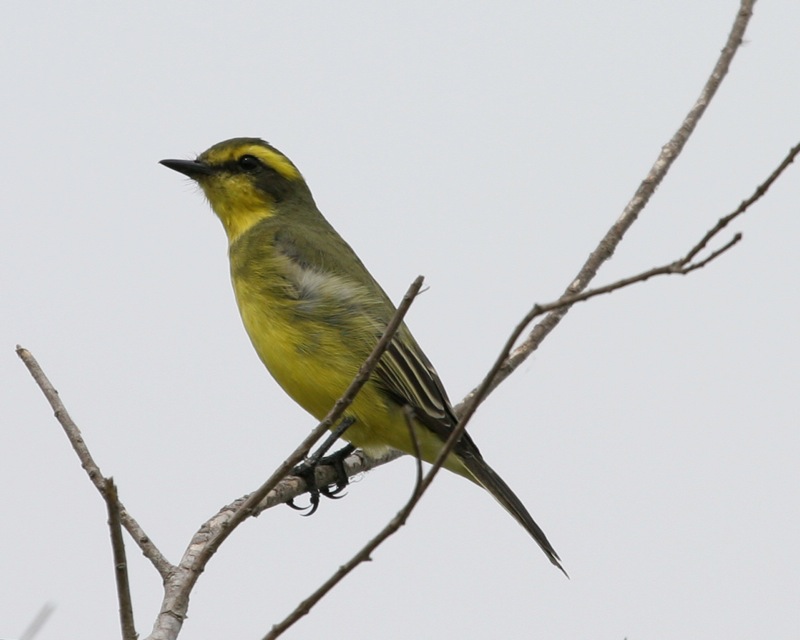
The Yellow-browed Tyrant is a small passerine, measuring approximately 15 cm in length. It is distinguished by its striking facial markings, featuring a vivid yellow eyebrow stripe above its eyes, which contrasts sharply with its otherwise grayish plumage. The back and wings exhibit a dull olive color, while the underparts are paler, often with a slight yellowish wash.
Both males and females share similar plumage, with no significant sexual dimorphism, making them difficult to differentiate in the field. Juveniles resemble adults but may show duller colors and less distinct facial markings, which can sometimes lead to confusion with other tyrant flycatchers.
In flight, the Yellow-browed Tyrant displays a rapid, direct flight pattern typical of many small flycatchers. When perched, it maintains an upright posture, often flicking its tail. Its overall appearance, especially the presence of the yellow eyebrow, helps distinguish it from other species such as the Tropical Kingbird, which lacks the distinctive facial stripe.
Having trouble telling birds apart? Upload a photo to our bird identification tool for an instant species match.
Yellow-browed Tyrant Habitat and Range
Preferred Habitat
The Yellow-browed Tyrant predominantly inhabits lowland tropical and subtropical forests, with a particular affinity for edges and clearings where vegetation remains dense. It is commonly found at elevations from sea level up to 1200 meters but tends to prefer areas that offer both open spaces for foraging and dense cover for nesting.
These birds also adapt to secondary growth and partially altered landscapes, including plantations and gardens, where natural vegetation is present. Seasonal shifts in habitat usage occur mainly in response to food availability, with some populations moving to lower elevations during the non-breeding season.
While the Yellow-browed Tyrant can occasionally be found in urban areas, it generally requires proximity to more natural habitats, showing a preference for rural settings where human impact on the landscape is minimized.
Geographic Range
The Yellow-browed Tyrant's range extends across much of South America, with core populations found in Brazil, Argentina, Paraguay, and Bolivia. It is a non-migratory species, though individuals may undertake local movements, especially in areas with pronounced wet and dry seasons.
In Brazil, the bird is widespread, inhabiting the Atlantic Forest and Pantanal regions. In Argentina, it is more common in the northern provinces, such as Misiones and Corrientes. Paraguay and Bolivia also host significant populations, particularly in forested and semi-open habitats.
Density hotspots for the Yellow-browed Tyrant are typically associated with areas where habitat conditions support abundant insect life. The species is generally more numerous in regions where human activity has minimally impacted natural landscapes.
Want to know which birds visit your area? Browse our backyard birds by location guides for region-specific species lists.
What Does the Yellow-browed Tyrant Eat?
The Yellow-browed Tyrant primarily feeds on insects, making it an important biological control agent within its ecosystem. Its diet consists mainly of small arthropods, including ants, beetles, and flies, which it captures in quick aerial sallies from perches.
During the breeding season, the bird's dietary needs intensify, prompting it to focus on abundant food sources, sometimes supplementing its insect diet with small fruits and seeds. Such dietary flexibility aids its survival in varying environmental conditions.
The Yellow-browed Tyrant forages actively throughout the day, with peak feeding times occurring during the early morning and late afternoon. Its foraging technique involves short flights to snatch prey mid-air, often returning to the same perch multiple times.
Yellow-browed Tyrant Behavior and Social Structure
Yellow-browed Tyrants are generally solitary or found in pairs, especially during the breeding season. They exhibit territorial behavior, with males often singing from prominent perches to establish and defend their territories against rivals.
During courtship, the male performs aerial displays and vocalizations to attract a mate, sometimes presenting food as a gift. Once a pair forms, they remain together throughout the breeding season, working cooperatively to raise their young.
Flocking behavior is rare, although outside the breeding season, Yellow-browed Tyrants may join mixed-species foraging groups. These gatherings enhance feeding efficiency and provide protection against predators.
Daily activity patterns show the birds are most active during the cooler parts of the day, while during midday heat, they tend to reduce activity and rest in shaded areas. They are vigilant, quickly responding to potential threats with alarm calls and evasive maneuvers.
Yellow-browed Tyrant Nesting and Reproduction
The Yellow-browed Tyrant constructs an open cup nest, typically located in the fork of a tree or shrub, at heights ranging from 1 to 5 meters above the ground. The nest is composed of twigs, grasses, and other plant materials, lined with softer substances like feathers or fine rootlets for insulation.
Clutch size generally consists of two to three eggs, which the female incubates for approximately 14 days. During this period, the male plays a crucial role in providing food for the female.
Once hatched, the chicks remain in the nest for about 16 days before fledging. Both parents participate in feeding the young, bringing a variety of insects to the nest. The number of broods per year varies, but the species is known to raise at least one brood annually, with favorable conditions sometimes permitting a second.
Yellow-browed Tyrant Sounds and Vocalizations
The Yellow-browed Tyrant's primary song is a rapid series of clear, whistled notes, often described as 'chee-chee-chee.' This song, delivered from a prominent perch, serves both to attract a mate and to assert territory.
Call notes are typically sharp and metallic, used for communication between mates and within family groups. Alarm calls, in contrast, are harsher and more insistent, alerting others to potential dangers such as predators.
At dawn, the Yellow-browed Tyrant participates in the morning chorus, contributing its song to the symphony of forest sounds. Its vocalizations, while not as varied as some other passerines, remain an integral aspect of its behavioral repertoire.
Interesting Facts About the Yellow-browed Tyrant
- 1The Yellow-browed Tyrant's eye-catching yellow eyebrow stripe is an adaptation for visual communication in dense forest habitats.
- 2Despite its small size, the Yellow-browed Tyrant is an efficient predator of insects, capturing prey in swift aerial maneuvers.
- 3Yellow-browed Tyrants are known to participate in mixed-species foraging flocks, enhancing their feeding efficiency and protection.
- 4During courtship, male Yellow-browed Tyrants may present food to females as part of their mate selection process.
- 5The species exhibits a high degree of adaptability, often thriving in secondary growth and partially disturbed habitats.
Yellow-browed Tyrant Conservation Status
The Yellow-browed Tyrant is currently classified as Least Concern by the IUCN, with a stable population trend. However, ongoing habitat loss due to deforestation and agricultural expansion poses a potential threat to its long-term viability. Conservation efforts aimed at preserving tropical and subtropical forests indirectly benefit this species by maintaining essential habitats. Protected areas and sustainable land use practices are vital in safeguarding the environments upon which the Yellow-browed Tyrant depends. Historical population changes are not well-documented, but the species' adaptability to secondary habitats suggests resilience to moderate habitat alteration. Continued monitoring and habitat conservation will be crucial in ensuring its future survival.
Other Tyrannidae Species


Birds Similar to the Yellow-browed Tyrant
These species are often confused with the Yellow-browed Tyrant due to similar appearance or overlapping range.

