
Yellow-crowned Woodpecker
Leiopicus mahrattensis
Order: Piciformes / Family: Picidae
Wikimedia Commons
About the Yellow-crowned Woodpecker
The Yellow-crowned Woodpecker, scientifically known as Leiopicus mahrattensis, inhabits the Indian subcontinent, thriving in a variety of environments from the dense forests of the Western Ghats to the dry deciduous woodlands of central India. This species plays a significant ecological role as a primary cavity nester, facilitating nesting opportunities for secondary cavity-nesters like some owls and small mammals. The Yellow-crowned Woodpecker can often be found in close association with mixed-species feeding flocks, particularly during the non-breeding season.
In terms of its contribution to biodiversity, the Yellow-crowned Woodpecker aids in controlling insect populations, which is beneficial for maintaining ecological balance. This woodpecker is primarily insectivorous, feeding on ants, beetles, and larvae extracted from tree bark. During the breeding season, which generally occurs from March to July, the Yellow-crowned Woodpecker becomes more territorial. Males and females engage in elaborate courtship displays that involve drumming and mutual tapping.
Regionally, the Yellow-crowned Woodpecker is a resident species across much of its range, although its abundance varies with habitat quality. In the Western Ghats, it is relatively common, while in the arid zones of Rajasthan, its presence is more sporadic. Seasonal movements are minor, with birds sometimes descending to lower altitudes during the winter months. The adaptability of the Yellow-crowned Woodpecker to various habitats underscores its resilience, yet habitat destruction remains a threat. Conservation efforts focus on preserving the natural habitats crucial for this species' survival.
The Yellow-crowned Woodpecker belongs to the family Picidae, within the order Piciformes. These birds typically live typically 5-7 years in the wild..
How to Identify a Yellow-crowned Woodpecker
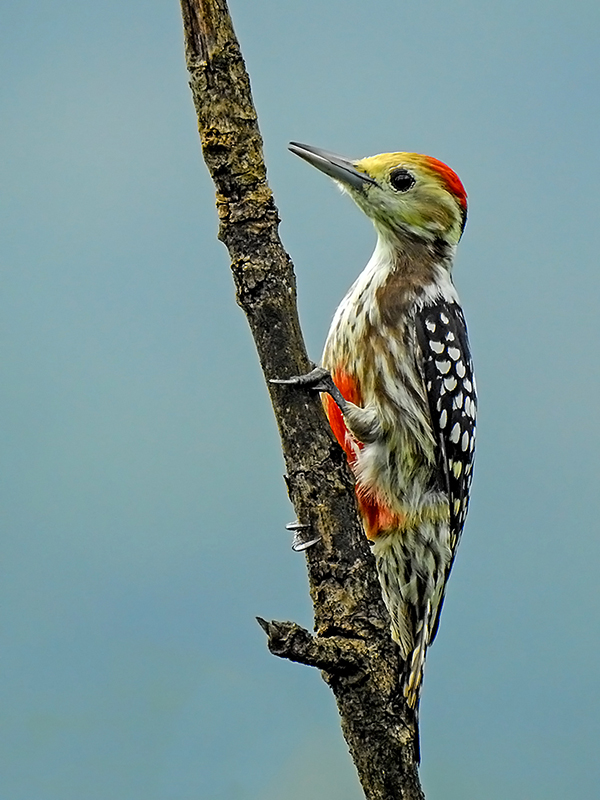
The Yellow-crowned Woodpecker is a small, striking bird, typically measuring around 18 cm in length. Its most distinctive feature is the bright yellow crown on males, while females have a subtler buff-colored crown. The rest of its plumage is predominantly black and white, with a characteristic barred pattern on the back and wings. The underparts are white with black spotting, which can vary in intensity among individuals.
Juveniles resemble adults but exhibit less vivid coloration, particularly on the crown, which is more buff in young males. Both sexes boast a short, chisel-like bill ideal for foraging insects beneath bark. In flight, the Yellow-crowned Woodpecker displays a distinctive bounding motion typical of woodpeckers, alternating between rapid wingbeats and short glides.
This species might be confused with the Brown-capped Pygmy Woodpecker, especially in regions where their ranges overlap. However, the Yellow-crowned Woodpecker can be distinguished by its brighter crown and more pronounced barring. Its perching posture is often upright on tree trunks, sometimes moving in a spiral manner as it searches for food.
Having trouble telling birds apart? Upload a photo to our bird identification tool for an instant species match.
Yellow-crowned Woodpecker Habitat and Range
Preferred Habitat
The Yellow-crowned Woodpecker inhabits a range of environments, from the humid evergreen forests of the Western Ghats to the dry deciduous forests of the Deccan Plateau. It is also found in open woodlands and scrub areas, adapting well to secondary growth and plantations. This adaptability allows it to thrive at various elevations, from sea level up to 1,800 meters. While primarily a forest bird, the Yellow-crowned Woodpecker can occasionally be spotted in urban parks and gardens, where trees are abundant.
Seasonal habitat shifts are minimal, yet in winter, the species might move to lower elevations, favoring areas with ample food supply. Despite its adaptability, the Yellow-crowned Woodpecker is less common in areas where extensive deforestation has occurred, highlighting the importance of forested habitats for its survival.
Geographic Range
The Yellow-crowned Woodpecker's range extends across the Indian subcontinent, predominantly within India, but it is also found in parts of Pakistan, Nepal, and Bangladesh. Its breeding grounds are widespread, primarily in the Western Ghats, central India, and the lower Himalayan foothills. The species is non-migratory, with minor altitudinal movements in response to seasonal changes in food availability.
In terms of population density, the Yellow-crowned Woodpecker is relatively abundant in the Western Ghats and central India's forested regions. Conversely, it is less common in the dry northwest, where suitable habitats are fragmented. This woodpecker's preference for specific forest types means its presence is a reliable indicator of habitat quality within its range.
Want to know which birds visit your area? Browse our backyard birds by location guides for region-specific species lists.
What Does the Yellow-crowned Woodpecker Eat?
The diet of the Yellow-crowned Woodpecker primarily consists of insects, which it skillfully extracts from tree bark using its strong beak. Ants and beetle larvae form the bulk of its diet, although it occasionally consumes other arthropods. During the breeding season, the woodpecker's diet may shift slightly to include more larval forms, providing the necessary protein for growing chicks.
Foraging techniques involve pecking and probing, often seen scaling tree trunks in a spiral fashion. The woodpecker uses its stiff tail feathers for support against the tree surface. Occasionally, it will glean insects from foliage, showcasing its versatility in feeding methods. Feeding primarily occurs during daylight hours, with peak activity in the early morning and late afternoon.
Yellow-crowned Woodpecker Behavior and Social Structure
The Yellow-crowned Woodpecker exhibits a fascinating range of behaviors, particularly during the breeding season. Males become fiercely territorial, employing drumming and vocalizations to establish dominance and attract mates. Courtship involves mutual tapping and the presentation of potential nesting sites.
Socially, this species often joins mixed-species flocks outside the breeding season, benefiting from collective foraging and predator vigilance. Despite this, Yellow-crowned Woodpeckers generally forage alone or in pairs. Flocking behavior tends to occur more frequently in less densely forested areas, where food resources are patchier.
In response to predators, the Yellow-crowned Woodpecker relies on its cryptic plumage to remain inconspicuous. Its daily activities follow a diurnal pattern, with increased activity during cooler parts of the day. The woodpecker's adaptability in behavior underscores its resilience in varying environmental conditions.
Yellow-crowned Woodpecker Nesting and Reproduction
The Yellow-crowned Woodpecker constructs its nest by excavating a cavity in dead or decaying wood, typically in a tree trunk or large branch. This cavity provides a secure environment for egg-laying and chick development. Nesting sites are often selected in wooded areas, favoring trees with softer wood that facilitates excavation.
The clutch size typically ranges from three to five eggs, with both parents sharing responsibilities during the incubation period, which lasts about 11 to 14 days. After hatching, the altricial chicks remain in the nest for approximately 20 to 25 days before fledging. Parental roles are well-defined, with both the male and female involved in feeding the chicks and maintaining the nest.
Yellow-crowned Woodpeckers usually produce one brood per year, although in regions with prolonged favorable conditions, a second brood may occasionally occur. The choice of nesting site and careful parental care contribute significantly to the survival of the young.
Yellow-crowned Woodpecker Sounds and Vocalizations
The primary song of the Yellow-crowned Woodpecker consists of a series of sharp, metallic notes delivered in rapid succession. The rhythm is steady and can be likened to the sound of a small, distant drum roll. In addition to its song, the woodpecker produces a variety of calls, including a harsh 'kik' sound that serves as an alarm when predators are nearby.
During the dawn chorus, the Yellow-crowned Woodpecker's vocalizations are particularly prominent, contributing to the ambient sounds of the forest. These vocal signals play a crucial role in territory establishment and mate attraction. Compared to other woodpeckers, its calls are relatively higher pitched, aiding in their transmission through dense foliage.
Interesting Facts About the Yellow-crowned Woodpecker
- 1The Yellow-crowned Woodpecker's drumming can communicate territory boundaries over long distances, up to 2 kilometers.
- 2While primarily insectivorous, the Yellow-crowned Woodpecker occasionally feeds on the sap of certain tree species.
- 3Unlike many woodpeckers, the Yellow-crowned Woodpecker can adapt to urban environments, often seen in city parks.
- 4Each Yellow-crowned Woodpecker pair excavates a new nest cavity each year, providing habitats for other species.
- 5The species is named for the bright yellow feathers on the male's head, which is a key distinguishing feature.
- 6Yellow-crowned Woodpeckers contribute to forest health by controlling pest insect populations naturally.
- 7Their presence in a forest is an indicator of ecological health due to their reliance on mature trees for nesting.
Yellow-crowned Woodpecker Conservation Status
The Yellow-crowned Woodpecker is currently classified as Least Concern by the IUCN, with population trends considered stable. However, habitat destruction due to deforestation and land-use changes poses a significant threat. Conservation efforts focus on habitat preservation, particularly in biodiversity-rich regions like the Western Ghats. Over the past century, some localized populations have experienced declines due to urban expansion and agricultural development. Initiatives aimed at protecting forest habitats and promoting sustainable land use are crucial for ensuring the long-term survival of this species. Education and awareness programs also emphasize the ecological importance of retaining natural forest cover.
Other Picidae Species


Birds Similar to the Yellow-crowned Woodpecker
These species are often confused with the Yellow-crowned Woodpecker due to similar appearance or overlapping range.
