
Yellow-legged Tinamou
Crypturellus noctivagus
Order: Tinamiformes / Family: Tinamidae
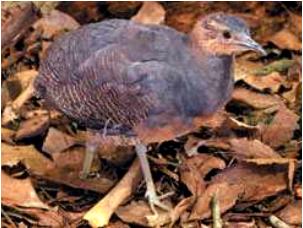
Wikimedia Commons
About the Yellow-legged Tinamou
The Yellow-legged Tinamou, or Crypturellus noctivagus, is a terrestrial bird native to South America, particularly prevalent in Brazil's Atlantic Forest. This species plays a crucial role in seed dispersal, contributing to forest regeneration and biodiversity. As a member of the Tinamidae family, it shares ancient lineage with ratites, though it possesses the capability of flight unlike its larger relatives. Observers often find this bird elusive due to its preference for dense forest undergrowth, where it forages for seeds, fruits, and small invertebrates. The Yellow-legged Tinamou exhibits seasonal behavior, becoming more vocal during the breeding season, which typically aligns with the wet season in its native range. Its calls, often heard at dawn and dusk, serve as a means of communication between mates and to delineate territory. The species' significance extends beyond its ecological role; it is also an indicator of forest health, as it thrives in primary and well-conserved secondary forests. Its presence in a particular area can suggest a relatively intact ecosystem. Despite its elusive nature, the Yellow-legged Tinamou is occasionally observed near forest edges, particularly in the mornings and late afternoons when it is most active. Human activity, including deforestation and habitat fragmentation, poses significant threats to its population. However, conservation efforts aimed at preserving the Atlantic Forest's biodiversity indirectly support the conservation of the Yellow-legged Tinamou. In conclusion, this bird not only enriches South America's avian diversity but also serves as a vital component of its forest ecosystems.
The Yellow-legged Tinamou belongs to the family Tinamidae, within the order Tinamiformes. These birds typically live average 8 years, max recorded 12 years.
How to Identify a Yellow-legged Tinamou
The adult Yellow-legged Tinamou is characterized by its cryptic brown and gray plumage, which provides excellent camouflage in the forest floor litter. Its most distinctive feature, as implied by its name, is its bright yellow legs, which contrast with its otherwise subdued coloration. Males and females are similar in appearance, but females are slightly larger. Juveniles resemble adults but have a duller overall coloration and less distinct leg coloration. Compared to similar species like the Brown Tinamou, the Yellow-legged Tinamou's yellow legs aid in quick identification. In flight, this bird exhibits a rapid, direct flight pattern with short bursts of flapping followed by gliding. On the ground, it maintains a low profile posture, often crouching as it forages or moves stealthily through the underbrush. Its tendency to remain still when threatened can make spotting this bird a challenge for even the most experienced birders.
Having trouble telling birds apart? Upload a photo to our bird identification tool for an instant species match.
Yellow-legged Tinamou Habitat and Range
Preferred Habitat
The Yellow-legged Tinamou inhabits the tropical and subtropical moist broadleaf forests of southeastern Brazil. It thrives in the understory of primary forests and well-preserved secondary forests, favoring areas with dense vegetation. The bird is typically found at elevations ranging from sea level to 1,200 meters. Seasonal shifts do not significantly affect its choice of habitat, as it remains a year-round resident of forest environments. While it occasionally ventures to forest edges, it is rarely found in open areas or urban settings, preferring the cover and resources provided by forest habitats. Conservation of these habitats is critical, as deforestation poses a significant threat to the species' survival.
Geographic Range
The breeding range of the Yellow-legged Tinamou is primarily confined to southeastern Brazil, extending from the southern part of Bahia to northern Rio Grande do Sul. It does not engage in long-distance migrations, instead maintaining a relatively localized presence within this range throughout the year. Population density is highest in protected forest reserves where habitat conditions are ideal. Outside of Brazil, the species is rarely observed, making it a focal point for Brazilian conservation efforts. The bird's preference for specific forested regions underscores its vulnerability to habitat loss.
Want to know which birds visit your area? Browse our backyard birds by location guides for region-specific species lists.
What Does the Yellow-legged Tinamou Eat?
The diet of the Yellow-legged Tinamou primarily consists of seeds and fruits, supplemented by small invertebrates such as insects and snails. During the wet season, when fruits and insects are abundant, its diet shifts to take advantage of these resources. Foraging occurs predominantly on the ground, where the bird uses its bill to probe the leaf litter and soil. Prey sizes vary, but the bird typically consumes items small enough to swallow whole. Feeding activity peaks during the cooler hours of early morning and late afternoon, aligning with the bird's overall activity patterns. This dietary adaptability is crucial for survival in the dynamic forest environment.
Yellow-legged Tinamou Behavior and Social Structure
The Yellow-legged Tinamou exhibits solitary or paired behavior, with pairs forming during the breeding season. It is generally not a social bird and does not form flocks outside of familial groups. Territorial behavior is pronounced during the breeding season, with males vocalizing to establish and maintain territory boundaries. Courtship involves vocal displays and subtle physical maneuvers, with males often taking the lead in these interactions. When threatened by predators, the bird relies on its cryptic coloring and stillness to avoid detection rather than fleeing. Its daily activity patterns are crepuscular, with heightened activity during dawn and dusk, minimizing exposure during the heat of the day.
Yellow-legged Tinamou Nesting and Reproduction
The nesting strategy of the Yellow-legged Tinamou is ground-based, with nests typically hidden among dense vegetation or within natural depressions on the forest floor. The nest itself is simple, consisting of a shallow scrape lined with leaves and other plant material. The female lays a clutch of 3 to 5 eggs, which are smooth and glossy, often with a pale blue or greenish tint. Incubation duties are primarily undertaken by the male, lasting approximately 16 to 20 days. After hatching, chicks are precocial, leaving the nest shortly after and following the male parent, who continues to provide protection and guidance until they are independent. Typically, the species produces one brood per year, though environmental conditions can influence reproductive success.
Yellow-legged Tinamou Sounds and Vocalizations
The primary vocalization of the Yellow-legged Tinamou is a series of low, resonant whistles, often described as haunting or mournful. These calls are most frequently heard during the early morning and late evening, serving both territorial and mate-attracting functions. Alarm calls are sharp and brief, alerting nearby birds to potential threats. Unlike some more vocal species, the Yellow-legged Tinamou does not participate in a complex dawn chorus, instead relying on these simple yet effective calls to communicate.
Interesting Facts About the Yellow-legged Tinamou
- 1The Yellow-legged Tinamou is one of the few birds that can boast a lineage close to ancient flightless birds like the ostrich.
- 2Despite its ability to fly, the Yellow-legged Tinamou prefers to run to escape danger, using its strong legs.
- 3The Yellow-legged Tinamou's call can carry over long distances, making it a key communication tool in dense forests.
- 4This species has a unique role in seed dispersal, aiding in the regeneration of its forest habitat.
- 5The Yellow-legged Tinamou's eggs are among the most colorful of any bird, with a glossy, vibrant appearance.
Yellow-legged Tinamou Conservation Status
The Yellow-legged Tinamou is currently listed as Near Threatened by the IUCN, with its population trend showing a decline due to habitat destruction and fragmentation. The primary threats to its survival include deforestation for agriculture and urban development in its native range. Conservation efforts focus on habitat preservation, particularly within Brazil's Atlantic Forest, where protected areas offer some refuge. Historical population declines correlate strongly with the loss of forest cover, highlighting the importance of sustainable land management practices in reversing these trends.


