
Abbott's Starling
Poeoptera femoralis
Order: Passeriformes / Family: Sturnidae
Wikimedia Commons
About the Abbott's Starling
Abbott's Starling (Poeoptera femoralis) is a fascinating avian species belonging to the Sturnidae family, which includes various starlings and mynas. This rare bird is endemic to the montane regions of East Africa, specifically in Kenya and Tanzania. In these regions, Abbott's Starling plays a significant role in the ecosystem, primarily through seed dispersal and insect population control. Its existence aids in maintaining the health and diversity of the montane forest habitats.
This bird is often found within the dense canopy of these forests, where it forages for insects and fruits. The montane forests, characterized by cooler temperatures and high humidity, provide the ideal environment for the Abbott's Starling. The bird's preference for such habitats makes it less adaptable to changes in climate and deforestation, factors that threaten its survival.
Abbott's Starling is crucial in maintaining the ecological balance within its habitat. It facilitates forest regeneration by dispersing seeds over wide areas. Additionally, its insectivorous diet helps control insect populations, which can become pests if left unchecked. The seasonal behaviors of Abbott's Starling are closely tied to the availability of food resources. During certain times of the year, when fruit is abundant, the starling's diet shifts more towards frugivory, while at other times, it relies heavily on insects.
The bird's limited range and specific habitat requirements make it a species of significant conservation concern. Deforestation and habitat fragmentation pose ongoing threats, underscoring the need for focused conservation efforts. Protecting the montane forests of East Africa is crucial not only for the Abbott's Starling but also for the myriad other species that rely on these unique ecosystems.
The Abbott's Starling belongs to the family Sturnidae, within the order Passeriformes. These birds typically live average 5-7 years, max recorded 9 years.
How to Identify a Abbott's Starling
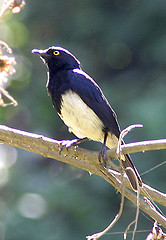
Abbott's Starling is a medium-sized songbird, easily identifiable by its glossy black plumage with a bluish sheen. This starling exhibits sexual monomorphism, meaning males and females appear similar in the field. Adult birds have a distinctive white vent and under-tail coverts, contrasting sharply with their dark body.
Juvenile Abbott's Starlings, in contrast, exhibit duller plumage with less pronounced sheen and more brownish tones on their feathers. This differentiation in plumage can aid birders in distinguishing between adults and immatures. In flight, the starling's broad wings and short tail are noticeable, along with its direct and swift flight pattern.
One could confuse Abbott's Starling with other members of the starling family, though its predominantly black plumage and habitat preference set it apart. When perched, it maintains an upright posture, often seen in small groups or pairs. Its vocalizations, distinct from other starlings, also assist in identification.
Having trouble telling birds apart? Upload a photo to our bird identification tool for an instant species match.
Abbott's Starling Habitat and Range
Preferred Habitat
Abbott's Starling thrives in the montane forests of East Africa, particularly within Kenya and Tanzania. These forests, situated at elevations ranging from 1,800 to over 2,500 meters, provide the necessary canopy cover and food resources that the starlings require.
The bird's reliance on these specific habitats makes it less adaptable to urban environments or open landscapes. Seasonal shifts in habitat use are minimal, given the bird's dependence on montane forests throughout the year. However, slight movements may occur in response to food availability, especially during fruiting seasons.
The dense canopy and understory of the montane forests offer protection from predators and a rich diversity of food resources, including fruits and insects. Abbott's Starling is rarely found in disturbed or deforested areas, highlighting the importance of preserving intact forest ecosystems for its survival.
Geographic Range
The range of Abbott's Starling is restricted to the montane regions of East Africa. It is primarily found in central and southern Kenya, as well as northern Tanzania. These areas encompass some of the continent's most biodiverse montane forests, where the starling is a resident species.
Unlike many other starlings, Abbott's Starling does not undertake long-distance migrations. Instead, it remains within its breeding territory throughout the year, with only minor local movements. These movements are typically in response to food availability rather than seasonal climate changes.
Population density hotspots for Abbott's Starling are closely associated with intact montane forest areas. The bird is absent from lower elevations and significantly disturbed habitats, emphasizing the need for conservation measures in its limited range.
Want to know which birds visit your area? Browse our backyard birds by location guides for region-specific species lists.
What Does the Abbott's Starling Eat?
Abbott's Starling primarily feeds on a diet of fruits and insects, utilizing its environment's rich biodiversity. During the fruiting season, the starling consumes a variety of fruits, aiding in seed dispersal and contributing to the regeneration of the forest.
Insects form a significant part of the bird's diet, especially when fruit is scarce. Abbott's Starling employs a foraging technique characterized by gleaning insects from foliage, branches, and sometimes the forest floor. This opportunistic feeding behavior allows it to exploit various food sources throughout the year.
The starling’s feeding schedule is primarily diurnal, with peak activities occurring in the early morning and late afternoon. It tends to forage in small groups, increasing efficiency and providing safety from potential predators.
Abbott's Starling Behavior and Social Structure
Abbott's Starling exhibits social behavior, often found in small flocks or pairs. These groups maintain territories within the montane forests, which they defend from intruders, particularly during the breeding season.
Courtship displays in Abbott's Starling involve both vocalizations and visual demonstrations, with males showcasing their plumage and engaging in aerial displays to attract females. Pair bonds are generally strong, and these birds may remain with the same mate across multiple breeding seasons.
The starling's response to predators includes alarm calls and mobbing behavior, often enlisting the aid of other birds in the vicinity. Daily activity patterns show a peak in morning and late afternoon foraging, with midday often spent resting or engaging in preening activities within the canopy.
Abbott's Starling Nesting and Reproduction
Abbott's Starling nests in tree cavities, often utilizing natural hollows or those created by other species. The nest construction involves the use of twigs, leaves, and grasses, providing a soft lining for the eggs.
The typical clutch size ranges from two to four eggs, with both parents involved in incubation and feeding duties. Incubation lasts approximately 14 days, after which the chicks hatch, requiring extensive parental care.
Fledging occurs about three weeks post-hatching, with young birds remaining dependent on their parents for several weeks thereafter. Abbott's Starling usually raises one brood per year, though favorable conditions may allow for a second.
Abbott's Starling Sounds and Vocalizations
The primary song of Abbott's Starling is a series of melodious whistles and trills, delivered with a rhythm that varies between individuals. The pitch remains relatively constant, providing a recognizable audio signature in the dense forest.
Call notes are sharp and piercing, often used in communication between flock members or as alarm signals. During the dawn chorus, Abbott's Starling participates actively, contributing to the forest's symphony with its clear and vibrant song.
Alarm calls are harsher, designed to alert conspecifics and other species to the presence of potential threats. These vocalizations play a crucial role in the bird's social structure and territorial defense.
Interesting Facts About the Abbott's Starling
- 1Abbott's Starling was first described in 1893 by the British ornithologist Richard Bowdler Sharpe.
- 2Despite being a songbird, Abbott's Starling's vocalizations are more subdued compared to other starlings.
- 3The bird's limited range makes it one of the lesser-known members of the starling family.
- 4Abbott's Starling's role in seed dispersal helps maintain the biodiversity of its forest habitat.
- 5This starling can be elusive, often remaining high in the forest canopy, making sightings rare.
- 6The species was named in honor of William Louis Abbott, an American naturalist and explorer.
- 7Abbott's Starling's population is estimated to be fewer than 10,000 mature individuals.
Abbott's Starling Conservation Status
Abbott's Starling is currently classified as Vulnerable on the IUCN Red List. Population trends indicate a decrease, mainly due to habitat loss from deforestation and land conversion for agriculture. Conservation efforts focus on protecting the remaining montane forest habitats in East Africa. These efforts include establishing protected areas and promoting sustainable land-use practices. The historical population of Abbott's Starling has suffered from human-induced changes to its environment, necessitating immediate conservation actions to prevent further declines.
Other Sturnidae Species


Birds Similar to the Abbott's Starling
These species are often confused with the Abbott's Starling due to similar appearance or overlapping range.

