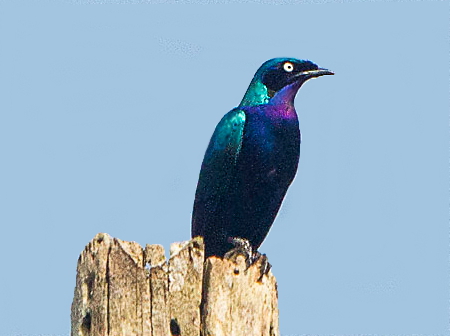
Superb Starling
Lamprotornis superbus
Order: Passeriformes / Family: Sturnidae

Wikimedia Commons
About the Superb Starling
The Superb Starling, scientifically known as Lamprotornis superbus, is a striking member of the Sturnidae family, renowned for its iridescent plumage that shimmers in the sunlight. Found predominantly in East Africa, the bird graces countries such as Kenya, Tanzania, Uganda, and Ethiopia with its presence. The Superb Starling thrives in open woodlands, savannas, and scrublands, frequently seen near human settlements where it readily adapts to cultivated lands and gardens. Its ecological role is significant as it participates actively in controlling insect populations, thus contributing to the balance of its ecosystem. Moreover, the Superb Starling is often involved in seed dispersal, facilitating plant propagation across its habitat. Seasonally, these birds exhibit minor movements, often dictated by rainfall patterns which influence food availability. During the breeding season, they gather in larger numbers, displaying a fascinating social structure that includes cooperative breeding, where non-breeding individuals assist in raising the young. This adaptability and resilience highlight the Superb Starling's importance in its native regions, where it remains a common sight and a subject of interest for both locals and visitors.
The Superb Starling belongs to the family Sturnidae, within the order Passeriformes. These birds typically live typically 5-8 years, with some living up to 10 years in the wild..
How to Identify a Superb Starling
The Superb Starling is easily identifiable by its vibrant plumage, which features a striking combination of metallic blue-green upperparts and orange underparts. Its white chest band creates a clear demarcation between the two colors. Both males and females share this vivid coloration, making sexual dimorphism minimal. Juveniles, however, display duller plumage with less iridescence and more muted colors. In flight, the Superb Starling presents a compact silhouette, with short, rounded wings and a slightly squared tail. Its straight bill and upright posture while perching further distinguish it from similar species. The Hildebrandt's Starling, another resident of East Africa, can be confused with the Superb Starling but lacks the white chest band and has a more pronounced orange eye. Observing these key field marks can aid in the correct identification of the Superb Starling in its natural habitat.
Having trouble telling birds apart? Upload a photo to our bird identification tool for an instant species match.
Superb Starling Habitat and Range
Preferred Habitat
The Superb Starling inhabits a variety of environments across East Africa. It is most commonly found in open woodlands, savannas, and scrublands, thriving at elevations ranging from sea level to around 2000 meters. In addition to these natural habitats, the bird has adapted to urban areas, frequently foraging in gardens, parks, and cultivated lands. During the dry season, the Superb Starling may shift to areas where water and food sources are more abundant, often moving closer to human settlements. This adaptability to both rural and urban environments underscores its resilience and ability to coexist with human populations.
Geographic Range
The Superb Starling's range encompasses a significant portion of East Africa, with its distribution extending across countries such as Kenya, Tanzania, Uganda, and Ethiopia. It is a resident species, meaning it does not undergo long-distance migrations but may exhibit local movements in response to environmental conditions such as rainfall. The bird prefers regions with adequate food supply and nesting opportunities, often leading to higher population densities in areas where these resources are plentiful. The Rift Valley, with its diverse habitats and abundant resources, serves as a prime location for observing these birds year-round.
Want to know which birds visit your area? Browse our backyard birds by location guides for region-specific species lists.
What Does the Superb Starling Eat?
Superb Starlings have a varied diet composed primarily of insects such as beetles, grasshoppers, and caterpillars. They also consume fruits, seeds, and grains, especially during seasons when insects are less abundant. Their foraging technique involves searching on the ground, turning over leaf litter, and probing into crevices to locate food. These birds often feed in flocks, which can include a mix of adult and juvenile starlings, optimizing their foraging efficiency. The Superb Starling's diet changes seasonally, with a heavier reliance on fruits during the dry season. This flexibility in diet allows the bird to thrive in a range of environments.
Superb Starling Behavior and Social Structure
The Superb Starling exhibits complex social structures, often forming large flocks that contribute to its dynamic behavior. It is a colonial breeder, with groups of starlings nesting in close proximity and engaging in cooperative breeding practices. Non-breeding individuals, or helpers, assist in raising the offspring by feeding them and protecting the nest. During courtship, males perform elaborate displays, including singing and wing-fluttering, to attract females. The Superb Starling is diurnal, being most active during the early morning and late afternoon. When faced with predators, these starlings often mob the threat collectively, demonstrating their communal defense strategies.
Superb Starling Nesting and Reproduction
Superb Starlings build their nests in tree holes or crevices, often reusing old nests of woodpeckers or barbets. The nest is constructed using grass, twigs, and other plant materials, lined with softer substances like feathers and wool. A typical clutch consists of 3 to 5 eggs, which are pale blue with brown speckles. Both parents participate in incubating the eggs for about 12 to 14 days. After hatching, the chicks are altricial and require constant feeding and care. The fledging period lasts approximately three weeks, during which the young birds remain in the nest. Superb Starlings typically raise two broods per year, capitalizing on favorable environmental conditions.
Superb Starling Sounds and Vocalizations
The Superb Starling's song is a melodious mixture of whistles, trills, and clicks, characterized by its rhythmic and varied pitch. These complex vocalizations serve both to attract mates and to communicate within flocks. The call notes are sharp and metallic, often used as contact calls between individuals. Alarm calls, in contrast, are more urgent and harsh, alerting the flock to potential dangers. During the dawn chorus, Superb Starlings are particularly vocal, contributing to the vibrant soundscape of their habitats. Their vocal repertoire is extensive, making them one of the more acoustically engaging species in their range.
Interesting Facts About the Superb Starling
- 1The Superb Starling is one of the few starling species that engage in cooperative breeding, with up to 15 helpers aiding a single breeding pair.
- 2This starling's iridescent plumage results from microscopic structures in the feathers, causing light to refract and create vibrant colors.
- 3Superb Starlings can form flocks of several hundred individuals, enhancing their ability to find food and protect against predators.
- 4These birds have adapted to urban areas, often seen foraging in gardens and taking advantage of human food resources.
- 5Superb Starlings are known for their intricate vocalizations, capable of mimicking sounds from their environment.
- 6Unlike many birds, Superb Starlings do not migrate over long distances, but they may move locally in response to seasonal changes.
- 7The species plays a crucial role in controlling insect populations, acting as a natural pest management system.
Superb Starling Conservation Status
The Superb Starling is currently classified as Least Concern by the IUCN, with stable population trends across its range. Its adaptability to various habitats, including human-altered landscapes, has contributed to its widespread presence. However, habitat destruction and changes in land use pose potential threats to localized populations. Conservation efforts focus on habitat preservation and mitigating the impacts of agricultural expansion. Historically, the Superb Starling has maintained robust numbers, benefiting from its ecological versatility and cooperative breeding strategies.
Other Sturnidae Species


Birds Similar to the Superb Starling
These species are often confused with the Superb Starling due to similar appearance or overlapping range.