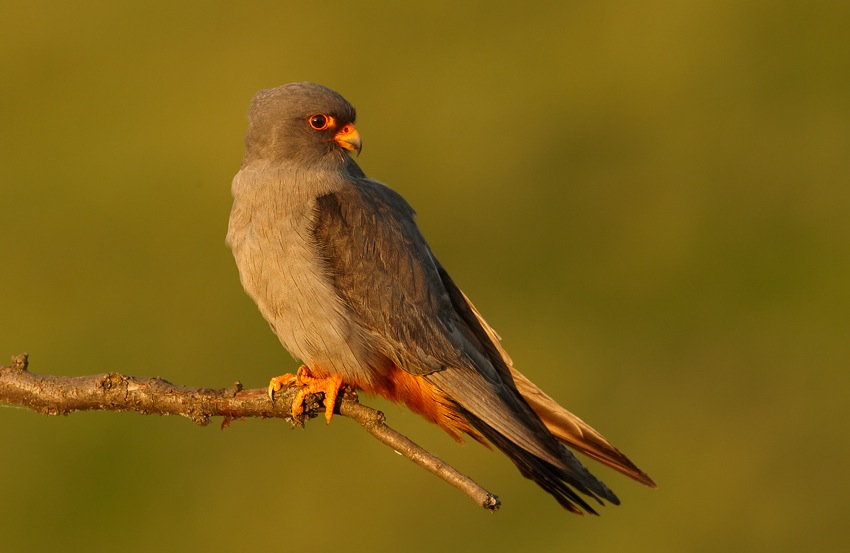
African Hobby
Falco cuvierii
Order: Falconiformes / Family: Falconidae

Wikimedia Commons
About the African Hobby
The African Hobby, scientifically known as Falco cuvierii, is a small falcon that boasts remarkable speed and agility, making it a master of aerial pursuits. This bird of prey is primarily found across sub-Saharan Africa and has carved a niche for itself as a highly adaptable hunter. Its ecological role as a predator helps maintain the balance of insect and small bird populations, thus playing a crucial role in its native ecosystems. Preferring habitats like savannas, open woodlands, and clearings, the African Hobby is a versatile species well-suited to a variety of landscapes. It is particularly prevalent in the Sahel region, stretching from Senegal and the Gambia in the west to Sudan and Ethiopia in the east. Unlike some falcons that migrate, many populations of the African Hobby are sedentary, though some exhibit local movements in response to environmental conditions or prey availability. Seasonally, this bird adapts its hunting tactics to the abundance of insect prey, particularly during the wet season when such food sources are plentiful. The African Hobby's significance extends beyond its role as a predator. It serves as an indicator of environmental health, with stable populations often reflecting a well-balanced ecosystem. Birders and naturalists alike find the African Hobby fascinating not only for its hunting prowess but also for its striking appearance and engaging behaviors. Despite its widespread presence, the African Hobby faces challenges from habitat destruction and pesticide use, which can impact both its prey availability and nesting sites. Conservation efforts aimed at preserving natural habitats and curbing pesticide usage are crucial to ensuring the continued survival of this charismatic raptor.
The African Hobby belongs to the family Falconidae, within the order Falconiformes. These birds typically live typically 10-12 years in the wild, with some living up to 18 years..
How to Identify a African Hobby
The African Hobby is a small falcon characterized by its slender build and long, pointed wings. Adult plumage is distinct, with a dark slate-grey back and wings contrasting sharply with its reddish-brown underparts. The throat and upper breast are paler, often featuring a subtle streaking pattern. Juveniles display a browner appearance with less pronounced coloration, making them more challenging to identify. Males and females of the species have similar plumage, although females tend to be slightly larger, a typical trait in birds of prey. When observing the African Hobby in flight, its silhouette is unmistakable. The long wings, rapid wingbeats, and swift, agile flight distinguish it from similar species such as the Eurasian Hobby or the Peregrine Falcon. Perched, the African Hobby maintains an upright posture, often scanning the surroundings for prey. While it shares some characteristics with other falcons, its unique color palette and flight style make it identifiable to the keen observer.
Having trouble telling birds apart? Upload a photo to our bird identification tool for an instant species match.
African Hobby Habitat and Range
Preferred Habitat
The African Hobby thrives in a range of habitats, primarily favoring open landscapes such as savannas, grasslands, and woodland edges. These environments provide ample hunting grounds for their insect and small bird prey. The species can also be found in agricultural areas, where its adaptability allows it to exploit human-altered landscapes. Typically, the African Hobby resides at lower elevations, though it can occasionally be found in higher terrain if prey availability is sufficient. Unlike many raptors, it shows a degree of tolerance for urban environments, occasionally spotted in towns and cities where green spaces offer hunting opportunities. Seasonal shifts in habitat are minimal for this species, as it tends to remain within its preferred territories year-round.
Geographic Range
The African Hobby's range extends across sub-Saharan Africa, absent only from the most arid or densely forested regions. Its breeding range includes countries such as Senegal, Nigeria, Kenya, and Tanzania. While some populations are resident, others exhibit slight migratory or nomadic behavior, particularly those in regions with marked dry and wet seasons. Migration corridors are typically localized, with movements triggered by shifts in prey abundance or environmental conditions. In West Africa, population hotspots include the savannas and open woodlands of Ghana and Côte d'Ivoire, while in East Africa, it is commonly seen in the Rift Valley and surrounding areas. The species is less common in the southernmost parts of Africa, although sightings do occur in northern Namibia and Botswana.
Want to know which birds visit your area? Browse our backyard birds by location guides for region-specific species lists.
What Does the African Hobby Eat?
The African Hobby's diet is diverse, primarily comprising insects and small birds. During the wet season, when insects are abundant, dragonflies and beetles become significant food sources. The falcon's impressive aerial skills enable it to capture insects mid-flight with remarkable precision. When bird prey is targeted, the African Hobby employs stealth and speed to outmaneuver its quarry, often capturing small passerines. Prey size typically ranges from large insects to birds the size of a sparrow. Feeding times are primarily during the early morning and late afternoon when prey activity peaks, though the hobby is known to hunt opportunistically throughout the day. Seasonal diet changes align with prey availability, showcasing the bird's adaptability to its environment.
African Hobby Behavior and Social Structure
The African Hobby exhibits a solitary or paired social structure outside of breeding season, with pairs often remaining together year-round. Territorial behavior is pronounced, particularly during the breeding season when the falcons defend nesting sites aggressively. Courtship displays involve spectacular aerial maneuvers, with males performing high-speed chases and presenting food to potential mates. These displays demonstrate both the male's prowess and his ability to provide. While not known to form large flocks, the African Hobby may gather in small groups where prey abundance is high. The species exhibits a cautious response to predators, relying on its speed to evade threats. Daily activity patterns include periods of intense hunting interspersed with rest, often perched in a vantage point with a clear view of its surroundings.
African Hobby Nesting and Reproduction
The African Hobby prefers to nest in trees, selecting sites that offer some protection and a good vantage point. Nests are often situated in the fork of a branch or on a ledge, generally reusing old nests constructed by other birds like crows or kites. The clutch size typically ranges from two to four eggs, with both parents sharing the responsibility of incubation, which lasts approximately 28 to 32 days. Once hatched, chicks fledge after about five to six weeks, during which time they remain dependent on their parents for food. The African Hobby usually produces one brood per year, although under favorable conditions, a second brood may be attempted.
African Hobby Sounds and Vocalizations
The African Hobby's vocalizations are varied but less prominent than those of many songbirds. Its primary call is a high-pitched, rapid series of notes, often described as 'kee-kee-kee,' used frequently during breeding season to communicate with mates or signal alarm. These calls are sharp and piercing, serving as effective communication over distance. While generally quiet, the African Hobby becomes more vocal when agitated or during courtship. Compared to the melodious songs of many avian species, its calls are more functional yet equally important in its behavioral repertoire.
Interesting Facts About the African Hobby
- 1The African Hobby can reach speeds of up to 160 km/h during hunting dives, making it one of the fastest birds in the world.
- 2Unlike many birds of prey, the African Hobby often hunts at dawn and dusk when its insect prey is most active.
- 3The African Hobby's diet is highly opportunistic, shifting between insects and small birds depending on seasonal availability.
- 4Breeding pairs of African Hobbies are known to reuse the same nest sites year after year, often refurbishing old nests.
- 5The African Hobby exhibits a unique hunting technique called 'hawking,' where it catches insects mid-flight.
- 6In urban areas, the African Hobby has adapted to hunting around streetlights, which attract insects at night.
- 7Despite its small size, the African Hobby is a formidable predator, capable of taking prey nearly its own size.
African Hobby Conservation Status
Currently, the African Hobby is listed as Least Concern by the IUCN, with populations considered stable across much of its range. However, localized threats such as habitat destruction and pesticide use can negatively impact certain populations. Conservation efforts primarily focus on habitat preservation and sustainable agricultural practices to ensure the availability of prey species. Historical population changes have been relatively minor, although ongoing monitoring is essential to detect any shifts in population dynamics. Despite its adaptability, the African Hobby's future depends on maintaining healthy ecosystems and mitigating human-induced threats.
Other Falconidae Species


Birds Similar to the African Hobby
These species are often confused with the African Hobby due to similar appearance or overlapping range.