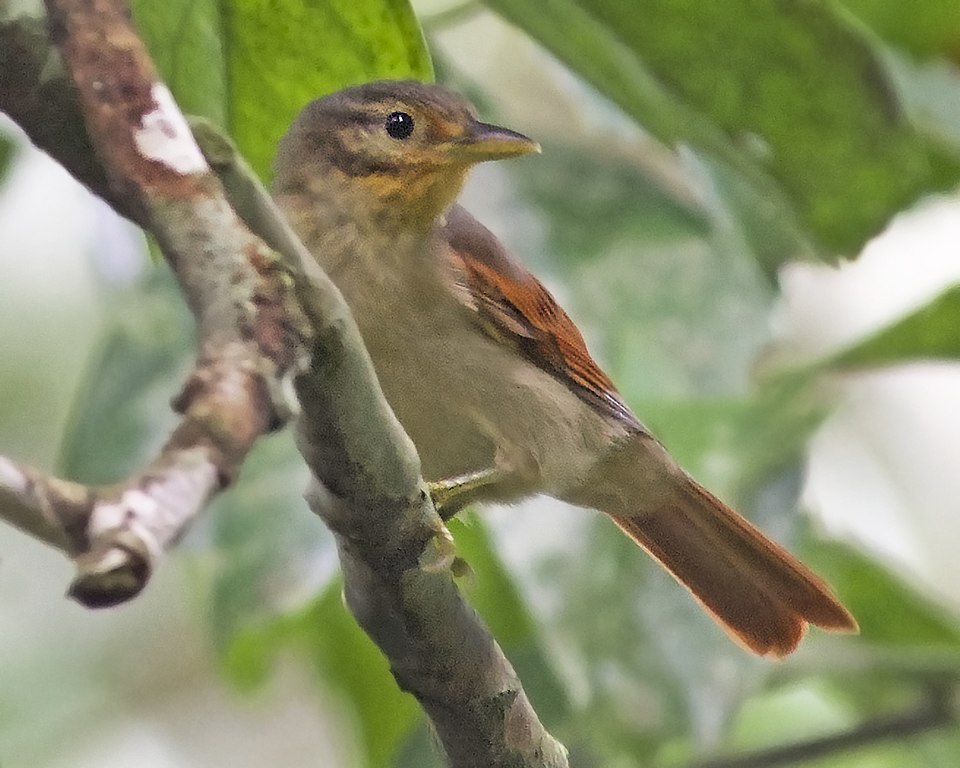
Alagoas Foliage-gleaner
Philydor novaesi
Order: Passeriformes / Family: Furnariidae

Wikimedia Commons
About the Alagoas Foliage-gleaner
The Alagoas Foliage-gleaner (Philydor novaesi) is a rare and critically endangered passerine belonging to the Furnariidae family, endemic to the Atlantic Forest of northeastern Brazil. This bird plays a pivotal role in its ecosystem by participating in the nutrient cycling of its forest habitat. Historically, it inhabited the humid forest regions of Alagoas and Pernambuco, where it thrived in areas rich with dense foliage and abundant insect life. Its ecological role as an insectivore helps control insect populations and contributes to the health of its forest environment. Unfortunately, due to extensive deforestation and habitat fragmentation, the Alagoas Foliage-gleaner has experienced a dramatic population decline. Its presence indicates a healthy, biodiverse forest ecosystem, making its conservation crucial. This species exhibits distinctive behaviors that reflect its adaptation to the forest environment. It is non-migratory, residing year-round in its native range, although its movement within these forests can be influenced by seasonal changes in food availability. The bird primarily engages in solitary foraging or in pairs, occasionally accompanying mixed-species flocks. The Alagoas Foliage-gleaner uses its strong, slightly curved bill to glean insects from foliage, a behavior which defines its common name. This foraging technique not only helps maintain the balance of insect populations but also aids in the dispersal of seeds and the breakdown of organic material, contributing to the nutrient cycle of the forest. Despite its small size, the Alagoas Foliage-gleaner has a significant impact on its ecosystem, highlighting the intricate connections between species and their environments in the Atlantic Forest.
The Alagoas Foliage-gleaner belongs to the family Furnariidae, within the order Passeriformes. These birds typically live typically 4-6 years, though little is known due to its rarity..
How to Identify a Alagoas Foliage-gleaner
Identifying the Alagoas Foliage-gleaner requires attention to its distinctive plumage and behavior. Adult Alagoas Foliage-gleaners possess a rich reddish-brown upper body, which blends seamlessly with the forest's leaf litter. Their underparts are paler, often a buff color, allowing them to remain inconspicuous among the branches. Juveniles are similar but exhibit slightly duller plumage, lacking the full vibrancy of adults. There is little sexual dimorphism, as both males and females share similar coloration and size. One might confuse the Alagoas Foliage-gleaner with related species such as the Buff-fronted Foliage-gleaner, but careful observation reveals that Philydor novaesi is smaller and lacks the contrasting buff forehead present in some relatives. In flight, the Alagoas Foliage-gleaner displays a short, rounded silhouette, with its tail often fanned slightly. When perched, it maintains a horizontal posture, frequently flicking its wings and tail as it searches for insects. This behavior, combined with its distinctive coloration, aids in its identification among the dense undergrowth of its forest habitat.
Having trouble telling birds apart? Upload a photo to our bird identification tool for an instant species match.
Alagoas Foliage-gleaner Habitat and Range
Preferred Habitat
The Alagoas Foliage-gleaner inhabits the Atlantic Forest, a biodiversity hotspot in northeastern Brazil. It favors lowland humid forests, particularly those with dense understory and abundant leaf litter. The bird typically resides at elevations ranging from sea level to about 500 meters. Seasonal shifts in habitat usage are minimal, as it is non-migratory, but local movements within the forest may occur in response to food availability. Though predominantly a forest dweller, the Alagoas Foliage-gleaner is occasionally found in secondary forests, provided they contain sufficient undergrowth. Urban and agricultural encroachment have significantly reduced its available habitat, making conservation of remaining forest patches critical for its survival.
Geographic Range
The Alagoas Foliage-gleaner is endemic to Brazil, specifically within the northeastern states of Alagoas and Pernambuco. Historically, it occupied a more extensive range within the Atlantic Forest, but its habitat has become increasingly fragmented. Its current distribution is limited to a few isolated forest patches, where population densities are extremely low. The bird does not migrate, and its range does not expand or shift seasonally, making it particularly vulnerable to habitat loss. Regular surveys and conservation efforts focus on these remaining habitats, aiming to protect and restore the forest areas essential for its survival.
Want to know which birds visit your area? Browse our backyard birds by location guides for region-specific species lists.
What Does the Alagoas Foliage-gleaner Eat?
The Alagoas Foliage-gleaner feeds primarily on insects and other arthropods, which it skillfully extracts from leaves and branches. Its diet includes small beetles, caterpillars, and spiders, with occasional consumption of other invertebrates. Seasonal changes may influence the availability of specific prey, but the bird remains an insectivore year-round. It employs a unique foraging technique known as leaf-gleaning, where it uses its bill to flip over leaves and inspect crevices for hidden insects. This method allows it to exploit a niche within the forest ecosystem, specializing in areas often overlooked by other bird species. The Alagoas Foliage-gleaner typically forages alone or in pairs, but it may join mixed-species flocks during periods of food scarcity, enhancing its foraging efficiency.
Alagoas Foliage-gleaner Behavior and Social Structure
The Alagoas Foliage-gleaner exhibits intriguing behavioral patterns within its forest environment. It is generally solitary or pairs with a mate, displaying a strong territorial instinct. While it defends its territory vigorously from intruders, it also shows a degree of social tolerance, occasionally joining mixed-species flocks. Courtship behavior involves mutual preening and soft vocalizations, strengthening pair bonds. During the day, this bird actively forages, dedicating much of its time to searching for insects. Its foraging activity peaks in the early morning and late afternoon, with a noticeable lull during midday. Despite its small size, the Alagoas Foliage-gleaner displays pugnacious behavior when confronted by predators. It issues sharp alarm calls and engages in distraction displays to protect its nest and territory. The bird's daily routine is closely tied to its forest habitat, relying on the dense foliage for both foraging and protection.
Alagoas Foliage-gleaner Nesting and Reproduction
The nesting habits of the Alagoas Foliage-gleaner reflect its adaptation to the forest environment. It constructs its nest in the form of a cup, using materials like twigs, leaves, and moss, often placed in a well-hidden location. Preferred nest sites include tree cavities or dense foliage, providing both security and camouflage. The typical clutch size consists of two to three eggs, which both parents incubate for approximately 17 to 19 days. After hatching, the chicks remain in the nest for about 22 days before fledging. Both male and female parents share responsibilities in feeding and caring for the young. The Alagoas Foliage-gleaner usually raises one brood per year, although favorable conditions may occasionally permit a second. Nesting success is closely linked to habitat quality, with increased predation and environmental pressures posing significant threats.
Alagoas Foliage-gleaner Sounds and Vocalizations
The Alagoas Foliage-gleaner's vocalizations are subtle yet distinctive. Its primary song consists of a series of soft, melodic whistles, delivered at a moderate pace with varying pitch. These whistles serve as both contact calls and territorial signals. Calls include short, sharp notes used for communication between mates or to alert others of potential threats. Alarm calls are more urgent and rapid, often accompanied by agitated movements. During the dawn chorus, the Alagoas Foliage-gleaner participates by joining other forest birds in a symphony of sound, though its contribution remains gentle and understated. Its vocal repertoire reflects its secretive nature, with sounds that blend harmoniously into the forest background.
Interesting Facts About the Alagoas Foliage-gleaner
- 1The Alagoas Foliage-gleaner was first described in 1983, making it a relatively recent discovery in ornithology.
- 2Though small, the Alagoas Foliage-gleaner has a significant impact on insect populations, acting as a natural pest control.
- 3This bird has one of the smallest known ranges of any bird species, limited to a few forest patches in Brazil.
- 4Despite its critical status, the Alagoas Foliage-gleaner was once thought to be a subspecies of the Buff-fronted Foliage-gleaner.
- 5The bird's specialized foraging behavior inspired its common name, emphasizing its role in leaf litter ecosystems.
- 6The Alagoas Foliage-gleaner is part of the diverse Furnariidae family, known for its varied and unique ecological roles.
- 7Efforts to conserve the Atlantic Forest habitat are essential not only for birds like the Alagoas Foliage-gleaner but also for numerous other endemic species.
Alagoas Foliage-gleaner Conservation Status
The IUCN lists the Alagoas Foliage-gleaner as critically endangered, with its population continuing to decline. The primary threat to its survival is habitat loss due to deforestation and agricultural expansion. Conservation efforts focus on protecting and restoring the Atlantic Forest, with initiatives to establish protected areas and promote sustainable land use. Historical population changes underscore the urgency of these efforts, as the Alagoas Foliage-gleaner once occupied a broader range. Conservation programs also aim to increase awareness and involve local communities in preserving this unique species. The bird's plight serves as a poignant reminder of the impact of human activities on biodiversity.
Other Furnariidae Species


Birds Similar to the Alagoas Foliage-gleaner
These species are often confused with the Alagoas Foliage-gleaner due to similar appearance or overlapping range.