
Chestnut-winged Foliage-gleaner
Philydor erythropterum
Order: Passeriformes / Family: Furnariidae
Wikimedia Commons
About the Chestnut-winged Foliage-gleaner
The Chestnut-winged Foliage-gleaner (Philydor erythropterum), a member of the Furnariidae family, plays a critical role in the ecology of tropical forests due to its insectivorous diet and foliage-gleaning behavior. This bird thrives in the humid, shaded understories of primary and secondary forests, predominantly in the Amazon Basin, spanning countries like Brazil, Peru, and Bolivia. Its presence indicates a healthy, biodiverse ecosystem, as it relies on intact forest structure for foraging. Unlike some of its avian counterparts, the Chestnut-winged Foliage-gleaner exhibits a strong preference for undisturbed habitats, making it a potential indicator species for conservation efforts. This bird also contributes to pest control by consuming insects that could otherwise proliferate in these regions. During the rainy season, when insect populations surge, the Chestnut-winged Foliage-gleaner becomes particularly active, taking advantage of the abundance of food. Seasonal behaviors include subtle shifts in foraging patterns as the bird adapts to fluctuating insect availability. Additionally, its role extends to seed dispersal, albeit indirectly, as it disturbs leaf litter, aiding in the germination of certain plant species. The Chestnut-winged Foliage-gleaner's adaptability to seasonal changes highlights its ecological significance. As a resident species, it does not undergo long migrations, instead adjusting its range locally in response to environmental variables. These adaptations underscore the bird's ability to maintain its niche within the forest ecosystem, making it a fascinating subject for ornithologists and conservationists alike.
The Chestnut-winged Foliage-gleaner belongs to the family Furnariidae, within the order Passeriformes. These birds typically live averages around 5-8 years, with some individuals reaching up to 9 years..
How to Identify a Chestnut-winged Foliage-gleaner
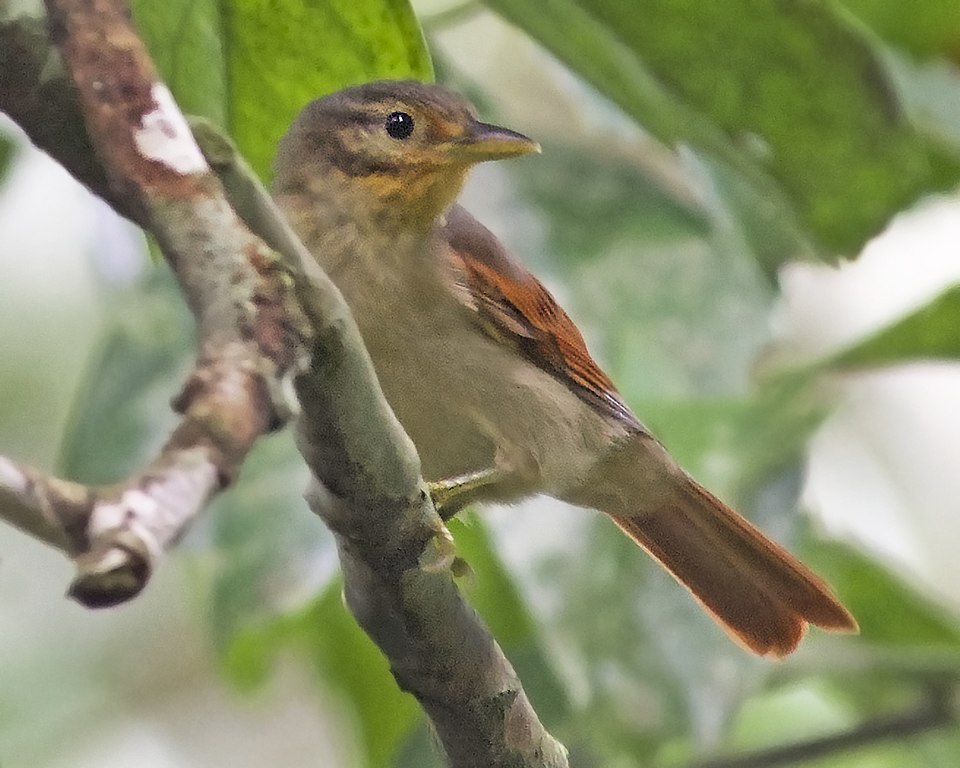
Identifying the Chestnut-winged Foliage-gleaner involves noting its distinctive field marks. Adults display rich chestnut-colored wings and a contrasting olive-brown body, which provides excellent camouflage among dense foliage. The chestnut hue extends to the bird's rump, further distinguishing it from similar species. Juveniles resemble adults but may exhibit slightly duller plumage. Male and female Chestnut-winged Foliage-gleaners are alike in appearance, making sex differentiation in the field challenging. This species can be confused with the Rufous-rumped Foliage-gleaner, though the latter lacks the distinct chestnut wings. In flight, the Chestnut-winged Foliage-gleaner presents a compact silhouette with rapid, direct flight patterns. When perched, it often assumes a slightly hunched posture, typical of foliage-gleaners, as it methodically searches for insects. The bird's movements are deliberate and calculated, reflecting its specialized foraging technique.
Having trouble telling birds apart? Upload a photo to our bird identification tool for an instant species match.
Chestnut-winged Foliage-gleaner Habitat and Range
Preferred Habitat
The Chestnut-winged Foliage-gleaner inhabits lowland tropical forests, particularly favoring the Amazon Basin. It thrives in humid environments with dense understories, where it can effectively forage. Although primarily found in primary forests, this species can adapt to secondary growth, provided there is sufficient tree cover. The bird's preferred elevation ranges from sea level to about 1,200 meters. It seldom ventures into urban areas, maintaining a strong preference for undisturbed forest habitats. Seasonal habitat shifts are minimal, as the Chestnut-winged Foliage-gleaner is a resident species. However, it may adjust its territory within the forest in response to microhabitat changes, such as local insect abundance.
Geographic Range
The Chestnut-winged Foliage-gleaner occupies a range primarily within the Amazon Basin, including Brazil, Peru, Bolivia, and parts of Colombia and Ecuador. Its range aligns with regions of dense tropical forest, where it finds ample food and shelter. Unlike migratory birds, the Chestnut-winged Foliage-gleaner remains within its range year-round, making only localized movements. Population density hotspots correlate with areas of intact forest, particularly in the central Amazon. Although its exact population numbers fluctuate, this species is generally considered stable in regions where deforestation is limited. As a non-migratory bird, its range does not extend beyond the humid tropics, and it is absent from more arid or temperate zones.
Want to know which birds visit your area? Browse our backyard birds by location guides for region-specific species lists.
What Does the Chestnut-winged Foliage-gleaner Eat?
The Chestnut-winged Foliage-gleaner primarily consumes insects, employing a specialized foraging technique known as foliage-gleaning. This method involves meticulously searching through leaves, branches, and leaf litter to unearth hidden prey. The bird's diet includes caterpillars, beetles, spiders, and other small arthropods. During the rainy season, when insect populations are most abundant, the bird takes full advantage of this seasonal bounty. Its diet may also include small fruits and seeds, especially when insects are less available. The Chestnut-winged Foliage-gleaner forages throughout the day, often in mixed-species flocks, which enhances its foraging efficiency by reducing competition and increasing prey availability.
Chestnut-winged Foliage-gleaner Behavior and Social Structure
The Chestnut-winged Foliage-gleaner exhibits solitary and social behaviors, often forming part of mixed-species flocks. These flocks provide safety in numbers and enhance foraging success. Territorial behavior is evident during the breeding season, with pairs defending nesting sites vigorously. Courtship displays include mutual preening and vocalizations, strengthening pair bonds. The bird's daily activity patterns involve foraging in the early morning and late afternoon, with periods of rest during the hottest parts of the day. In response to predators, the Chestnut-winged Foliage-gleaner employs cryptic behavior, relying on its plumage for camouflage while remaining motionless. Flocking patterns are less pronounced outside the breeding season, as individuals may become more territorial.
Chestnut-winged Foliage-gleaner Nesting and Reproduction
Chestnut-winged Foliage-gleaners construct cup-shaped nests using plant fibers, leaves, and moss. These nests are typically placed in tree cavities or dense vegetation, providing protection from predators. The typical clutch consists of two to three eggs, which both parents incubate for approximately 17-20 days. Upon hatching, the chicks remain in the nest for about 18-21 days before fledging. Parental care continues post-fledging, with both adults feeding and protecting the young until they become independent. The species usually raises one brood per year, although favorable conditions may allow for a second.
Chestnut-winged Foliage-gleaner Sounds and Vocalizations
The primary song of the Chestnut-winged Foliage-gleaner consists of a rapid series of clear, high-pitched notes, often described as a tinkling or chattering sound. These vocalizations serve as contact calls within mixed-species flocks or between mates. Alarm calls are sharper and more abrupt, signaling the presence of predators. During the dawn chorus, their song contributes to the symphony of sounds in tropical forests, although it is less prominent compared to more vocal species.
Interesting Facts About the Chestnut-winged Foliage-gleaner
- 1The Chestnut-winged Foliage-gleaner can move with remarkable agility through dense foliage, which aids in its foraging efficiency.
- 2This bird plays a crucial role in controlling insect populations within its habitat, helping maintain ecological balance.
- 3Despite its small size, the Chestnut-winged Foliage-gleaner exhibits aggressive territorial behavior during the breeding season.
- 4The species' nest construction involves a complex weaving technique using plant materials, showcasing avian engineering skills.
- 5Chestnut-winged Foliage-gleaners are often seen participating in mixed-species flocks, which can number up to 20 different bird species.
Chestnut-winged Foliage-gleaner Conservation Status
The Chestnut-winged Foliage-gleaner is not currently listed as threatened, with a stable population trend, except in areas experiencing significant deforestation. Primary threats include habitat loss due to logging, agriculture, and urban expansion. Conservation efforts focus on preserving large tracts of contiguous forest, which are vital for maintaining population stability. Historical changes in population dynamics are mostly linked to habitat alteration, underscoring the importance of habitat protection.
Other Furnariidae Species


Birds Similar to the Chestnut-winged Foliage-gleaner
These species are often confused with the Chestnut-winged Foliage-gleaner due to similar appearance or overlapping range.

