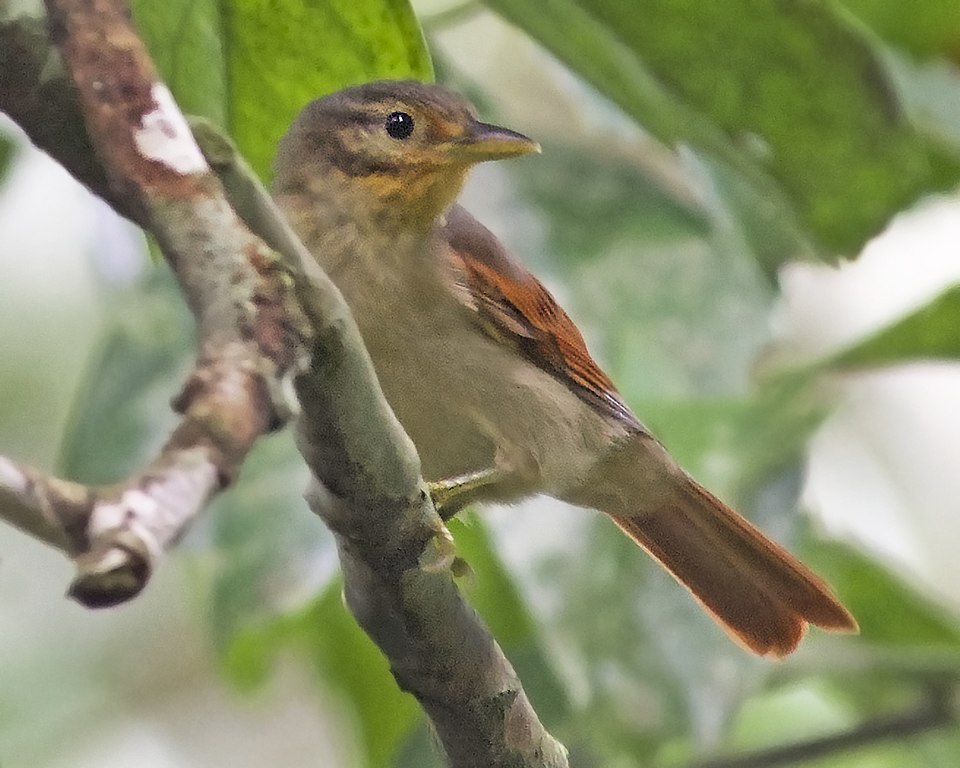
Slaty-winged Foliage-gleaner
Philydor fuscipenne
Order: Passeriformes / Family: Furnariidae

Wikimedia Commons
About the Slaty-winged Foliage-gleaner
The Slaty-winged Foliage-gleaner (Philydor fuscipenne) is a small bird that plays a vital role in the ecological balance of South American forests. This species belongs to the family Furnariidae, known for their adaptive radiation in a variety of forest environments. The Slaty-winged Foliage-gleaner is primarily found in the dense, humid forests of the Amazon basin, spanning countries such as Brazil, Peru, and Bolivia. Its significance in these ecosystems cannot be overstated, as it contributes to the control of insect populations and participates in seed dispersal, thereby aiding forest regeneration processes. This bird is a quintessential example of the complexity and interconnectedness of forest ecosystems. The Slaty-winged Foliage-gleaner is an integral component of the understory bird community. It specializes in foraging through the leaf litter and dense foliage for insects and other arthropods. During the wetter months, its role in keeping insect populations in check becomes crucial. The bird's ecological role extends beyond mere insect control; it is also part of the forest's intricate food web, serving as prey for larger predators. Seasonal behaviors of the Slaty-winged Foliage-gleaner include forming mixed-species flocks during the non-breeding season, which enhances foraging efficiency and predator avoidance. These flocks often include other foliage-gleaner species and small insectivorous birds. The bird's activity patterns are typically diurnal, with peak foraging occurring in the early morning and late afternoon. As a non-migratory species, the Slaty-winged Foliage-gleaner maintains a relatively stable presence in its preferred habitats year-round. Its resilience and adaptability to various microhabitats within the forest make it an essential species for researchers studying ecological dynamics and biodiversity conservation.
The Slaty-winged Foliage-gleaner belongs to the family Furnariidae, within the order Passeriformes. These birds typically live typically 6-8 years, with some reaching up to 10 years..
How to Identify a Slaty-winged Foliage-gleaner
In the field, the Slaty-winged Foliage-gleaner is identifiable by its distinct plumage and behavior. The adult bird showcases a striking combination of rich brown and slate-colored wings, which contrast with its paler underparts. Its stout bill and rounded wings are typical of foliage-gleaners, designed for probing and maneuvering through dense vegetation. Juvenile birds tend to have a duller plumage compared to adults, with less pronounced slate on the wings. There is little sexual dimorphism in this species, meaning males and females appear quite similar in coloration and size. When observing in the wild, it's important to note the bird's posture and movement patterns. The Slaty-winged Foliage-gleaner often perches with a slightly hunched stance and exhibits a deliberate, methodical approach to foraging. Its flight is typically short and direct, with quick wingbeats allowing it to navigate effectively through its cluttered habitat. Confusion with similar species, such as the Buff-fronted Foliage-gleaner, is possible; however, the latter has a more pronounced buff-colored head and lacks the distinctive slate-colored wings that define Philydor fuscipenne.
Having trouble telling birds apart? Upload a photo to our bird identification tool for an instant species match.
Slaty-winged Foliage-gleaner Habitat and Range
Preferred Habitat
The Slaty-winged Foliage-gleaner favors the understory of tropical moist broadleaf forests, where it finds ample cover and foraging opportunities. This habitat preference is most evident in the Amazon basin, a region characterized by high biodiversity and complex forest structures. The bird typically inhabits elevations ranging from lowland areas up to around 1000 meters. It demonstrates a preference for primary forests but can also be found in well-preserved secondary forests. Seasonal habitat shifts are minimal, as the bird is non-migratory and maintains territories year-round. Although predominantly a forest species, the Slaty-winged Foliage-gleaner occasionally ventures into edge habitats but is rarely observed in urban or suburban areas. Its reliance on the structural complexity of forest environments underscores the importance of habitat conservation for its continued survival.
Geographic Range
The Slaty-winged Foliage-gleaner boasts a range that predominantly extends across the Amazon basin. Its breeding range encompasses vast areas of northern and western Brazil, eastern Peru, and northern Bolivia, and it also extends into southern Colombia and Ecuador. The bird does not undertake long-distance migrations but may exhibit localized movements in response to food availability or environmental pressures. Within its range, population densities can vary, with higher concentrations typically found in regions with well-preserved primary forests. The bird's presence in protected areas such as the Manu National Park in Peru and the Noel Kempff Mercado National Park in Bolivia highlights the importance of conservation efforts in maintaining its habitat. Although not considered migratory, the Slaty-winged Foliage-gleaner's movements within its range are essential for understanding its ecological needs and adaptation strategies.
Want to know which birds visit your area? Browse our backyard birds by location guides for region-specific species lists.
What Does the Slaty-winged Foliage-gleaner Eat?
The diet of the Slaty-winged Foliage-gleaner is primarily insectivorous, consisting mainly of insects and other arthropods found within the dense foliage and leaf litter of its forest habitat. Key food sources include beetles, caterpillars, spiders, and various larvae. Seasonal variations in food availability can lead to shifts in diet composition, with the bird occasionally consuming small fruits and seeds, particularly during the dry season when insects are less abundant. Foraging techniques are adapted to its environment, with the bird using its stout bill to probe into crevices and under leaves. It often employs a methodical approach, moving through vegetation with deliberate precision to uncover hidden prey. The Slaty-winged Foliage-gleaner usually feeds during the early morning and late afternoon, capitalizing on peak insect activity. The bird's ability to exploit various microhabitats for food makes it an effective forager and a key player in controlling insect populations.
Slaty-winged Foliage-gleaner Behavior and Social Structure
The Slaty-winged Foliage-gleaner exhibits a range of behaviors that reflect its adaptations to a forested environment. Socially, it is often seen as part of mixed-species foraging flocks. These flocks enhance foraging efficiency and provide increased protection from predators. The bird displays territorial behavior, especially during the breeding season, when pairs defend their nesting areas from intruders. Courtship displays are relatively understated, involving mutual preening and soft vocalizations between mates. Flocking patterns during non-breeding seasons often include other insectivorous bird species, allowing for effective resource sharing. In response to predators, the Slaty-winged Foliage-gleaner relies on its cryptic plumage and evasive flight to avoid detection. Daily activity patterns are largely diurnal, with the bird active primarily at dawn and dusk. This pattern aligns with the foraging habits of many insectivores and helps minimize competition for resources. Understanding these behavioral traits provides insight into the species' survival strategies and its role in the forest ecosystem.
Slaty-winged Foliage-gleaner Nesting and Reproduction
Nesting habits of the Slaty-winged Foliage-gleaner are closely tied to its forest environment. The bird typically constructs its nest in natural cavities or abandoned woodpecker holes, utilizing materials such as dead leaves, moss, and fibers to line the nest. Preferred nesting sites are often located within the mid-story of the forest, offering protection from predators and environmental elements. Clutch size generally ranges from two to three eggs, with both parents participating in incubation duties, which last approximately 17 to 20 days. Post-hatching, both parents continue to share responsibilities for feeding and caring for the young. Fledging occurs around 21 to 24 days after hatching, although the exact timeline can vary based on environmental conditions and food availability. The Slaty-winged Foliage-gleaner typically raises one brood per year, though favorable conditions may occasionally lead to a second brood. The bird's nesting behavior highlights its adaptability and reliance on the complex forest structure for reproductive success.
Slaty-winged Foliage-gleaner Sounds and Vocalizations
The vocalizations of the Slaty-winged Foliage-gleaner consist of a series of sharp, high-pitched notes that form a rhythmic sequence, often compared to the sound of a small mechanical device. Its primary song serves both territorial and communicative functions, helping to maintain pair bonds and establish territory boundaries. Call notes are short and clipped, used frequently during foraging to maintain contact with flock members. Alarm calls are more urgent and varied, employed to alert others of potential threats. During the dawn chorus, the Slaty-winged Foliage-gleaner contributes with its distinctive song, adding to the rich tapestry of sounds within its habitat. These vocal characteristics make it an intriguing subject of study for ornithologists and bird enthusiasts alike.
Interesting Facts About the Slaty-winged Foliage-gleaner
- 1The Slaty-winged Foliage-gleaner can be found up to 1000 meters in elevation, showcasing its adaptability to varying forest heights.
- 2This bird species participates in mixed-species flocks, which can include up to 20 different bird species at times.
- 3Slaty-winged Foliage-gleaners rarely move more than a few kilometers from their birthplace, highlighting their strong territorial fidelity.
- 4Their nests are often located in abandoned woodpecker holes, demonstrating a unique example of interspecies resource utilization.
- 5The Slaty-winged Foliage-gleaner uses its stout bill to forage effectively, often turning over leaves to find hidden insects.
- 6Females and males are almost indistinguishable in the field, sharing similar plumage and size, a trait known as sexual monomorphism.
- 7Despite being a forest dweller, the Slaty-winged Foliage-gleaner occasionally ventures into edge habitats, showing some habitat flexibility.
Slaty-winged Foliage-gleaner Conservation Status
The Slaty-winged Foliage-gleaner currently holds a status of Least Concern according to the IUCN Red List, but its population trends warrant attention. Habitat loss due to deforestation in the Amazon basin poses a significant threat to its long-term survival. While the bird has shown some adaptability to secondary forests, ongoing habitat destruction could lead to population declines. Conservation efforts focus on preserving large tracts of undisturbed forest and implementing sustainable land-use practices. Historical population changes are not well-documented, but current estimates suggest a stable population in protected regions. Continued research and monitoring are essential to ensure conservation measures address the species' ecological needs and mitigate potential threats.
Other Furnariidae Species


Birds Similar to the Slaty-winged Foliage-gleaner
These species are often confused with the Slaty-winged Foliage-gleaner due to similar appearance or overlapping range.