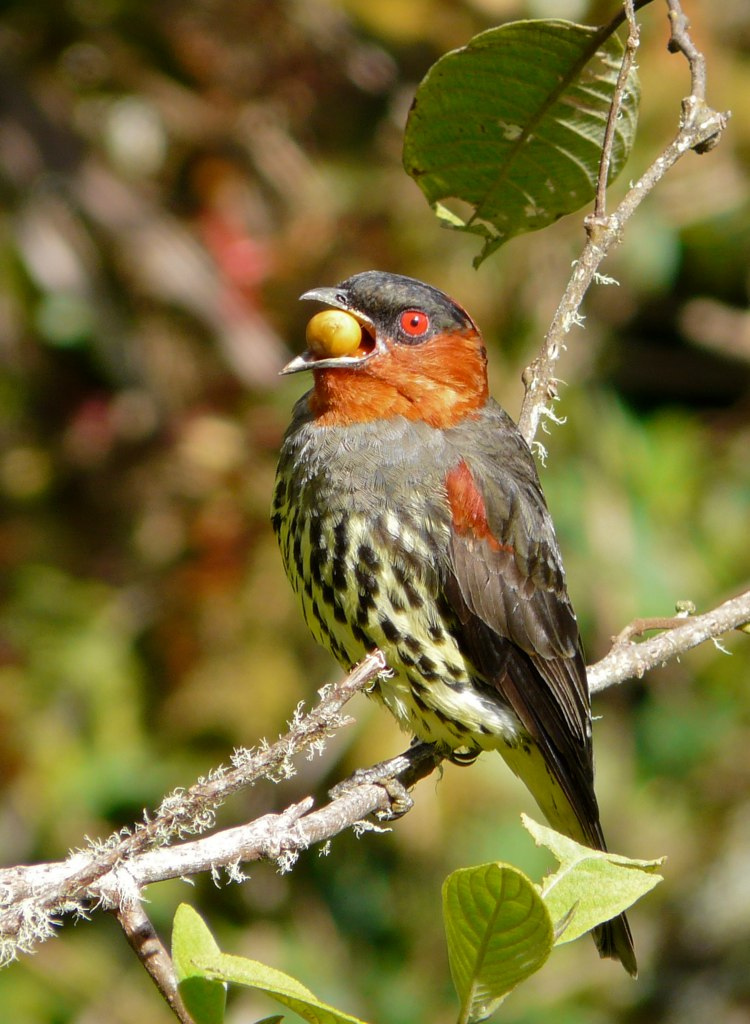
Andean Cock-of-the-rock
Rupicola peruvianus
Order: Passeriformes / Family: Cotingidae

Wikimedia Commons
About the Andean Cock-of-the-rock
The Andean Cock-of-the-rock (Rupicola peruvianus) is a visually arresting bird found predominantly in the Andean cloud forests, where its vivid coloration and unique social behavior make it a subject of fascination among ornithologists and birdwatchers. Males are particularly striking with their bright red-orange plumage and distinctive fan-shaped crests, which they use prominently in courtship displays. Females, though more subdued in color, possess an equally important role in their habitat's ecological dynamics. This species plays a crucial role in seed dispersal across its habitat, contributing significantly to the biodiversity of the Andean forests. The Cock-of-the-rock is symbolic of the rich avian diversity of the Andes, attracting ecotourists and researchers alike to regions such as Manu National Park in Peru and the Mindo area in Ecuador. Their presence is an indicator of healthy forest ecosystems, as they prefer regions with dense vegetation and high humidity. Seasonal behaviors of the Andean Cock-of-the-rock include pronounced lekking activities during the breeding season, where males gather to perform elaborate displays to attract females. This behavior ensures genetic diversity and signals the onset of breeding activities in the region. As an integral part of the Andean forest ecosystem, the Cock-of-the-rock's role extends beyond its striking appearance. It aids in the maintenance of forest structure by dispersing seeds of fruiting trees and shrubs, thus promoting plant regeneration and diversity. The bird's presence is vital for sustaining the health of these environments, which are increasingly threatened by human activities. The Cock-of-the-rock's ecological significance highlights the interconnectedness of species within these biodiverse hotspots. Understanding and protecting the Andean Cock-of-the-rock and its habitat is critical for preserving the unique ecological balance of the Andean cloud forests. Conservation efforts aimed at sustaining these environments not only benefit this iconic bird but also the myriad of species that inhabit these lush, mountainous regions.
The Andean Cock-of-the-rock belongs to the family Cotingidae, within the order Passeriformes. These birds typically live average 5-7 years, with a max recorded of 12 years..
How to Identify a Andean Cock-of-the-rock
Identifying the Andean Cock-of-the-rock involves noting the male's brilliant red-orange plumage and striking fan-shaped crest, which sets it apart from other species in its range. The female, while less conspicuous, features a more muted brownish-orange coloration, aiding in camouflage within the forest understory. Juveniles resemble females but can be distinguished by their less defined crests and duller plumage. The male's large, rounded head and prominent crest are the most distinctive field marks. In flight, the Cock-of-the-rock shows a somewhat chunky silhouette, with broad wings and a short tail, which contribute to its somewhat labored, yet direct, flight pattern. When perched, it often adopts an upright posture, displaying its vibrant colors to maximum effect. Confusion with other species is rare due to these distinctive features, though in dim light or dense foliage, the less colorful females might be mistaken for other similarly colored forest birds. However, the males' coloration is unmistakable, even in the dim light of the forest.
Having trouble telling birds apart? Upload a photo to our bird identification tool for an instant species match.
Andean Cock-of-the-rock Habitat and Range
Preferred Habitat
The Andean Cock-of-the-rock inhabits the cloud forests of the Andes, thriving in humid, densely vegetated areas that provide ample food and shelter. These birds are typically found at elevations ranging from 500 to 2400 meters, although they may occasionally venture slightly higher or lower depending on local conditions. They favor areas with abundant fruiting trees, which supply their primary food source, and they are often seen near water sources like streams and rivers. Seasonal shifts in habitat use are minimal, as they remain in these forested areas year-round, relying on the consistently moist environment. The Cock-of-the-rock is rarely seen in urban or heavily altered landscapes, preferring the relative isolation of primary and secondary forests, where human disturbance is minimal.
Geographic Range
The breeding range of the Andean Cock-of-the-rock extends through the humid forests of the Andes, from Venezuela in the north, through Colombia, Ecuador, Peru, and Bolivia. These birds do not typically migrate, but their range includes various altitudes within these countries, depending on habitat availability. In Peru and Ecuador, they are particularly common in protected areas such as Manu National Park and the Mindo region, where populations are dense due to suitable habitat conditions. In these areas, they can be found in relative abundance compared to other parts of their range where habitat fragmentation and deforestation have impacted their numbers. Their non-migratory nature means that they rely heavily on the conservation of their native forests for survival.
Want to know which birds visit your area? Browse our backyard birds by location guides for region-specific species lists.
What Does the Andean Cock-of-the-rock Eat?
The Andean Cock-of-the-rock primarily feeds on a diet of fruits, making them important seed dispersers in their habitat. They consume a variety of fruits, with a preference for those that are small to medium-sized, which they can easily swallow whole. Their feeding schedule is most active during the early morning and late afternoon, when they forage both in the canopy and understory. During the breeding season, their diet may diversify to include small insects and other invertebrates, providing additional protein necessary for courtship and egg production. Foraging techniques involve gleaning fruits directly from trees, often in acrobatic displays that showcase their agility. The size of their prey typically ranges from small berries to larger fruits, depending on availability.
Andean Cock-of-the-rock Behavior and Social Structure
The social behavior of the Andean Cock-of-the-rock is most notable during the breeding season, when males engage in lekking. This involves group displays where males gather in designated areas to perform ritualized courtship dances and calls to attract females. These displays are highly competitive, with each male attempting to outshine the others through a combination of visual and auditory signals. Outside of the breeding season, the Cock-of-the-rock is more solitary or found in small groups. Territorial behavior is evident, especially among males during the breeding season, as they defend their display areas from rivals. Their response to predators includes loud alarm calls and swift retreats to dense cover, where their vibrant colors are surprisingly effective camouflage. Daily activity patterns show peaks in activity during the cooler parts of the day, with periods of rest and preening during the midday heat.
Andean Cock-of-the-rock Nesting and Reproduction
The nesting habits of the Andean Cock-of-the-rock are as distinctive as their appearance. They build their nests on rocky outcrops, cliffs, or ledges, often near waterfalls or streams where moisture helps maintain the integrity of the nest structure. The nests are typically cup-shaped and constructed from mud, plant fibers, and moss, which the female collects and shapes painstakingly. A typical clutch consists of two eggs, which the female incubates over a period of about 25 to 28 days. During this time, the male plays little role in incubation but may provide food occasionally. Once hatched, the chicks are altricial and remain in the nest for up to six weeks, during which both parents contribute to feeding and protection. The species generally raises one brood per year, although in optimal conditions, a second brood is possible.
Andean Cock-of-the-rock Sounds and Vocalizations
The primary song of the Andean Cock-of-the-rock is a series of loud, rhythmic grunts and squawks, which can be heard echoing through the forest during lekking displays. These sounds are deep and resonant, often compared to the calls of frogs or the croaks of larger birds. Call notes are varied and include harsh, nasal sounds used for communication between individuals. Alarm calls are sharper and more insistent, alerting others to potential threats. During the dawn chorus, males are particularly vocal, using their calls to establish territory and attract mates. The vocalizations of the Cock-of-the-rock are distinctive and serve as an important tool in their social interactions.
Interesting Facts About the Andean Cock-of-the-rock
- 1The Andean Cock-of-the-rock is the national bird of Peru, symbolizing the country's vibrant wildlife.
- 2Males gather in leks with as many as 50 individuals, performing displays to attract females.
- 3The species is rarely seen flying long distances, preferring short, direct flights between trees.
- 4Despite their bright colors, males can effectively camouflage among the forest foliage.
- 5Chicks are fed a diet primarily of regurgitated fruit, rich in nutrients for rapid growth.
- 6The Cock-of-the-rock's lekking behavior resembles that of some tropical grouse species.
- 7Their loud, frog-like calls can be heard up to 100 meters away in dense forest environments.
Andean Cock-of-the-rock Conservation Status
The Andean Cock-of-the-rock currently holds a status of Least Concern on the IUCN Red List, though its population is decreasing due to habitat loss and fragmentation. The primary threats include deforestation for agriculture, mining, and urban development, which reduce the availability of suitable habitat. Conservation efforts focus on protecting large swathes of forest through the establishment of national parks and reserves, as well as community-based initiatives that promote sustainable land use. Historical population trends indicate a decline in areas where human activities have intensified, but stable populations persist in well-protected regions. Continued conservation efforts are essential to ensure the survival of this iconic species.