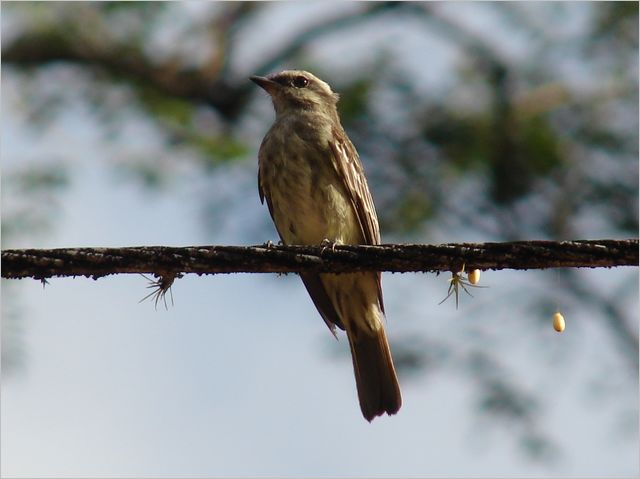
Baird's Flycatcher
Myiodynastes bairdii
Order: Passeriformes / Family: Tyrannidae

Wikimedia Commons
About the Baird's Flycatcher
Baird's Flycatcher (Myiodynastes bairdii) is a notable member of the Tyrannidae family, known for its commanding presence and striking appearance. This medium-sized flycatcher is primarily found in the tropical lowlands and foothills of western South America, particularly in countries like Ecuador and Peru. Its habitats range from deciduous forests to scrubby woodlands, where it plays a crucial ecological role as both a predator of insects and a prey item for larger avian species. Baird's Flycatcher is adept at capturing insects in mid-air, demonstrating a keen agility that is characteristic of the Tyrannidae family. During the breeding season, which aligns with the wet season, this flycatcher becomes more territorially vocal, marking its presence with a series of sharp, clear calls. These vocalizations help maintain territories and attract mates. In the non-breeding season, the bird disperses slightly but generally remains within its range, taking advantage of the varied food sources available year-round. The significance of Baird's Flycatcher extends beyond its feeding habits; it also contributes to the control of insect populations, thereby maintaining ecological balance. It is well adapted to the diverse environments it inhabits, from the edges of tropical forests to more open woodland areas. This adaptability is a testament to its evolutionary success and ensures its continued presence in its native regions. As habitats continue to face pressures from human expansion and climate change, Baird's Flycatcher serves as an indicator species, reflecting the health of tropical ecosystems. Its presence, or absence, can provide insights into the broader environmental conditions of its habitat. Observers often find Baird's Flycatcher perched prominently, making it a favorite among birders visiting South America's rich biodiversity hotspots. Its striking plumage and lively behavior offer a visual and auditory treat, making encounters with this bird memorable.
The Baird's Flycatcher belongs to the family Tyrannidae, within the order Passeriformes. These birds typically live average 5-7 years, with a maximum recorded of 10 years..
How to Identify a Baird's Flycatcher
The Baird's Flycatcher is a medium-sized flycatcher, easily identified by its bold eye stripe, which contrasts against its olive-brown upperparts. The underparts are a bright yellow, making it stand out in the dappled light of its forest habitat. Adult plumage is strikingly consistent across sexes, with males and females exhibiting similar coloration. Juveniles, however, may display a slightly duller version of the adult plumage, with less pronounced markings. The bird's wings and tail feature subtle rufous edging, which can be observed during flight or when seen at closer range. In flight, the Baird's Flycatcher's silhouette is characterized by a broad, rounded tail and relatively long wings, which it uses adeptly to maneuver through its environment. When perched, it often adopts an upright posture, showcasing its vibrant belly against the more muted tones of its back. This upright position is typical of many flycatchers and aids in quick takeoffs when capturing prey. Similar species, such as the Streaked Flycatcher, can cause confusion; however, Baird's Flycatcher lacks the extensive streaking on the breast that is a hallmark of its relatives. The bird's distinct calls and habitat preferences also aid in distinguishing it from other sympatric species.
Having trouble telling birds apart? Upload a photo to our bird identification tool for an instant species match.
Baird's Flycatcher Habitat and Range
Preferred Habitat
Baird's Flycatcher predominantly inhabits tropical lowland forests, often favoring areas with dense foliage interspersed with open clearings. It thrives in deciduous and semi-deciduous woodlands, where it can effortlessly hunt its insect prey. This flycatcher is typically found at elevations ranging from sea level up to about 1500 meters, although it primarily occupies lower elevations. Seasonal shifts in habitat are minimal, as this species tends to remain within the same general area throughout the year, relying on the consistent availability of food resources. In terms of urban presence, Baird's Flycatcher is infrequently observed in heavily populated areas, preferring the cover and resources provided by more natural settings. However, it may occasionally venture into rural areas or plantations, especially where these abut its preferred forested environments.
Geographic Range
Baird's Flycatcher is primarily distributed along the western side of South America. Its breeding range extends from southwestern Ecuador through to northwestern Peru. This region provides the specific environmental conditions necessary for its survival, such as abundant food supply and suitable nesting sites. There is no significant migratory behavior noted for this species, as it tends to remain within its established range throughout the year. The bird's population density is highest in areas with optimal forest cover, where its insect prey is most abundant. Though not considered migratory, local movements can occur in response to food availability and other environmental factors. The corridors between the Andes and the Pacific serve as critical habitats, allowing the species to thrive within these diverse ecosystems.
Want to know which birds visit your area? Browse our backyard birds by location guides for region-specific species lists.
What Does the Baird's Flycatcher Eat?
Baird's Flycatcher's diet is primarily composed of insects, which it catches with acrobatic flight maneuvers typical of the Tyrannidae family. Its feeding technique involves perching quietly on a branch or other vantage point before sallying out to snatch passing insects mid-flight. This flycatcher predominantly targets small to medium-sized insects, including beetles, flies, and moths, which are abundant in its tropical habitat. During the wet season, when insect populations surge, Baird's Flycatcher takes full advantage, increasing its feeding activity to match food availability. Interestingly, while insects form the bulk of its diet, the bird may also consume small fruits and berries on occasion, supplementing its nutritional intake, especially during periods when insect prey is less abundant. The flycatcher's feeding schedule is primarily diurnal, with peaks in activity occurring during the early morning and late afternoon, coinciding with the times when insects are most active.
Baird's Flycatcher Behavior and Social Structure
Baird's Flycatcher exhibits a range of behaviors typical of the Tyrannidae family, including a solitary or paired lifestyle outside of the breeding season. It is territorial, with males becoming particularly vocal to defend their chosen area from rivals. During courtship, males may perform display flights and vocalizations to attract a mate, showcasing their fitness and suitability. Once paired, the flycatchers work together to secure a nesting site and raise their young. When faced with potential predators, Baird's Flycatcher employs a combination of vocal alarms and evasive maneuvers to protect itself and its offspring. The bird's daily activity patterns are primarily focused on feeding and territory maintenance, with less pronounced social structures compared to more gregarious species. While not inclined to flock, individuals may be seen in loose associations where food is plentiful, particularly at the edges of their preferred forest environment.
Baird's Flycatcher Nesting and Reproduction
Baird's Flycatcher constructs its nest in a sheltered location, often choosing the fork of a tree or a dense thicket for added protection from predators. The nest itself is a cup-shaped structure, meticulously woven from grasses, stems, and other plant materials. It is lined with softer materials such as feathers and fine fibers to ensure comfort and insulation for the eggs. The typical clutch size for this species is 2 to 3 eggs, which are incubated primarily by the female for a period of approximately 14 to 16 days. During this time, the male plays a crucial role in providing food for the incubating female. After hatching, both parents participate in feeding the chicks, which fledge about 16 to 18 days post-hatching. Baird's Flycatcher generally raises one brood per year, although in areas with particularly favorable conditions, a second brood may occasionally be attempted.
Baird's Flycatcher Sounds and Vocalizations
The primary song of Baird's Flycatcher consists of a series of sharp, clear notes delivered in rapid succession. This song, often described as a repeated 'peet-peet-peet,' serves both to establish territory and attract mates. In addition to its primary song, Baird's Flycatcher emits various call notes, including a shorter, more abrupt 'chip' or 'chak' sound used in communication between mates or as an alarm call. The bird's vocalizations are most prominent during the early morning hours, contributing to the dawn chorus that defines its tropical habitat. The clarity and rhythm of its calls make them distinguishable from those of other flycatcher species, providing a reliable auditory cue for identification.
Interesting Facts About the Baird's Flycatcher
- 1Baird's Flycatcher is named in honor of Spencer Fullerton Baird, a prominent 19th-century American ornithologist.
- 2Unlike many flycatchers, Baird's Flycatcher does not migrate extensively, remaining in its tropical range year-round.
- 3Insects make up the majority of its diet, but it will occasionally eat berries and small fruits when available.
- 4Baird's Flycatcher uses a sallying technique, launching from a perch to catch insects in mid-air with precision.
- 5During the breeding season, its bold calls can be heard echoing through the tropical forests of western South America.
- 6Despite its preference for natural habitats, Baird's Flycatcher can sometimes be found in rural areas with suitable vegetation.
- 7The species' adaptability to different forest types has helped it maintain a stable population despite environmental pressures.
Baird's Flycatcher Conservation Status
Baird's Flycatcher is currently listed as Least Concern by the IUCN, with its population considered stable. However, like many tropical species, it faces potential threats from habitat loss due to deforestation and agricultural expansion in its native range. Conservation efforts aimed at preserving the tropical forests of Ecuador and Peru are crucial for maintaining the habitat of this species. Local initiatives that promote sustainable land use and protect key forested areas can help ensure the long-term survival of Baird's Flycatcher. Historical data suggests that while some local populations have experienced declines, the overall population remains resilient due to the species' adaptability and the relatively large areas of suitable habitat still available.
Other Tyrannidae Species


Birds Similar to the Baird's Flycatcher
These species are often confused with the Baird's Flycatcher due to similar appearance or overlapping range.