Bhutan Laughingthrush
Trochalopteron imbricatum
Order: Passeriformes / Family: Leiothrichidae

Wikimedia Commons
About the Bhutan Laughingthrush
The Bhutan Laughingthrush (Trochalopteron imbricatum) represents a fascinating example of avian biodiversity in the Himalayan region. This species thrives in the montane forests of Bhutan, Northeastern India, and parts of Tibet, where its presence is integral to the ecological balance. Known for its distinctive calls which resemble laughter, the Bhutan Laughingthrush plays a crucial role in the forest soundscape. The species inhabits altitudes ranging from 2,000 to 3,500 meters, preferring the dense undergrowth of subtropical and temperate forests. The Bhutan Laughingthrush, belonging to the Leiothrichidae family, is significant for seed dispersal in its environment, contributing to forest regeneration. During the breeding season, these birds are particularly active, engaging in elaborate courtship displays. Seasonal changes in the Himalayan region influence their behaviors, with more conspicuous activity in pre-monsoon months. The Bhutan Laughingthrush also exhibits a degree of altitudinal migration, descending to lower elevations during the harshest winter months, which allows for survival in variable climatic conditions. This species' ability to adapt to seasonal shifts exemplifies its resilience and ecological importance. In regions like the Bumthang Valley in Bhutan, the bird is often seen foraging in mixed-species flocks, underscoring its role in the broader avian community. Conservation of its habitat is essential, as this bird not only contributes to the biodiversity of the region but also serves as an indicator of forest health. Observations of the Bhutan Laughingthrush can provide insights into the effects of climate change and habitat disturbance on Himalayan avifauna.
The Bhutan Laughingthrush belongs to the family Leiothrichidae, within the order Passeriformes. These birds typically live 5-7 years with a maximum recorded of 9 years..
How to Identify a Bhutan Laughingthrush
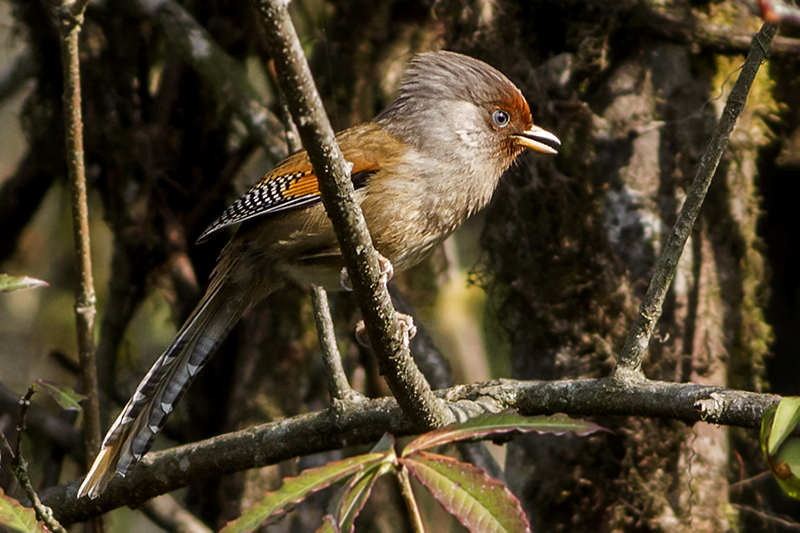
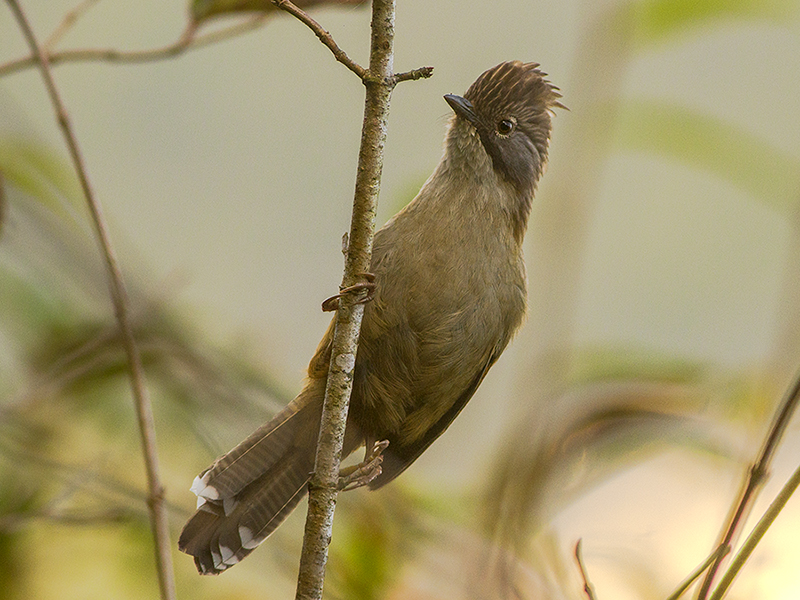
The Bhutan Laughingthrush is a medium-sized bird, measuring approximately 26 centimeters in length. Its plumage predominantly features warm brown tones, interspersed with subtle gray markings on the head and nape. The bird's wings and tail are marked with striking rufous and black barring, which are key field marks for identification. Distinct from juveniles, adult Bhutan Laughingthrushes exhibit more vivid coloration, while younger birds tend toward a duller, more uniform appearance. Males and females appear similar, making visual sex differentiation challenging in the field. However, males may be slightly larger. The bird's silhouette in flight is characterized by broad, rounded wings and a relatively long tail, which aids in navigating dense forest understoreys. When perched, the Bhutan Laughingthrush often holds its tail slightly cocked, a behavior that can assist birders in identification. In comparison to similar species, the Bhutan Laughingthrush's unique vocalizations and its preference for higher altitudes often distinguish it from other laughingthrushes, which might inhabit overlapping terrains. Familiarity with its song and call notes, alongside visual cues, is essential for accurate identification in its complex habitat.
Having trouble telling birds apart? Upload a photo to our bird identification tool for an instant species match.
Bhutan Laughingthrush Habitat and Range
Preferred Habitat
The Bhutan Laughingthrush is predominantly found in the dense, humid broadleaf and coniferous forests of the eastern Himalayas. It shows a marked preference for subtropical and temperate forest zones, thriving at elevations between 2,000 and 3,500 meters. The species' affinity for thick understorey and shrubbery means it is often found in areas with dense foliage, such as the forested valleys and slopes of Bhutan and Northeastern India. During the colder months, some altitudinal migration occurs, allowing the bird to inhabit slightly lower elevations. While primarily associated with rural and forested areas, it can occasionally be spotted in more open forest edges or near human settlements, particularly when foraging. Despite its adaptability to different forest types, the Bhutan Laughingthrush is rarely found in urban environments, as it requires the cover and resources of natural forest ecosystems for survival.
Geographic Range
The Bhutan Laughingthrush is largely endemic to the eastern Himalayas, with its range primarily covering Bhutan, parts of Northeastern India such as Arunachal Pradesh, and extending into southeastern Tibet. Its distribution is highly localized within these regions, often dictated by suitable habitat availability. The bird's breeding range is confined to these montane areas, where it is a resident species throughout the year. However, in response to seasonal climatic changes, the Bhutan Laughingthrush may undertake limited altitudinal migrations, descending to lower elevations during severe winter conditions. Such movements ensure access to food resources and more favorable microclimates. While not known for extensive migratory behavior, its presence is a reliable indicator of healthy montane forest ecosystems. High population densities are often reported in regions like the temperate forests of Bhutan, where conservation efforts focus on maintaining forest integrity.
Want to know which birds visit your area? Browse our backyard birds by location guides for region-specific species lists.
What Does the Bhutan Laughingthrush Eat?
The Bhutan Laughingthrush exhibits an omnivorous diet, predominantly feeding on a variety of insects and other invertebrates, which it gleans from the forest floor and undergrowth. During the breeding season, its diet becomes more insectivorous, providing protein-rich sustenance to growing chicks. In addition to insects, the bird also consumes a range of fruits, berries, and seeds, which are more abundant during the monsoon months. This dietary flexibility allows the Bhutan Laughingthrush to exploit seasonal food availability effectively. Foraging typically occurs in mixed-species flocks, where the laughingthrush plays a role in seed dispersal. Its feeding schedule peaks during the early morning and late afternoon, times when insect activity is heightened. The bird's foraging technique is characterized by deliberate movements through dense foliage, using its strong bill to probe for hidden prey.
Bhutan Laughingthrush Behavior and Social Structure
The Bhutan Laughingthrush exhibits intricate social behaviors, often forming small family groups or joining mixed-species flocks, which provides safety in numbers and facilitates efficient foraging. While generally non-territorial outside the breeding season, pairs may defend small territories during nesting, engaging in vocal displays to ward off intruders. Courtship behavior includes mutual preening and vocal exchanges, reinforcing pair bonds. The bird demonstrates a marked curiosity, often approaching observers within its forested domain. Its response to predators, such as hawks and snakes, involves alarm calls that alert conspecifics and other birds within the vicinity. Daily activity patterns are diurnal, with a peak in activity during cooler hours of the day, such as early morning and late afternoon. The Bhutan Laughingthrush's playful demeanor and varied vocalizations contribute to its role as an active participant in the avian communities of its habitat.
Bhutan Laughingthrush Nesting and Reproduction
The Bhutan Laughingthrush constructs its nest using a variety of natural materials, such as twigs, grasses, and leaves, forming a deep cup shape. Nests are typically situated in dense shrubbery or low trees, providing concealment from predators. The choice of location often reflects a preference for secluded spots that offer protection and optimal conditions for rearing young. Clutch sizes generally range from two to four eggs, which are incubated primarily by the female for approximately 14 days. Both parents participate in feeding the chicks, which fledge after about two weeks. Parental care continues post-fledging, ensuring the juveniles develop necessary survival skills. The species generally produces one brood per year, although favorable conditions may lead to a second brood. The Bhutan Laughingthrush's nesting habits are adapted to its montane environment, ensuring reproductive success despite variable climatic conditions.
Bhutan Laughingthrush Sounds and Vocalizations
The Bhutan Laughingthrush is renowned for its melodious song, which consists of a series of rich, varied whistles interspersed with chattering notes. This complex vocal performance is often described as laughter-like, contributing to its common name. Calls include sharp, metallic chirps used for communication within flocks and softer notes exchanged between pairs. Alarm calls are more harsh and urgent, serving to alert others to potential threats. The species participates actively in the dawn chorus, with singing peaking during the early hours of the morning. The vocalizations of the Bhutan Laughingthrush can be compared to those of other laughingthrushes but are distinguished by their unique rhythm and tonal quality.
Interesting Facts About the Bhutan Laughingthrush
- 1The Bhutan Laughingthrush is named for its distinctive song, which sounds remarkably like human laughter.
- 2Despite its name, the Bhutan Laughingthrush is also found in parts of Northeastern India and Tibet.
- 3The bird's vibrant calls play a crucial role in maintaining social bonds within flocks.
- 4With a length of about 26 centimeters, it is considered a medium-sized bird among the laughingthrushes.
- 5The Bhutan Laughingthrush's diet shifts seasonally, with insects dominating in the breeding season.
- 6This species is an important seed disperser, aiding in forest regeneration.
- 7The Bhutan Laughingthrush often participates in mixed-species flocks, enhancing its foraging efficiency.
Bhutan Laughingthrush Conservation Status
The Bhutan Laughingthrush is currently listed as Least Concern by the IUCN, with populations considered stable across its range. However, habitat loss due to deforestation and land conversion for agriculture pose ongoing threats. Conservation efforts in regions like Bhutan focus on preserving forest habitats and promoting sustainable land-use practices. Historically, the species has maintained stable populations, benefiting from the relatively intact forest ecosystems of its core range. Continued monitoring and habitat protection are essential to ensure the long-term survival of this charismatic species.