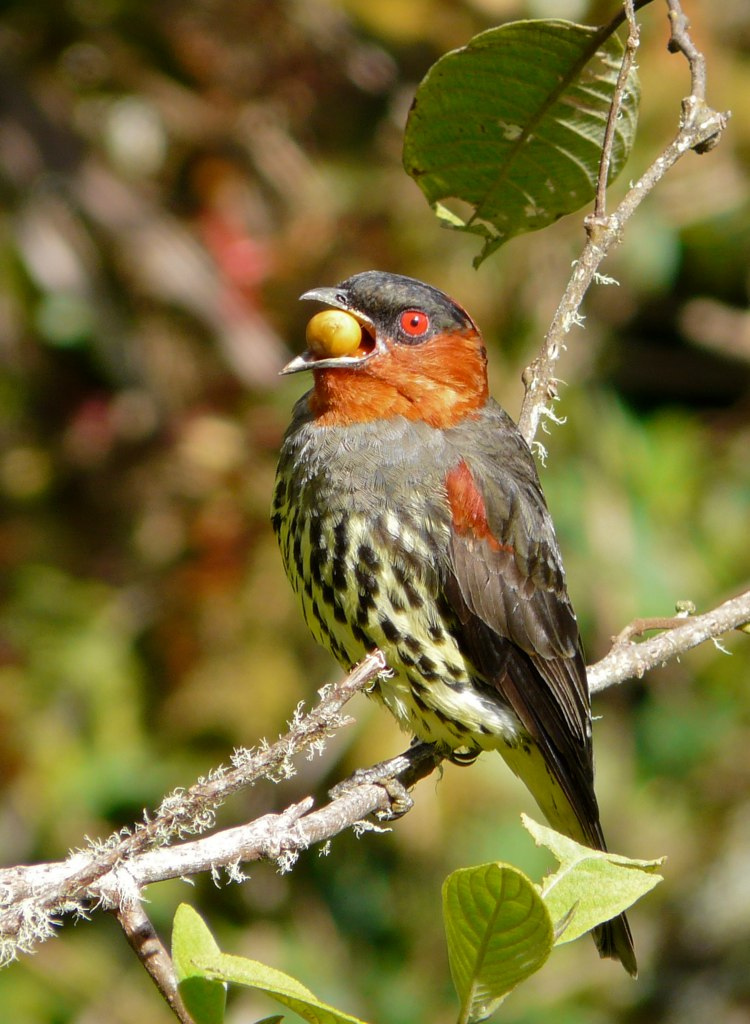
Black-and-white Becard
Pachyramphus albogriseus
Order: Passeriformes / Family: Cotingidae

Wikimedia Commons
About the Black-and-white Becard
The Black-and-white Becard (Pachyramphus albogriseus) is a medium-sized passerine bird belonging to the family Cotingidae. This bird is primarily found in the tropical forests of Central and South America, with a range that extends from southern Mexico through Central America and into the northwestern parts of South America, including Colombia and Ecuador. Its striking black and white plumage makes it easy to identify, with males typically displaying a more contrasting appearance than females. The Black-and-white Becard is a significant component of its ecosystem, playing a role in seed dispersal and insect population control. It occupies the middle to upper canopy levels of mature forests, where it is often seen foraging actively among the foliage. The ecological role of the Black-and-white Becard is quite important, particularly in the dense forests of the Chocó-Darién Biogeographic region, known for its high biodiversity. During the breeding season, which varies slightly depending on the region but generally occurs from March to August, these birds engage in distinctive courtship displays involving vocalizations and acrobatic flights. Outside the breeding season, the Black-and-white Becard may form small, loose flocks, often accompanied by other bird species, which helps in locating food sources. Its presence in the diverse habitats of the Andes foothills and its adaptability to different forest types highlight its ecological significance. Seasonal behaviors include slight altitudinal migrations in response to food availability, particularly during the wet and dry seasons. The Black-and-white Becard is less commonly found in degraded habitats, indicating its preference for well-preserved environments. The bird's role in maintaining the balance of its habitat underscores its importance in the face of ongoing habitat destruction.
The Black-and-white Becard belongs to the family Cotingidae, within the order Passeriformes. These birds typically live average 4-6 years, with a max recorded of 9 years..
How to Identify a Black-and-white Becard
The Black-and-white Becard exhibits a distinctive black and white coloration. Adult males showcase a sleek black head, wings, and tail, contrasted by a white underbelly and a prominent white wing bar. Females and juveniles are generally more subdued in coloration, with grayish tones replacing the stark black of the males. Juvenile birds may also show some brownish hues on their wing feathers. The Black-and-white Becard's overall size is medium, with a body length typically ranging from 15 to 17 cm and a wingspan of approximately 25 cm. When compared to similar species, such as the Barred Becard, the Black-and-white Becard lacks the barring and instead displays a cleaner, more defined black and white pattern. In flight, the Black-and-white Becard has a robust silhouette with a slightly rounded tail. It often perches in an upright posture on branches, scanning for insects and other prey. Despite its striking appearance, it can sometimes be overlooked due to its preference for remaining within the forest canopy.
Having trouble telling birds apart? Upload a photo to our bird identification tool for an instant species match.
Black-and-white Becard Habitat and Range
Preferred Habitat
The Black-and-white Becard inhabits subtropical and tropical moist lowland forests, preferring dense forest canopies and edges. It is commonly found at elevations ranging from sea level up to 2000 meters, though it favors areas between 500 and 1500 meters. In countries like Colombia, it is frequently observed in the lush montane forests of the Andes. The bird shows a preference for well-preserved forests, avoiding heavily disturbed areas. In Central America, it thrives in the lowland rainforests of Costa Rica and Panama, where it takes advantage of the rich biodiversity. Seasonal habitat shifts are minimal, but it may move to lower elevations during cooler months. The Black-and-white Becard is occasionally spotted in semi-urban areas with sufficient tree cover but is primarily a forest dweller.
Geographic Range
The Black-and-white Becard's range extends from southern Mexico through Central America and into northwestern South America. In Mexico, it is primarily found in the states of Chiapas and Oaxaca. In Central America, its range includes Belize, Guatemala, Honduras, Nicaragua, Costa Rica, and Panama. In South America, the bird is present in western Colombia and northern Ecuador. It inhabits both the Pacific and Caribbean slopes, favoring regions with abundant forest cover. The bird does not undertake long-distance migrations but may exhibit local movements based on food availability and climatic conditions. Population density is highest in well-preserved forest regions, such as Panama's Darién National Park and Colombia's Chocó region.
Want to know which birds visit your area? Browse our backyard birds by location guides for region-specific species lists.
What Does the Black-and-white Becard Eat?
The Black-and-white Becard primarily feeds on insects, including beetles, caterpillars, and other arthropods. Its diet also includes fruits, particularly during the breeding season when energy demands are higher. The bird employs a sallying technique, flitting from a perch to catch insects mid-air or picking them off foliage. It often forages alone or in pairs but may join mixed-species flocks to exploit abundant food sources. During the wet season, when insect abundance peaks, the Black-and-white Becard focuses more on animal prey. In drier periods, its diet shifts to include a higher proportion of fruit. It tends to forage in the middle to upper canopy, where its agility allows it to navigate dense foliage.
Black-and-white Becard Behavior and Social Structure
The Black-and-white Becard exhibits a variety of behaviors that are both intriguing and practical for survival. Socially, it is relatively solitary except during the breeding season or when participating in mixed-species foraging flocks. Territorial behavior is evident, particularly during breeding, as males establish and defend territories with vocalizations and displays. Courtship involves the male presenting food to the female, accompanied by fluttering wing displays. Flocking patterns outside the breeding season can include small groups, often with other insectivorous birds. The Black-and-white Becard is diurnal, with peak activity in the early morning and late afternoon when foraging is most productive. In response to predators, it often employs distraction displays or retreats to denser cover. Its adaptability in various forest environments and interactions with other species highlight its complex behavioral ecology.
Black-and-white Becard Nesting and Reproduction
Nesting for the Black-and-white Becard involves constructing a neat, dome-shaped nest with a side entrance. The nest is typically made from twigs, leaves, and plant fibers, and is placed in a tree, often at considerable height to avoid ground predators. The preferred nesting sites are in dense forest areas, sometimes along the edges where visibility is reduced. A typical clutch consists of two to three eggs, which are incubated primarily by the female for around 14-16 days. Both parents participate in feeding the chicks, which fledge approximately 18-20 days after hatching. The Black-and-white Becard usually raises one brood per year, although in favorable conditions, a second brood may be attempted.
Black-and-white Becard Sounds and Vocalizations
The Black-and-white Becard's primary song is a series of melodious whistles, often described as a rising and falling sequence of 'wee-wee-wee' notes. The pitch is medium-high, and the tone is clear and flute-like. Calls include short 'chup' notes used for communication between mates or as alarm signals. During the dawn chorus, its song is especially prominent, serving as both a territorial declaration and an attraction to potential mates. The alarm calls are sharper and more rapid, signaling the presence of predators.
Interesting Facts About the Black-and-white Becard
- 1The Black-and-white Becard can often be heard before it is seen, thanks to its distinctive, melodious calls.
- 2Despite its striking appearance, the Black-and-white Becard can be surprisingly elusive due to its preference for dense forest canopies.
- 3The bird's dome-shaped nest design provides excellent camouflage and protection from predators.
- 4The species exhibits minimal sexual dimorphism, although males tend to have more contrasting plumage.
- 5The Black-and-white Becard's range is surprisingly extensive, covering multiple countries from Mexico to Ecuador.
- 6It is a part of the Cotingidae family, known for its diverse and often vibrantly colored members.
- 7In some regions, the Black-and-white Becard participates in mixed-species flocks, enhancing its foraging efficiency.
Black-and-white Becard Conservation Status
The Black-and-white Becard is currently classified as Least Concern by the IUCN, with a stable population trend. Primary threats include habitat loss due to deforestation and agricultural expansion, particularly in Central and South America. Conservation efforts focus on protecting and restoring forest habitats, especially in biodiversity hotspots like the Chocó and Amazon regions. Historically, the bird's population has remained relatively stable, but ongoing habitat destruction poses a potential risk. Efforts by local and international conservation organizations aim to mitigate these threats through sustainable land-use practices.