
Black-and-yellow Silky-flycatcher
Phainoptila melanoxantha
Order: Passeriformes / Family: Ptilogonatidae
Wikimedia Commons
About the Black-and-yellow Silky-flycatcher
The Black-and-yellow Silky-flycatcher (Phainoptila melanoxantha) is a visually striking bird predominantly found in the montane cloud forests of Central America. Members of the family Ptilogonatidae, these birds are particularly recognized for their vibrant plumage and unique ecological niche within their habitat. Residing mostly in the highlands of Costa Rica and western Panama, these birds are not only fascinating due to their appearance but also because of the roles they play in their ecosystem, particularly as seed dispersers.
The Black-and-yellow Silky-flycatcher is vital to the cloud forest ecosystems where it resides. Its primary role involves seed dispersal, which supports forest regeneration and biodiversity. These birds frequently consume fruits from a variety of native plants, inadvertently aiding in the propagation of these species through their droppings. This seed dispersal is crucial for maintaining the diverse plant life of the cloud forests, which in turn supports a wide range of animal species.
Notably, the species exhibits some seasonal behaviors. During the breeding season, which typically stretches from March to July, the Black-and-yellow Silky-flycatcher becomes more territorial and vocal. The males are known for their striking displays, often flaring their bright plumage to attract potential mates. Outside of the breeding period, these birds may become less conspicuous, often retreating to less accessible parts of the forest where they continue their role in seed dispersal. Their presence in these forests is a testament to the delicate balance of this ecosystem, where every species plays an integral part.
The Black-and-yellow Silky-flycatcher belongs to the family Ptilogonatidae, within the order Passeriformes. These birds typically live average 6-8 years, with some individuals reaching 10 years..
How to Identify a Black-and-yellow Silky-flycatcher
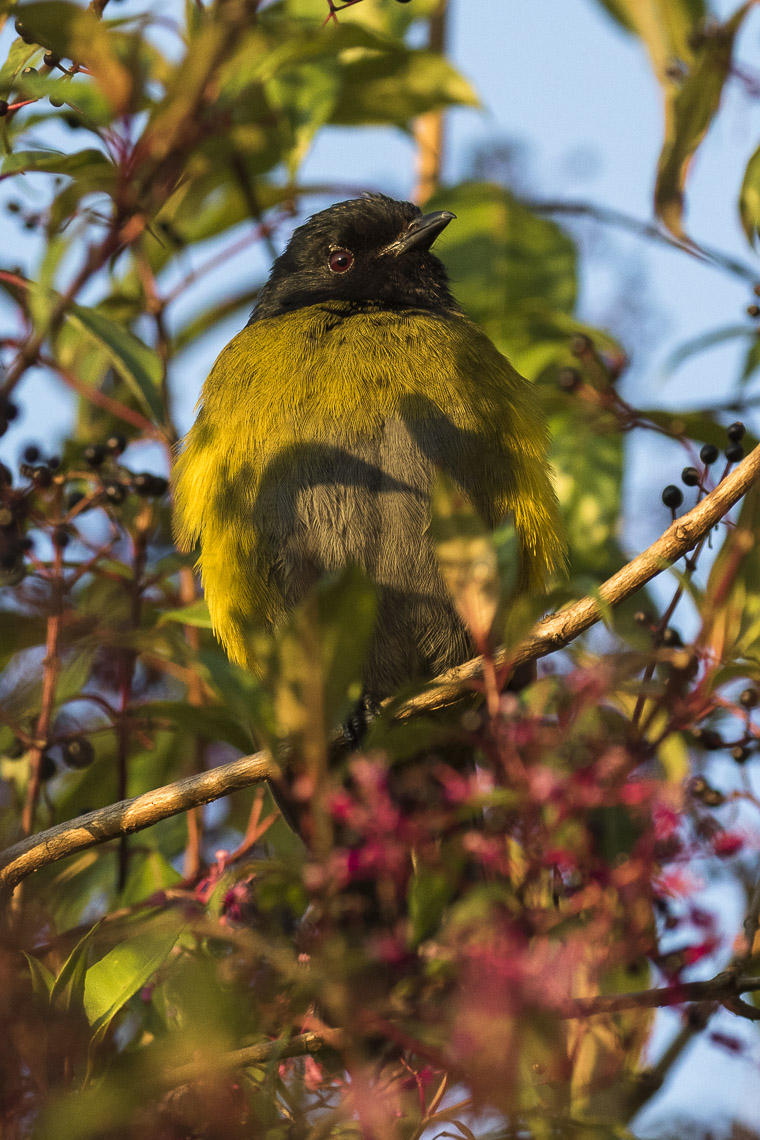
Adult Black-and-yellow Silky-flycatchers are distinguished by their striking coloration, with males displaying more vibrant hues compared to females. The males feature a deep black head and back, contrasting sharply with their bright yellow underparts and rump, making them quite conspicuous against the lush green backdrop of their forest habitats. Females, while similar in pattern, exhibit a more subdued coloration, with a charcoal gray head and a duller yellow belly. Juveniles resemble females but have even less contrast between their body parts, often appearing more uniformly grayish.
The species can be confused with other passerines in the region, such as the Yellow-thighed Finch, but the Black-and-yellow Silky-flycatcher has a more elongated body and distinct plumage pattern. Its flight silhouette is sleek, with a relatively short tail and rounded wings, allowing it to navigate through dense foliage with agility. When perched, these birds have a characteristic upright posture, often seen while surveying for food or during courtship displays.
Their unique combination of coloration, size, and behavior makes them unmistakable for those familiar with the avifauna of the highland cloud forests of Central America. Observers should note their preference for mid to upper canopy levels, where their distinctive calls can often be heard before they are seen.
Having trouble telling birds apart? Upload a photo to our bird identification tool for an instant species match.
Black-and-yellow Silky-flycatcher Habitat and Range
Preferred Habitat
The Black-and-yellow Silky-flycatcher predominantly inhabits montane cloud forests, which are characterized by high humidity and consistent canopy cover. These forests are typically located at elevations between 1,200 and 3,200 meters. Within these montane regions, the bird is most commonly found in primary forests, though it can occasionally be spotted in secondary growth forests that provide sufficient cover and food resources.
During different seasons, these birds may shift their habitats slightly, moving to areas with optimal fruit availability. However, they generally remain within the highland forest zones throughout the year. Unlike some bird species that adapt to urban environments, the Black-and-yellow Silky-flycatcher is rarely seen outside its native forest habitat, underscoring its reliance on dense, humid forest ecosystems for survival.
Geographic Range
The Black-and-yellow Silky-flycatcher is primarily found in the highland regions of Costa Rica and western Panama. Its range includes notable cloud forest reserves such as Monteverde and La Amistad International Park in Costa Rica. The bird is a resident species, meaning it does not undertake long-distance migrations. Instead, it remains within these montane areas year-round, though it may perform altitudinal movements in response to food availability.
While the bird's range is limited geographically, within its preferred habitat, it can be relatively common. Population density tends to be highest in well-preserved forest areas where human impact is minimal. The Black-and-yellow Silky-flycatcher's presence in these specific locales makes it an important species for regional biodiversity and a key indicator of forest health.
Want to know which birds visit your area? Browse our backyard birds by location guides for region-specific species lists.
What Does the Black-and-yellow Silky-flycatcher Eat?
The diet of the Black-and-yellow Silky-flycatcher primarily consists of fruits and berries, which are abundant in its montane forest habitat. This frugivorous diet is supplemented with insects, particularly during the breeding season when the demand for protein is higher. The birds often forage in the mid to upper canopy, skillfully plucking fruits from branches or catching flying insects in mid-air.
Seasonal changes in fruit availability can lead to shifts in diet, with the birds consuming a wider variety of fruits during the wet season when many plants are in fruit. During drier periods, insects may comprise a larger portion of their diet. The Black-and-yellow Silky-flycatcher's role as a seed disperser highlights its ecological importance, as its foraging activities contribute to the propagation of numerous plant species within its habitat.
Black-and-yellow Silky-flycatcher Behavior and Social Structure
The Black-and-yellow Silky-flycatcher exhibits a variety of behaviors that reflect its adaptation to the cloud forest environment. Socially, these birds are often found in pairs or small family groups, particularly during the breeding season. They are territorial birds, with males actively defending their chosen area through vocalizations and physical displays.
Courtship involves males showcasing their bright plumage, often accompanied by a series of calls to attract females. These displays are particularly notable during the breeding season, from March to July. Outside of this period, the birds may become less conspicuous, engaging in quieter foraging activities.
When faced with potential predators, the Black-and-yellow Silky-flycatcher relies on its agility and dense foliage for protection. Its daily activity patterns revolve around foraging and resting, with periods of increased vocal activity during early morning and late afternoon. Despite their vibrant coloration, these birds often blend into their surroundings when perched among the leafy canopy.
Black-and-yellow Silky-flycatcher Nesting and Reproduction
Black-and-yellow Silky-flycatchers construct open cup nests, typically situated in the forks of trees or dense shrubs within their forest habitat. The nests are crafted from fine twigs, moss, and lined with softer materials such as feathers or plant down. These nests are often well-concealed, providing protection from predators and harsh weather.
A typical clutch consists of two to three eggs, which are incubated primarily by the female for about 14 to 16 days. Both parents play roles in feeding and caring for the young, with the male often taking on more active foraging duties. The fledging period lasts approximately 15 to 20 days, during which the chicks are fed a diet rich in insects to promote healthy growth.
The Black-and-yellow Silky-flycatcher generally raises one brood per year, although in particularly favorable conditions, a second brood may be attempted. The success of these nesting efforts is closely tied to the availability of suitable habitat and food resources.
Black-and-yellow Silky-flycatcher Sounds and Vocalizations
The Black-and-yellow Silky-flycatcher's vocalizations are characterized by a series of clear, melodious notes that can often be heard echoing through the forest canopy. The primary song is a series of whistled phrases, medium-pitched and delivered at a deliberate pace, often described as 'tsee-wee, tsee-wee.'
In addition to their song, these birds produce various call notes used for communication between mates and during territorial disputes. Alarm calls are sharper and more urgent, serving to alert nearby individuals to potential threats. During the dawn chorus, the Black-and-yellow Silky-flycatcher contributes its distinctive song, joining the cacophony of other forest birds greeting the new day.
Interesting Facts About the Black-and-yellow Silky-flycatcher
- 1The Black-and-yellow Silky-flycatcher is the only member of its genus, highlighting its unique evolutionary path.
- 2These birds are primarily frugivorous but switch to a more insect-heavy diet during the breeding season for added protein.
- 3Males are known for their striking courtship displays, which involve flaring their bright yellow plumage.
- 4Despite their vivid colors, Black-and-yellow Silky-flycatchers are adept at blending into the dense forest canopy.
- 5The species plays a vital role in seed dispersal, contributing to the regeneration of cloud forest ecosystems.
- 6Typically found at elevations of 1,200 to 3,200 meters, these birds are true highland specialists.
- 7Their vocalizations, often heard in the early morning, contribute to the dawn chorus that defines the montane forest soundscape.
Black-and-yellow Silky-flycatcher Conservation Status
Currently classified as Least Concern by the IUCN, the Black-and-yellow Silky-flycatcher enjoys a stable population trend, primarily due to its presence in well-preserved forest habitats. However, ongoing deforestation and habitat degradation pose significant threats to its long-term survival. Conservation efforts in regions like Costa Rica and Panama have focused on preserving cloud forest ecosystems through the establishment of protected areas and reserves. These efforts are crucial in maintaining the habitat integrity necessary for the survival of this and other forest-dependent species. Historically, the species' population has remained stable, but continued vigilance is required to ensure that habitat loss does not lead to future declines.
Other Ptilogonatidae Species


Birds Similar to the Black-and-yellow Silky-flycatcher
These species are often confused with the Black-and-yellow Silky-flycatcher due to similar appearance or overlapping range.
