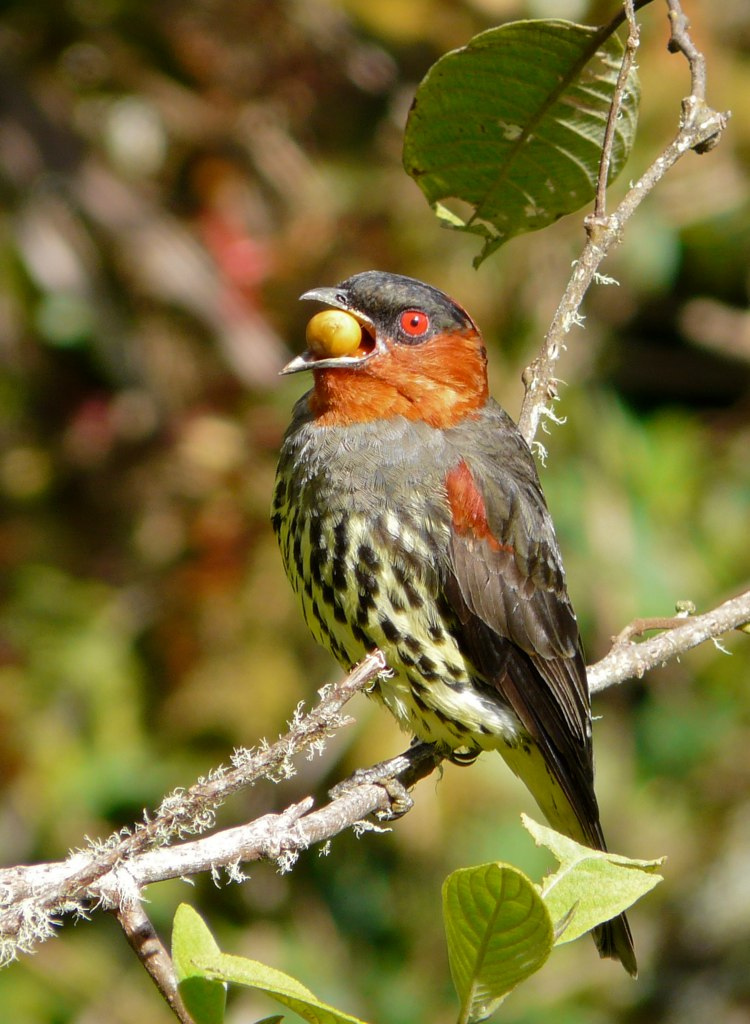
Black-capped Becard
Pachyramphus marginatus
Order: Passeriformes / Family: Cotingidae

Wikimedia Commons
About the Black-capped Becard
The Black-capped Becard, Pachyramphus marginatus, belongs to the family Cotingidae and is recognized by its unique combination of plumage and vocalizations. This medium-sized passerine bird is primarily found in the tropical and subtropical forests of South America, where it plays a significant role in the ecosystem as both a consumer of insects and a disperser of seeds. The species exhibits a preference for dense canopies and forest edges, which provide ample opportunities for foraging and nesting. The Black-capped Becard's range extends across several South American countries, including Brazil, Colombia, Peru, and Venezuela, where it inhabits lowland rainforests, montane forests, and secondary growth areas. Its presence in these varied habitats reflects its adaptability and ecological importance. During the breeding season, which typically aligns with the rainy season, the Black-capped Becard becomes more conspicuous due to its vocalizations and courtship displays. The male's song, a series of musical whistles, can be heard echoing through the canopy, serving as both a territorial declaration and a means of attracting a mate. Outside the breeding season, these birds are more solitary, although they may join mixed-species flocks while foraging. This social behavior not only enhances their foraging efficiency but also provides added protection from predators. The Black-capped Becard's ecological role extends beyond its immediate environment. As an insectivore, it helps control insect populations, contributing to the balance of the forest ecosystem. Additionally, by consuming fruits and dispersing seeds, it supports the regeneration and diversity of plant life in its habitat. Its reliance on forested environments underscores the importance of habitat conservation for maintaining the health and stability of tropical ecosystems. Despite facing threats from deforestation and habitat degradation, the Black-capped Becard remains a resilient species, adapting to changing environments and continuing to thrive in regions where forests are preserved.
The Black-capped Becard belongs to the family Cotingidae, within the order Passeriformes. These birds typically live average 5 years with a max recorded of 9 years.
How to Identify a Black-capped Becard
The Black-capped Becard is easily identified by its striking black cap, which contrasts sharply with its grayish-brown back and buffy underparts. Adult males exhibit a more pronounced black cap and slightly darker plumage compared to females, whose cap may appear more muted. Both sexes share a compact, stocky build with a relatively short tail and stout bill adapted for snatching insects. Juveniles resemble females but have even softer tones and less defined markings. In flight, the Black-capped Becard displays a distinctive silhouette characterized by broad, rounded wings and a short, slightly rounded tail. Its flight tends to be direct and purposeful, often punctuated by short bursts of wing beats followed by glides. When perched, it maintains an upright posture, often seen scanning its surroundings for prey or engaging in its characteristic vocalizations. While the Black-capped Becard's plumage and vocal habits set it apart, it can be confused with similar species such as the Chestnut-crowned Becard. However, the latter species lacks the defining black cap and exhibits a more chestnut-colored crown, aiding in differentiation.
Having trouble telling birds apart? Upload a photo to our bird identification tool for an instant species match.
Black-capped Becard Habitat and Range
Preferred Habitat
The Black-capped Becard thrives in a variety of forested habitats across its range in South America. It is commonly found in lowland rainforests, where dense canopy cover provides abundant food resources and nesting sites. These birds also inhabit montane forests, often at elevations ranging from sea level up to 1,500 meters. Within these forests, they show a preference for areas with a mix of tall trees and secondary growth, which offer both shelter and opportunities for foraging. In some regions, the Black-capped Becard can adapt to more disturbed habitats, such as forest edges and regenerating areas, demonstrating its ecological flexibility. While primarily a forest species, it occasionally ventures into more open areas, provided there is sufficient tree cover. The presence of the Black-capped Becard in both primary and secondary forests highlights the importance of maintaining diverse forest ecosystems to support its populations. Seasonal habitat shifts are generally minimal, with the species remaining largely within its established range throughout the year.
Geographic Range
The Black-capped Becard's range extends throughout much of northern and central South America. It is a resident breeder in countries like Brazil, Colombia, Peru, Ecuador, and Venezuela, where it occupies a wide array of forested habitats. Within these regions, it is most commonly found in lowland rainforests, but it also inhabits montane forests and areas of secondary growth. The population density of the Black-capped Becard tends to be higher in pristine forest areas, where suitable nesting sites and abundant food resources are readily available. Unlike some migratory bird species, the Black-capped Becard does not undertake long-distance migrations, and its movements are generally limited to local dispersal. This resident nature allows it to maintain a relatively stable presence within its preferred habitats year-round. While the species is widespread across its range, certain areas, such as the Amazon Basin and the Andean foothills, serve as population hotspots due to the availability of optimal habitat conditions.
Want to know which birds visit your area? Browse our backyard birds by location guides for region-specific species lists.
What Does the Black-capped Becard Eat?
The diet of the Black-capped Becard primarily consists of insects, which it captures using a variety of foraging techniques. It is adept at gleaning insects from foliage, often working its way through the canopy in search of caterpillars, beetles, and other arthropods. This insectivorous diet is supplemented by the consumption of fruits, particularly during the dry season when insect availability may decrease. The Black-capped Becard exhibits a preference for small to medium-sized prey, which it captures with its stout bill. While foraging, it displays a high level of agility, often hovering or sallying from a perch to catch flying insects. This active foraging behavior not only provides sustenance but also plays a role in controlling insect populations within its habitat. Feeding generally occurs throughout the day, with activity peaking during the early morning and late afternoon when prey is most active. The inclusion of fruit in its diet underscores its role as a seed disperser, contributing to forest regeneration and plant diversity.
Black-capped Becard Behavior and Social Structure
The Black-capped Becard exhibits a range of behaviors that reflect its adaptability and social nature. During the breeding season, males engage in elaborate courtship displays, which include vocalizations and aerial maneuvers intended to attract females and establish territories. These displays are often accompanied by a series of musical whistles, which resonate through the forest canopy. Outside the breeding season, the Black-capped Becard tends to be more solitary, although it participates in mixed-species flocks while foraging. This flocking behavior not only increases foraging efficiency but also offers protection from predators such as raptors and arboreal snakes. In terms of daily activity, the Black-capped Becard is primarily diurnal, with peak activity occurring during the cooler hours of the morning and late afternoon. It spends much of its time foraging within the forest canopy, rarely descending to the forest floor. Territorial behavior is more pronounced during the breeding season, with males defending their chosen areas with vocalizations and displays.
Black-capped Becard Nesting and Reproduction
The Black-capped Becard constructs a distinctive globular nest, typically suspended from the slender branches of a tree. This nest is crafted from a combination of twigs, moss, and other plant fibers, creating a sturdy structure that provides protection for the eggs and young. Nests are usually located at heights ranging from 3 to 12 meters above the ground, often concealed within dense foliage to deter predators. The female takes the primary role in nest construction, although the male may assist to some extent. Once the nest is complete, the female lays a clutch of 2 to 3 eggs, which she incubates for approximately 14 to 16 days. During this period, the male assists by bringing food to the female. After hatching, the chicks remain in the nest for about 16 to 18 days before fledging. Both parents participate in feeding and caring for the young during this critical period. The Black-capped Becard typically raises one brood per year, although in optimal conditions, a second brood may be attempted.
Black-capped Becard Sounds and Vocalizations
The Black-capped Becard's vocalizations are a defining feature of its presence in the forest. Its primary song consists of a series of melodious whistles, often described as clear and flute-like. This song serves multiple purposes, including territory defense and courtship. In addition to its song, the Black-capped Becard produces a variety of call notes, which can range from soft chirps to sharper, more insistent calls. These calls are used for communication between individuals, particularly within mixed-species flocks. During the breeding season, the male's song becomes more frequent and elaborate, forming an integral part of its courtship display. The dawn chorus, a symphony of avian vocalizations, often features the Black-capped Becard's distinctive song, adding to the richness of the forest soundscape. Compared to other birds within its habitat, the Black-capped Becard's song is relatively easy to identify, aiding birdwatchers in locating and identifying this species.
Interesting Facts About the Black-capped Becard
- 1The Black-capped Becard's nest, a globular structure, is unique in that it often hangs from slender branches, providing both camouflage and protection.
- 2This species is not strictly insectivorous; during certain seasons, up to 20% of its diet can consist of fruits, aiding in seed dispersal.
- 3The Black-capped Becard is part of the Cotingidae family, a group known for its diverse and often colorful members, though this species is more subtly hued.
- 4Despite its preference for forest habitats, the Black-capped Becard is frequently sighted at forest edges and in degraded forest areas, showcasing its adaptability.
- 5While many birds are migratory, the Black-capped Becard remains in its range year-round, reflecting the relatively stable climate of its tropical habitat.
Black-capped Becard Conservation Status
The Black-capped Becard is currently classified as Least Concern by the IUCN, indicating a stable population trend. However, the species faces threats from habitat loss due to deforestation and land conversion for agriculture. Conservation efforts aimed at preserving its forest habitat are crucial for maintaining healthy populations. In regions where forest cover remains intact, the Black-capped Becard continues to thrive, utilizing both primary and secondary growth forests. Historical population data suggest that while localized declines have occurred in heavily deforested areas, the overall population remains stable across its range. Initiatives focused on sustainable land management and the protection of critical forest habitats are essential for ensuring the long-term survival of the Black-capped Becard. Continued monitoring of population trends and habitat conditions will be necessary to address potential future threats and to implement effective conservation strategies.