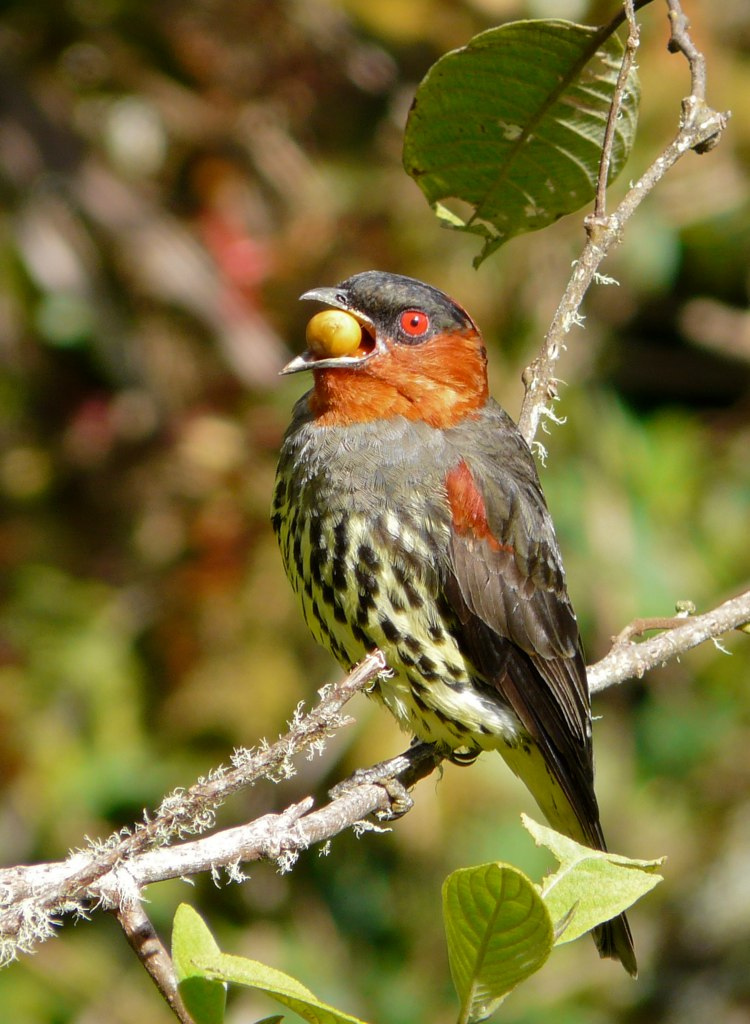
Black-capped Piprites
Piprites pileata
Order: Passeriformes / Family: Cotingidae

Wikimedia Commons
About the Black-capped Piprites
The Black-capped Piprites (Piprites pileata) is a small, enigmatic bird species belonging to the family Cotingidae. Found primarily in the montane and lowland forests of eastern Brazil and Paraguay, this species thrives in subtropical and tropical moist forests. Its presence in diverse forest environments marks it as an important indicator of ecosystem health and biodiversity. The bird plays a significant ecological role as both a seed disperser and insect predator, contributing to forest regeneration and pest control.
Endemic to South America, the Black-capped Piprites exhibits behaviors characteristic of its family, such as frugivory and territorial displays. Its seasonal behaviors are influenced markedly by the availability of fruiting trees and insect populations. The species is generally sedentary, with minor local movements in response to food availability. During the breeding season, the Black-capped Piprites engages in complex courtship displays, which are a spectacle of both sight and sound in the dense canopy.
Ecologically, the Black-capped Piprites serves an essential role in its habitat. Its diet primarily consists of fruits and insects, making it a versatile forager. The species' foraging behavior aids in the control of insect populations and the dispersal of seeds, which in turn supports forest growth and diversity. These ecological roles, coupled with its sensitivity to habitat disturbance, make the Black-capped Piprites an important species for monitoring environmental changes in its native regions.
The Black-capped Piprites belongs to the family Cotingidae, within the order Passeriformes. These birds typically live average 5 years with a maximum recorded of 9 years..
How to Identify a Black-capped Piprites
The Black-capped Piprites is easily recognizable by its striking black cap, which contrasts sharply with its olive-green body and yellowish underparts. Adult males and females share similar plumage, though males tend to have a slightly glossier black cap. Juveniles resemble adults but have a more subdued coloration overall, with a less defined cap.
In terms of size, the Black-capped Piprites is a small bird, measuring approximately 12-14 cm in length. Its wings and tail are relatively short, contributing to its compact silhouette. When in flight, the bird's wingbeats are rapid and direct, characteristic of many forest-dwelling passerines. Its perching posture is upright, often seen on horizontal branches within the mid to upper canopy.
The Black-capped Piprites may be confused with similar cotingid species, particularly those with olive-green plumage. However, the pronounced black cap serves as a definitive field mark that sets it apart. Observers should also note its distinctive call, which further aids in distinguishing it from similar species.
Having trouble telling birds apart? Upload a photo to our bird identification tool for an instant species match.
Black-capped Piprites Habitat and Range
Preferred Habitat
The Black-capped Piprites occupies subtropical and tropical moist forests, with a preference for dense, mature woodlands. It is often found at elevations ranging from 500 to 1,500 meters, though it may occur at lower altitudes in some regions. The species shows a marked preference for areas with abundant fruiting trees, which provide essential food resources.
While primarily a forest species, the Black-capped Piprites can adapt to secondary forests and forest edges, provided that sufficient cover and food sources remain available. Unlike some other cotingids, it is not typically found in urban environments, preferring the tranquility and resources of undisturbed forest habitats.
Geographic Range
The Black-capped Piprites is found almost exclusively in the eastern part of South America. Its range extends primarily across eastern Brazil, with populations also present in northeastern Argentina and eastern Paraguay. This limited distribution makes it a species of interest for conservationists and ornithologists alike.
The species is largely sedentary, with populations remaining within their established territories year-round. However, slight altitudinal migrations may occur in response to seasonal changes in food availability. Despite its limited range, the Black-capped Piprites occupies a variety of forest types within its distribution, from lowland tropical forests to montane cloud forests.
Want to know which birds visit your area? Browse our backyard birds by location guides for region-specific species lists.
What Does the Black-capped Piprites Eat?
The diet of the Black-capped Piprites consists mainly of fruits and insects, reflecting its adaptability as a forager. During the wet season, when fruit abundance peaks, the bird predominantly feeds on a variety of berries and small fruits from forest trees and shrubs.
Insect consumption increases during the dry season or whenever fruit becomes scarce. The Black-capped Piprites employs a gleaning technique, picking off insects from leaves and branches with precision. Prey items include small beetles, ants, and caterpillars, which provide essential protein and nutrients, particularly during breeding periods.
Feeding occurs throughout the day, with peaks in activity during the cooler morning and late afternoon hours. The bird often forages alone or in pairs, though it may join mixed-species flocks when food is plentiful.
Black-capped Piprites Behavior and Social Structure
The Black-capped Piprites displays interesting social and territorial behaviors. While generally solitary, it defends its territory vigorously during the breeding season, engaging in vocal and physical displays to deter rivals. Courtship involves elaborate displays, with males showcasing their plumage and engaging in aerial maneuvers to attract mates.
In terms of flocking behavior, the Black-capped Piprites may join mixed-species flocks outside the breeding season, benefiting from increased foraging efficiency and predator detection. These flocks often include other cotingids and insectivorous passerines, enhancing resource access.
The bird exhibits a diurnal activity pattern, with peak activity occurring in the early morning and late afternoon. It remains relatively inactive during the hottest midday hours, seeking shade and conserving energy.
Black-capped Piprites Nesting and Reproduction
The nesting habits of the Black-capped Piprites reflect its adaptation to dense forest environments. The species typically constructs cup-shaped nests using a variety of materials, including twigs, leaves, and moss. These nests are strategically placed in the mid to upper canopy, providing protection from ground predators and environmental elements.
Clutch size generally consists of 2-3 eggs, with both parents sharing incubation duties. The incubation period lasts approximately 14-17 days. After hatching, the young are fed by both parents and fledge around 18-20 days post-hatching.
The Black-capped Piprites usually raises one brood per year, though favorable conditions may allow for a second. Parental roles are shared, with both males and females contributing to feeding and protecting the young.
Black-capped Piprites Sounds and Vocalizations
The primary song of the Black-capped Piprites is a series of clear, melodious whistles that descend in pitch. It often sings its song from a concealed perch high in the forest canopy, making visual detection challenging. The call notes are sharp and distinctive, serving as a communication tool between mates and within mixed-species flocks.
Alarm calls are harsher and more abrupt, typically triggered by the presence of predators. During the dawn chorus, the Black-capped Piprites contributes its song to the rich tapestry of sounds that fill the forest, adding to the vibrant acoustic landscape of its habitat.
Interesting Facts About the Black-capped Piprites
- 1The Black-capped Piprites is one of the few cotingids that exhibits frugivory and insectivory, showcasing dietary flexibility.
- 2Despite its small range, the Black-capped Piprites contributes significantly to seed dispersal, aiding forest regeneration.
- 3The species' melodious song is often heard before the bird is seen, highlighting its elusive nature in dense forests.
- 4Black-capped Piprites' nesting habits include using moss for camouflage, an adaptation to avoid predation.
- 5With a preference for mature forests, the Black-capped Piprites serves as an indicator of forest health and stability.
Black-capped Piprites Conservation Status
Currently, the Black-capped Piprites is classified as Near Threatened by the IUCN, with a population trend that is decreasing due to habitat loss. Deforestation and agricultural expansion in its native range pose significant threats to its habitat. Conservation efforts focus on habitat preservation and restoration, with protected areas established in parts of its range to safeguard vital forest environments. Though historically more widespread, habitat destruction has led to localized population declines. Continued efforts are necessary to ensure the survival of this species, emphasizing the importance of sustainable land-use practices and environmental education.