Black-crowned Barwing
Actinodura sodangorum
Order: Passeriformes / Family: Leiothrichidae

Wikimedia Commons
About the Black-crowned Barwing
The Black-crowned Barwing, Actinodura sodangorum, is an intriguing passerine bird belonging to the Leiothrichidae family. This species inhabits the montane forests of the central highlands of Vietnam, particularly around the Ngoc Linh Mountain, where its presence is a key indicator of the ecological health of these unique habitats. The bird's ecological role is significant as it forms part of a diverse forest community, contributing to the complex web of life in these montane regions. The Black-crowned Barwing is known for its sociable nature, often found in mixed-species flocks, a behavior that aids in predator avoidance and enhances food foraging efficiency. It plays a crucial role in seed dispersal, helping maintain the forest's biodiversity. During the breeding season, which typically occurs from March to May, the Black-crowned Barwing becomes more territorial, engaging in vocal displays to establish and defend its territory. In the non-breeding season, the bird's movements are less constrained, and it can be seen traveling in larger flocks. The species' presence underscores the importance of conservation efforts in the montane forests of Vietnam, which are under threat from deforestation and habitat fragmentation. As these forests continue to face anthropogenic pressures, the conservation of the Black-crowned Barwing becomes increasingly vital, not only for preserving the species itself but also for maintaining the health and diversity of its forest home.
The Black-crowned Barwing belongs to the family Leiothrichidae, within the order Passeriformes. These birds typically live average 5-8 years with a max recorded of 10 years.
How to Identify a Black-crowned Barwing
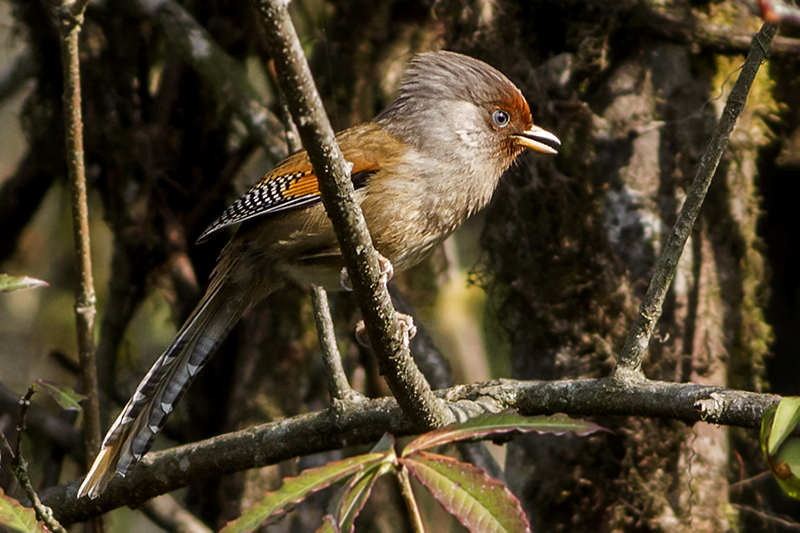
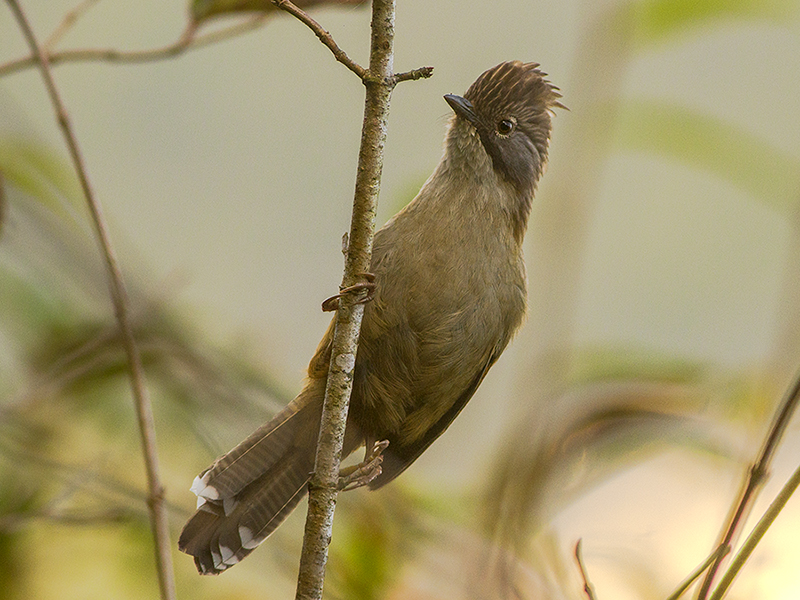
The Black-crowned Barwing is medium-sized, measuring approximately 22-25 cm in length. Its most distinguishing feature is the eponymous black crown, contrasting sharply with its grayish-brown back and wings adorned with intricate barring. The wings exhibit a unique pattern of white and cinnamon bars, making it stand out among similarly sized species. The bird's underparts are a lighter, buffy color, adding to its distinctive appearance. Juveniles resemble adults but have less defined barring and a slightly duller crown, which gradually darkens as they mature. Male and female Black-crowned Barwings are similar in appearance, though females may exhibit slightly duller plumage. In flight, the Black-crowned Barwing displays a steady, undulating pattern, with broad, rounded wings that contribute to its agile maneuvering through dense forest canopies. When perched, the bird often adopts an upright posture, showcasing its striking plumage and making it easier to spot against the forest backdrop. Potential confusion might arise with other barwing species, but the Black-crowned's distinctive black crown and wing patterns are reliable field marks for accurate identification.
Having trouble telling birds apart? Upload a photo to our bird identification tool for an instant species match.
Black-crowned Barwing Habitat and Range
Preferred Habitat
The Black-crowned Barwing is primarily found in montane forests, thriving at elevations ranging from 1,200 to 2,200 meters. These forests, characterized by dense canopy cover and a rich understory, provide the ideal environment for this species. Within these habitats, the bird prefers areas with abundant lianas and epiphytes, which offer both food resources and nesting sites. The Black-crowned Barwing is a resident species, showing little seasonal habitat shift, though it may move slightly in response to food availability. Unlike some other forest birds, it has not adapted well to urban environments, remaining largely restricted to undisturbed forest areas. This specificity in habitat preference highlights the vulnerability of the Black-crowned Barwing to forest degradation and underscores the need for targeted conservation of its montane forest habitat.
Geographic Range
The Black-crowned Barwing's range is quite limited, confined to the Annamite mountain range in central Vietnam. Within this range, it is primarily found in the Ngoc Linh Mountain area, where it occupies a relatively narrow altitudinal band. As a non-migratory species, its movements are largely restricted to its breeding and foraging territories within these montane forests. The bird's population density is highest in areas with dense forest cover and minimal human disturbance, making these regions crucial for its survival. Despite its limited range, the Black-crowned Barwing plays a significant role in its ecosystem, and efforts to map its range more comprehensively are ongoing to ensure effective conservation strategies.
Want to know which birds visit your area? Browse our backyard birds by location guides for region-specific species lists.
What Does the Black-crowned Barwing Eat?
The Black-crowned Barwing's diet consists mainly of insects and other small arthropods, which it gleans from foliage and bark surfaces in its forest habitat. The bird employs a variety of foraging techniques, including gleaning and probing, to extract prey from crevices and under leaves. During the breeding season, the Black-crowned Barwing increases its intake of protein-rich insects to support the energetic demands of raising young. Outside of the breeding season, its diet may expand to include a greater proportion of berries and seeds, especially during times when insect prey is less abundant. The bird typically forages in the cooler parts of the day, such as early morning and late afternoon, to avoid the midday heat. Its foraging behavior is often conducted in mixed-species flocks, which enhances its efficiency and provides safety in numbers.
Black-crowned Barwing Behavior and Social Structure
The Black-crowned Barwing exhibits a highly social behavior, often participating in mixed-species flocks that roam through the forest in search of food. This flocking behavior not only improves foraging success but also provides protection from predators, as the presence of multiple species increases vigilance. The bird's territorial behavior is most pronounced during the breeding season, when pairs establish and defend nesting territories through vocal displays and aggressive posturing. Courtship involves a series of intricate displays, where males showcase their plumage and engage in synchronized movements to attract females. Outside the breeding season, the Black-crowned Barwing is more relaxed in its social interactions, often seen in larger groups. Its response to predators involves a combination of alarm calls and evasive flight, retreating swiftly into dense vegetation. Daily activity patterns are influenced by the availability of food and the need to avoid the hottest parts of the day, with the bird most active during the cooler morning and late afternoon hours.
Black-crowned Barwing Nesting and Reproduction
The nesting behavior of the Black-crowned Barwing is characterized by careful selection of sites within dense montane forests. Nests are typically constructed in shrubs or small trees, at heights ranging from 1 to 3 meters above the ground. The nests themselves are cup-shaped, composed of twigs, leaves, and other plant materials, intricately woven to provide stability and camouflage. A typical clutch consists of 2 to 3 eggs, which are incubated by both parents. The incubation period lasts approximately 14 to 16 days, followed by a fledging period of about 12 to 14 days. Both parents share responsibilities in feeding and protecting the chicks. The species generally raises one brood per year, but in favorable conditions, a second brood may be attempted. The young are semi-altricial at hatching, requiring considerable parental care before they are ready to fledge.
Black-crowned Barwing Sounds and Vocalizations
The Black-crowned Barwing's primary song is a melodious series of clear whistles, often delivered from a conspicuous perch. The rhythm is steady, with each note rising in pitch, creating a cascading effect that resonates through the forest. Call notes are varied, including short chips and trills that serve as contact calls between flock members. Alarm calls are sharper and more urgent, designed to alert others to the presence of predators. During the dawn chorus, the Black-crowned Barwing's song contributes to the symphony of forest sounds, competing with other species' vocalizations. The bird's vocal repertoire is an essential element of its communication strategy, facilitating social interactions and territory defense.
Interesting Facts About the Black-crowned Barwing
- 1The Black-crowned Barwing was only discovered in 1996, making it one of the more recent additions to ornithological records.
- 2This species is part of a diverse mixed-species flock, sometimes including up to 10 different bird species.
- 3The intricate barring on its wings is not only aesthetic but also plays a role in camouflage against predators.
- 4Despite its relatively small size, the Black-crowned Barwing's song can carry over long distances in dense forests.
- 5Each Black-crowned Barwing pair maintains a territory of about 0.5 hectares during the breeding season.
- 6The species' diet shifts seasonally, relying more on berries during the dry season when insects are scarce.
- 7The Black-crowned Barwing's discovery in the late 20th century highlights the rich biodiversity still to be explored in Vietnam.
Black-crowned Barwing Conservation Status
The Black-crowned Barwing is currently classified as Vulnerable by the IUCN due to its limited range and the ongoing threat of habitat loss. Deforestation and habitat fragmentation in central Vietnam pose significant threats to its survival. Conservation efforts focus on habitat protection and restoration, with particular emphasis on preserving the montane forests that are critical to the species' existence. Historical population trends suggest a decline in numbers corresponding to increased human activity in the region. Active measures, such as the establishment of protected areas and community-based conservation programs, are vital to reversing this trend and ensuring the long-term survival of the Black-crowned Barwing.