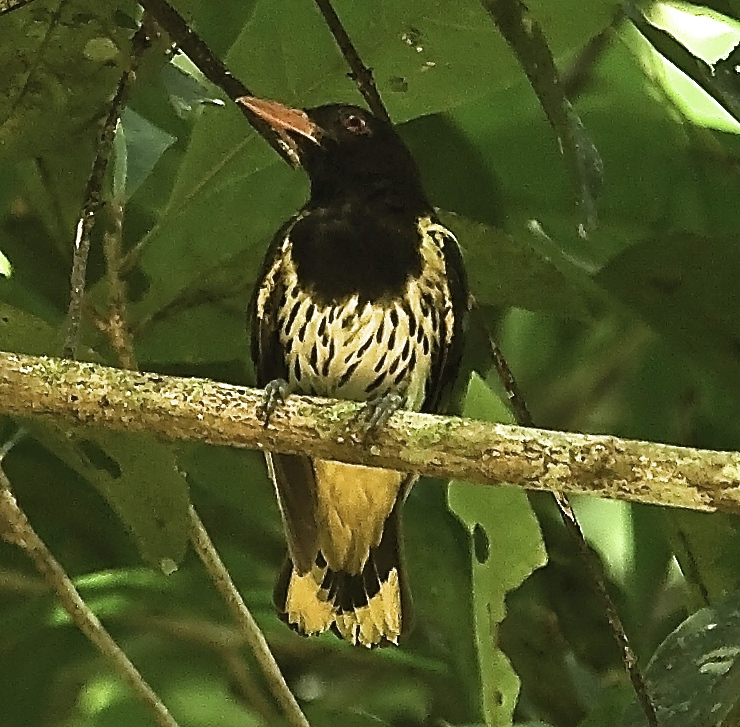
Black-hooded Oriole
Oriolus xanthornus
Order: Passeriformes / Family: Oriolidae

Wikimedia Commons
About the Black-hooded Oriole
The Black-hooded Oriole (Oriolus xanthornus) is a vibrant member of the Oriolidae family, renowned for its striking color contrast of a bright yellow body and a distinctive black hood. This species holds significant ecological value in South Asia, where it thrives in a variety of habitats ranging from deciduous forests to urban gardens. The Black-hooded Oriole plays a crucial role in its ecosystem by helping in seed dispersal and pest control. Its presence is often associated with lush greenery, as it prefers habitats with dense foliage that provide ample feeding and nesting opportunities.
In India and Sri Lanka, the Black-hooded Oriole is frequently observed in mixed forests, plantations, and even city parks, illustrating its adaptability. The bird is known for its melodious calls, which contribute to the acoustic landscape of its habitat and provide an auditory cue for birdwatchers and naturalists alike. During the breeding season, which typically spans from March to August, the Black-hooded Oriole becomes even more vocal, using its song to establish territories and attract mates.
The Black-hooded Oriole's ecological role extends beyond its interactions with plant species. As an insectivore, it helps control insect populations, thus maintaining a balance in its habitat. Its diet includes a variety of insects and fruits, making it an integral part of food webs. The presence of this oriole is an indicator of healthy ecosystems, as it thrives in environments with rich biodiversity. This species also exhibits regional variations in behavior, adapting to the climatic and ecological conditions of different parts of its range, from the humid lowlands of Bangladesh to the cooler regions of the Indian subcontinent.
The Black-hooded Oriole belongs to the family Oriolidae, within the order Passeriformes. These birds typically live average 8-10 years with a max recorded of 15 years.
How to Identify a Black-hooded Oriole
The adult Black-hooded Oriole is unmistakable, with a bright yellow body contrasted by a glossy black hood that covers the head and throat. The wings are black with white wing bars, and the tail is black with yellow tips. This striking appearance is consistent between males and females, though females may exhibit slightly duller plumage. Juveniles can be distinguished by their less intense yellow and a more patchy black hood.
In the field, the Black-hooded Oriole is often confused with the Indian Oriole (Oriolus kundoo) and the Black-naped Oriole (Oriolus chinensis). However, the Indian Oriole lacks a full black hood, and the Black-naped Oriole has a distinctive black nape rather than a full hood. The Black-hooded Oriole's flight silhouette is streamlined, with powerful wingbeats and a slightly undulating flight pattern.
When perched, the Black-hooded Oriole maintains an upright posture. Its long tail and strong, slightly curved bill are notable features. The combination of its vibrant plumage and active movement through the canopy makes it a conspicuous presence in its habitat. Observers should look for the bright yellow and black contrast to accurately identify this species.
Having trouble telling birds apart? Upload a photo to our bird identification tool for an instant species match.
Black-hooded Oriole Habitat and Range
Preferred Habitat
The Black-hooded Oriole inhabits a wide range of environments, demonstrating its adaptability. It favors open forests, wooded areas, and plantations, particularly those with abundant fruiting trees. In India, it is commonly found in the lowland forests of the Western Ghats and the subtropical forests of the northeastern states.
This oriole also thrives in urban areas, frequenting gardens and parks where mature trees are present. Its altitude range extends up to 2000 meters, though it is more commonly observed at lower elevations. Seasonal shifts in habitat are minimal, as the species does not undertake long migrations, instead adjusting its range locally based on food availability.
In rural settings, the Black-hooded Oriole often occupies agricultural landscapes, such as tea and coffee plantations, where it can find ample food and nesting sites. Its presence in diverse habitats underscores its adaptability and resilience, allowing it to maintain a stable population across its range.
Geographic Range
The Black-hooded Oriole's range encompasses much of South Asia, including India, Sri Lanka, Nepal, Bangladesh, and parts of Pakistan. It is a resident species throughout this region, with no significant long-distance migrations reported.
In India, it is widespread, with populations present in the Western Ghats, the central Indian highlands, and the northeastern states. Sri Lanka hosts a thriving population, particularly in the wet zone and dry lowlands. The species is less common in the arid regions of northwest India and Pakistan.
Population density hotspots include the forested regions of Assam and Kerala, where the Black-hooded Oriole benefits from the rich biodiversity and availability of resources. While the bird's distribution is stable, local population densities can fluctuate based on habitat quality and food availability. Its non-migratory nature ensures that it remains a consistent presence across its range, making it a familiar bird to residents and birdwatchers alike.
Want to know which birds visit your area? Browse our backyard birds by location guides for region-specific species lists.
What Does the Black-hooded Oriole Eat?
The Black-hooded Oriole has an omnivorous diet that varies with seasonal availability. Fruits form a significant part of its diet, with a preference for figs, berries, and other soft fruits found in its habitat. It also consumes nectar when available, often visiting flowering trees and shrubs.
Insectivory is another key aspect of its diet, with the oriole actively hunting for caterpillars, beetles, and other insects. This behavior is particularly prominent during the breeding season when protein demands are higher. The bird employs a gleaning technique, picking insects off leaves and branches, and occasionally executes short aerial sallies to catch flying insects.
Feeding occurs primarily in the morning and late afternoon, aligning with peak insect activity and fruit availability. The Black-hooded Oriole's diverse diet allows it to adapt to varying food resources, making it a versatile forager capable of thriving in multiple habitats throughout the year.
Black-hooded Oriole Behavior and Social Structure
The Black-hooded Oriole exhibits a variety of behaviors that reflect its adaptability and social nature. It is generally seen alone or in pairs, though small family groups may form during the non-breeding season. The species is territorial, especially during the breeding season, when males become more vocal and assertive in defending their nesting area.
Courtship displays include singing and posturing, with males showcasing their bright plumage to attract females. During this period, the oriole becomes more conspicuous, often perching prominently while calling. In response to predators, the Black-hooded Oriole employs a mix of vocal alarms and evasive flight, relying on its agility to escape threats.
The oriole's daily activity pattern involves active foraging in the morning and late afternoon, with periods of rest during the hottest parts of the day. Its ability to adapt to different social structures and environmental conditions is a testament to its evolutionary success in diverse habitats across its range.
Black-hooded Oriole Nesting and Reproduction
Black-hooded Orioles build their nests in trees, preferring to place them on a horizontal fork of a branch. The nest is a deep, cup-shaped structure woven from grass, twigs, and fibers, often reinforced with spider webs for durability. This construction provides a secure environment for raising young.
The typical clutch size ranges from two to three eggs, which are pale with reddish-brown spots. Incubation lasts about 14 days, primarily undertaken by the female, while the male assists by providing food and guarding the nest.
After hatching, both parents participate in feeding the chicks, which fledge approximately 14-16 days post-hatching. The Black-hooded Oriole may raise two broods per year, depending on food availability and environmental conditions. This reproductive strategy ensures the continuation of the species in its stable habitats.
Black-hooded Oriole Sounds and Vocalizations
The Black-hooded Oriole is known for its rich, melodious song that is both clear and fluty. The song consists of a series of whistled notes, often described as 'pee-loo, pee-loo' or 'pee-pee-pee-loo,' delivered with a rhythmic cadence. This song is most frequently heard during the breeding season, serving as a territorial and courtship display.
In addition to its primary song, the oriole produces several call notes, including a harsh 'krr-rack' used in alarm situations. Its vocal repertoire also includes softer, conversational calls exchanged between mates or family members.
The Black-hooded Oriole participates in the dawn chorus, adding its voice to the symphony of sounds that mark the early morning in its habitat. These vocalizations not only aid in communication but also enhance the bird's presence in the lush landscapes it inhabits.
Interesting Facts About the Black-hooded Oriole
- 1The Black-hooded Oriole is not a migratory bird, which allows it to maintain a stable presence in its range year-round.
- 2This oriole is often seen feeding on the fruits of the Ficus tree, playing a role in seed dispersal for this and other plant species.
- 3Despite its vivid plumage, the Black-hooded Oriole can be surprisingly elusive, often hidden among dense foliage.
- 4The Black-hooded Oriole's song can travel long distances in the forest, making it easier to hear than to see.
- 5In Sri Lanka, the Black-hooded Oriole is known locally as 'Kaha Kurulla,' highlighting its bright yellow coloration.
- 6The species has adapted well to urban environments, often seen in city parks and gardens where large trees are present.
- 7Black-hooded Orioles sometimes use their strong bills to peel bark in search of insects, showcasing their versatile foraging skills.
Black-hooded Oriole Conservation Status
The Black-hooded Oriole currently holds a conservation status of 'Least Concern' according to the IUCN Red List, reflecting its widespread distribution and stable population trend. However, habitat loss due to deforestation and urbanization poses a potential threat. Conservation efforts focus on preserving natural habitats and promoting sustainable land use practices in regions where this oriole is prevalent. In some areas, local initiatives aim to enhance biodiversity in urban landscapes, providing additional resources for the Black-hooded Oriole. Historically, the species has shown resilience to environmental changes, maintaining stable populations across its range. Continued monitoring and habitat conservation are essential to ensure its long-term survival, particularly in areas experiencing rapid development.
Other Oriolidae Species


Birds Similar to the Black-hooded Oriole
These species are often confused with the Black-hooded Oriole due to similar appearance or overlapping range.