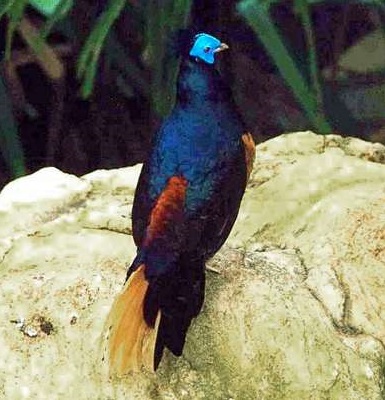
Black Partridge
Melanoperdix niger
Order: Galliformes / Family: Phasianidae

Wikimedia Commons
About the Black Partridge
The Black Partridge, or Melanoperdix niger, is a small, ground-dwelling bird native to the dense lowland rainforests of Southeast Asia. These birds are typically found in the humid undergrowth of primary and secondary forests, primarily in countries like Malaysia, Borneo, and Sumatra. Unlike many other members of the Phasianidae family, the Black Partridge has adapted to a life away from open habitats, showcasing its ecological significance by thriving in dense vegetation. As a ground-dwelling species, it plays a pivotal role in seed dispersal and insect population control within its ecosystem. This bird's presence is a strong indicator of a healthy forest environment, as it relies on undisturbed forest floors for feeding and nesting. During different seasons, especially the wet season, the Black Partridge's behavior and activity levels may change slightly, though it generally remains within its forested habitat throughout the year. Its seasonal behaviors include slight shifts in territory size and increased vocalizations during the breeding season. The Black Partridge is an elusive species, often heard rather than seen, as it prefers to remain hidden within the dense underbrush. Its importance extends beyond its ecological role, as it is also a cultural symbol in some local communities, often featured in traditional folklore and stories. Unfortunately, due to deforestation and habitat fragmentation, the Black Partridge's habitat is under threat, making conservation efforts crucial for its continued survival. Preserving its natural habitat not only helps maintain the balance of the ecosystem but also ensures the survival of a species that has coexisted with the rich biodiversity of Southeast Asia for centuries.
The Black Partridge belongs to the family Phasianidae, within the order Galliformes. These birds typically live average 6 years, with a maximum recorded of 9 years..
How to Identify a Black Partridge
The Black Partridge is easily identified by its uniform glossy black plumage, which distinguishes it from other partridge species. Adult males are entirely black with a slight iridescence, while females are a duller brown, providing them with effective camouflage in the forest undergrowth. Juveniles resemble the females but are slightly lighter in color, with more pronounced streaking. Unlike many of its relatives, the Black Partridge does not exhibit striking patterns or contrasting colors, relying instead on its dark plumage to blend into the shadows of the forest floor. In flight, the Black Partridge exhibits a short, rapid wingbeat pattern, staying low to the ground. When perched, it maintains a horizontal posture, often remaining motionless to avoid detection. While it could be confused with other dark-feathered birds, the absence of any bright or contrasting markings helps in its identification. Observers must rely on its size, approximately 27-30 centimeters in length, and its unique habitat preferences for accurate identification.
Having trouble telling birds apart? Upload a photo to our bird identification tool for an instant species match.
Black Partridge Habitat and Range
Preferred Habitat
The Black Partridge resides primarily in the dense lowland rainforests of Southeast Asia, including Malaysia, Borneo, and Sumatra. These birds prefer primary and secondary forests with ample undergrowth, which provides cover from predators and abundant food resources. They are typically found at elevations ranging from sea level to about 1,500 meters, although they show a preference for lower elevations where dense foliage is prevalent. Unlike some bird species, the Black Partridge does not show significant seasonal habitat shifts, remaining in forested areas year-round. While they are not commonly found in urban environments, small populations may persist in areas where forest edges meet agricultural lands.
Geographic Range
The Black Partridge is primarily found in the tropical rainforests of Southeast Asia. Its breeding range covers the Malay Peninsula, Borneo, and Sumatra, where it resides year-round due to the consistent climate of these regions. This bird does not undertake long-distance migrations, preferring to remain within its established territories throughout its life. In terms of population density, higher concentrations are often located in undisturbed forest regions where human impact is minimal. However, habitat fragmentation has caused some populations to become isolated, leading to localized declines in numbers in certain areas.
Want to know which birds visit your area? Browse our backyard birds by location guides for region-specific species lists.
What Does the Black Partridge Eat?
The diet of the Black Partridge primarily consists of seeds, fruits, and small insects, which it forages from the forest floor. During the wet season, when insect activity increases, the bird's diet shifts slightly to include a higher proportion of insects and other invertebrates. This dietary flexibility helps the Black Partridge thrive in its forest habitat. Foraging typically occurs during the early morning and late afternoon, when the ground is cooler and less disturbed. The bird uses its strong legs to scratch through leaf litter, uncovering hidden food sources. The size of its prey ranges from small insects to larger beetles, depending on availability. Its feeding schedule may vary slightly with changes in daylight and weather conditions.
Black Partridge Behavior and Social Structure
Socially, the Black Partridge tends to be a solitary or loosely paired bird, especially during the non-breeding season. Territorial behavior intensifies during the breeding season, with males often engaging in vocal displays to establish dominance and attract mates. These displays include a series of rapid, repetitive calls that can be heard echoing through the forest. Flocking behavior is not typical of this species, as they prefer to maintain a certain degree of distance from other individuals, except during courtship. In response to predators, the Black Partridge relies heavily on its camouflage and quick, low flight to evade capture. Daily activity patterns are largely crepuscular, with birds being most active during the cooler hours of dawn and dusk. This pattern reduces exposure to predators and allows them to exploit food resources with fewer competitors.
Black Partridge Nesting and Reproduction
The Black Partridge nests on the ground, often hidden among dense vegetation to protect against predators. Nests are typically shallow scrapes lined with leaves and grass, providing limited but effective insulation and camouflage. Clutch sizes range from four to six eggs, with females primarily responsible for incubation. The incubation period lasts approximately 18-21 days, after which chicks are precocial and leave the nest shortly after hatching. Both parents play a role in guiding the young and teaching them to forage, although the female takes the lead in brooding and initial care. The fledging timeline extends over several weeks, during which the chicks gradually develop the necessary skills for independence. Generally, the Black Partridge raises one brood per year, although in favorable conditions, a second brood might be attempted.
Black Partridge Sounds and Vocalizations
The primary song of the Black Partridge is a series of low, rhythmic calls that serve both as territorial markers and mating calls. These vocalizations consist of a rapid sequence of notes, often described as a 'chuck-chuck-chuck' sound, which are repeated at intervals. Call notes can vary in pitch and intensity, depending on the bird's emotional state or the presence of potential threats. Alarm calls are typically sharper and more urgent, serving to alert nearby birds of danger. During the dawn chorus, the Black Partridge contributes with its unique calls, adding to the symphony of the forest. Its vocalizations, though not as melodious as those of songbirds, are distinctive and invaluable for field identification.
Interesting Facts About the Black Partridge
- 1The Black Partridge is one of the few partridge species adapted to life in dense tropical rainforests, showcasing a unique ecological niche.
- 2Unlike many other game birds, the Black Partridge remains largely monogamous, with pairs often staying together year-round.
- 3Despite its name, the Black Partridge is not entirely black, as females exhibit a more subdued brown plumage for camouflage.
- 4This partridge's call, a distinctive 'chuck-chuck-chuck,' can be heard echoing through the forest during the early morning hours.
- 5The Black Partridge's preference for lowland forests makes it particularly vulnerable to deforestation and habitat fragmentation.
- 6It plays a crucial role in its ecosystem by aiding in seed dispersal and controlling insect populations naturally.
- 7The Black Partridge's elusive nature makes it a challenging species to observe in the wild, often requiring patience and keen listening skills.
Black Partridge Conservation Status
Currently classified as Near Threatened by the IUCN, the Black Partridge faces a declining population trend primarily due to habitat loss and fragmentation. Deforestation for agriculture and urban development poses the greatest threat to its natural habitat. Conservation efforts focus on habitat preservation and the establishment of protected areas to ensure the survival of remaining populations. Historically, the Black Partridge's range was more extensive, but human activity has significantly reduced its available habitat, leading to vulnerabilities in its population dynamics. Efforts to raise awareness and implement sustainable land-use practices are essential for reversing the decline and ensuring the species' long-term survival.
Other Phasianidae Species


Birds Similar to the Black Partridge
These species are often confused with the Black Partridge due to similar appearance or overlapping range.