
Blackish Pewee
Contopus nigrescens
Order: Passeriformes / Family: Tyrannidae
Wikimedia Commons
About the Blackish Pewee
The Blackish Pewee, scientifically known as Contopus nigrescens, is a small passerine bird that belongs to the family Tyrannidae. This bird is primarily known for its uniformly dark plumage, which provides excellent camouflage within the dense forest canopies it inhabits. The Blackish Pewee is native to Central and South America, where it inhabits montane forests, often found at elevations ranging from 900 to 2500 meters. Its range includes countries such as Costa Rica, Panama, Colombia, Ecuador, and northern Peru. These regions host cloud forests and subtropical montane forests, where the Blackish Pewee thrives.
The significance of the Blackish Pewee lies in its role within the ecosystem as an insectivore, contributing to the control of insect populations in its habitat. By preying on a variety of flying insects, it helps maintain the ecological balance in the forested regions it calls home. The Blackish Pewee is not migratory, making it a year-round resident in its range. However, it may exhibit altitudinal movements in response to seasonal changes in food availability. During the breeding season, which typically occurs from March to August, the Blackish Pewee becomes particularly vocal, with its calls resonating through the canopy as it establishes territories and attracts mates.
In terms of its ecological role, the Blackish Pewee serves as an indicator species for the health of montane forest ecosystems. Its presence signals relatively undisturbed forest habitats, as it tends to avoid areas with significant human disturbance. Because of its dependency on well-preserved forests, the Blackish Pewee is also sensitive to habitat degradation, emphasizing the importance of conservation efforts in these regions. Despite these challenges, the Blackish Pewee's overall population remains stable, benefiting from the protected areas within its range.
The Blackish Pewee belongs to the family Tyrannidae, within the order Passeriformes. These birds typically live average 4-5 years with a maximum recorded of 8 years..
How to Identify a Blackish Pewee
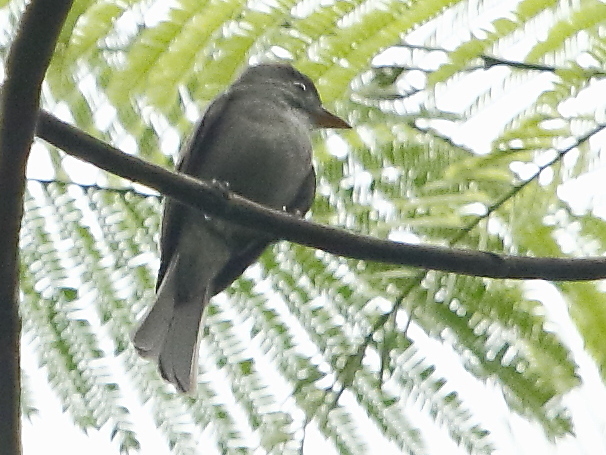
The Blackish Pewee is a small bird, measuring about 13 to 14 cm in length and weighing around 10 to 15 grams. Its plumage is predominantly dark gray to blackish, with subtle variations in shade across its body. The adult Blackish Pewee exhibits a uniformly dark upper body, while the underparts are slightly lighter, blending into a smokey gray. The bird's wings and tail are also dark, with the latter often showing a slight notched appearance when folded.
Juvenile Blackish Pewees can be distinguished from adults by their slightly browner tones and the presence of faint buffy wing bars, which fade as they mature. Male and female Blackish Pewees appear similar, making it challenging to differentiate the sexes by plumage alone. This uniformity in appearance can lead to confusion with other dark flycatcher species within their range, such as the Smoke-colored Pewee (Contopus fumigatus). However, the Blackish Pewee's smaller size and preference for higher elevations can help in distinguishing between these species.
In flight, the Blackish Pewee exhibits a compact silhouette with rapid, fluttering wing beats interspersed with brief glides. When perched, it often assumes an upright posture on exposed branches, scanning for passing insects. This characteristic behavior, coupled with its vocalizations, aids birdwatchers in locating it within dense forest canopies.
Having trouble telling birds apart? Upload a photo to our bird identification tool for an instant species match.
Blackish Pewee Habitat and Range
Preferred Habitat
The Blackish Pewee predominantly inhabits montane and cloud forests, favoring elevations between 900 and 2500 meters. It thrives in subtropical and tropical moist montane forests, where it finds ample food and suitable roosting sites. These forests are characterized by high humidity, dense vegetation, and a rich diversity of flora and fauna.
This species is particularly associated with regions that feature dense canopy cover and abundant epiphytes, such as mosses and lichens. It avoids open areas and heavily disturbed habitats, preferring the seclusion of the forest interior. The presence of mature trees and a mixed understory is crucial for its survival, providing both feeding opportunities and nesting sites.
The Blackish Pewee does not exhibit significant seasonal habitat shifts, remaining within its montane forest environment throughout the year. While it does not generally occur in urbanized areas, it may occasionally venture into forest edges near human settlements, especially where suitable forest patches remain intact.
Geographic Range
The Blackish Pewee's range extends through the montane forests of Central and South America. In Central America, it is found from Costa Rica through Panama, predominantly inhabiting the montane regions of the Talamanca Range and surrounding areas. Its range continues into South America, covering parts of the Andes' western slopes in Colombia and Ecuador, extending into northern Peru.
Within these regions, the Blackish Pewee is a resident species, maintaining a stable presence year-round. Its distribution is closely tied to the availability of suitable montane forest habitats, and it is notably absent from lowland areas. The species does not undertake long-distance migrations, but local movements may occur in response to changes in food availability and climatic conditions.
Population density of the Blackish Pewee is generally higher in well-preserved forest reserves and national parks, where the impacts of deforestation and habitat fragmentation are minimized. Areas such as Costa Rica's Monteverde Cloud Forest Reserve and Colombia's Otún Quimbaya Flora and Fauna Sanctuary are known hotspots for the species.
Want to know which birds visit your area? Browse our backyard birds by location guides for region-specific species lists.
What Does the Blackish Pewee Eat?
The Blackish Pewee primarily feeds on a variety of flying insects, which it catches in mid-air through a technique known as sallying. This involves making short, swift flights from a perch to snatch prey, usually returning to the same or nearby perch after capturing its meal.
Its diet includes dipterans, hymenopterans, and lepidopterans, among other insect orders. The Blackish Pewee's feeding is most active during the early morning and late afternoon, coinciding with peak insect activity. Seasonal changes in insect populations can influence its diet composition, but the bird remains predominantly insectivorous throughout the year.
While the Blackish Pewee primarily relies on flying insects, it may also consume other small arthropods found in the forest canopy. Foraging typically occurs at mid to upper canopy levels, where it takes advantage of its excellent aerial agility to pursue prey.
Blackish Pewee Behavior and Social Structure
The Blackish Pewee is a solitary and territorial bird, especially during the breeding season. Males establish and defend territories through vocalizations and displays, often engaging in aerial chases to deter intruders. These territories provide access to feeding grounds and nesting sites.
Courtship involves males performing flight displays and vocalizations to attract females. Once paired, the birds remain monogamous throughout the breeding season. Outside of the breeding period, Blackish Pewees may tolerate each other's presence, but they do not form flocks or social groups.
Daily activity patterns of the Blackish Pewee include periods of active foraging interspersed with rest and preening. The bird is most active during cooler parts of the day, avoiding the midday heat. In response to predators, the Blackish Pewee relies on its cryptic plumage and quick flight to evade capture. Its alarm calls alert other birds to potential threats, enhancing survival chances.
Blackish Pewee Nesting and Reproduction
The Blackish Pewee constructs a cup-shaped nest, typically placed on a horizontal branch or within a tree fork. The nest is made from a combination of mosses, lichens, and plant fibers, which blend seamlessly with the surrounding environment. This strategic placement helps protect the nest from predators and harsh weather conditions.
Clutch size usually consists of two to three eggs, which the female incubates for about 15 to 17 days. During this period, the male may assist by bringing food to the nesting female. Once hatched, the chicks remain in the nest for approximately 18 to 20 days, receiving care and feeding from both parents.
The Blackish Pewee typically raises one brood per year, although in favorable conditions, a second brood may occur. Parental care continues for a short period after fledging, as the young birds learn to forage independently.
Blackish Pewee Sounds and Vocalizations
The Blackish Pewee's primary song is a series of sharp, clear notes delivered with deliberate precision. The rhythm is steady, and the pitch is moderately high, creating a distinct vocal signature that stands out in the forest ambiance.
Its call notes consist of short, abrupt whistles or chirps that serve as communication between mates or as territorial warnings. Alarm calls are harsher and more rapid, indicating the presence of predators. During dawn chorus, the Blackish Pewee's song is most prominent, contributing to the rich soundscape of its montane habitat.
Interesting Facts About the Blackish Pewee
- 1The Blackish Pewee has a relatively small range, limited to montane forests in five countries.
- 2This bird's dark plumage helps it blend into the shadowy understory of its forest habitat.
- 3Despite its elusive nature, the Blackish Pewee's song is a key indicator of its presence.
- 4The Blackish Pewee's sallying flight technique is a hallmark of many flycatchers.
- 5It is one of the few pewees that does not migrate, remaining in its montane forests year-round.
- 6The nesting period of the Blackish Pewee aligns with peak insect abundance in its habitat.
- 7Its presence in a forest often signals a relatively undisturbed ecosystem.
Blackish Pewee Conservation Status
The Blackish Pewee is currently listed as Least Concern by the IUCN, with a stable population trend. However, habitat destruction poses a significant threat to its long-term survival. Deforestation for agriculture and logging reduces available habitat, especially in areas outside protected regions. Conservation efforts focus on preserving montane forest ecosystems through the establishment of reserves and national parks. Environmental education and sustainable land-use practices are also crucial in mitigating habitat loss. Historical population changes have been minimal, but ongoing habitat protection remains essential to ensure the species' future.
Other Tyrannidae Species


Birds Similar to the Blackish Pewee
These species are often confused with the Blackish Pewee due to similar appearance or overlapping range.

