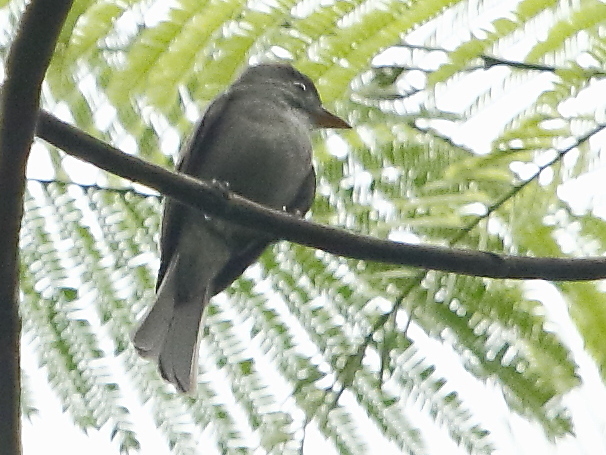
Ochraceous Pewee
Contopus ochraceus
Order: Passeriformes / Family: Tyrannidae

Wikimedia Commons
About the Ochraceous Pewee
The Ochraceous Pewee (Contopus ochraceus) is a small, unassuming flycatcher that inhabits the highland forests of Central America. This bird, belonging to the Tyrannidae family, plays a significant role in the ecological balance of its native habitats by controlling insect populations. The Ochraceous Pewee is most commonly found in moist montane forests, often at elevations ranging from 900 to 3,000 meters, where it blends seamlessly into the dense foliage.
These birds are particularly abundant in the cloud forests of Costa Rica and Panama, where they thrive in the humid, cool conditions provided by the high-altitude environment. The pewee's presence is an indicator of a healthy forest ecosystem, as it relies on a diverse insect population to sustain itself. The Ochraceous Pewee is primarily non-migratory, residing in the same areas year-round, although there may be some altitudinal movements depending on food availability and weather conditions.
During the breeding season, which peaks from March to July, the Ochraceous Pewee becomes more conspicuous. Males engage in vocal displays to attract mates and establish territories. Their calls, though subdued compared to some other flycatchers, are a familiar sound in their montane habitat. By maintaining a territory, the male ensures adequate food supply for his mate and offspring, highlighting the bird’s role in the intricate web of life in these forests.
The Ochraceous Pewee belongs to the family Tyrannidae, within the order Passeriformes. These birds typically live average 5-6 years with the possibility of reaching up to 10 years..
How to Identify a Ochraceous Pewee
The Ochraceous Pewee is a small flycatcher, measuring approximately 14 to 15 centimeters in length. Its most distinctive feature is its ochre-colored plumage, which gives the bird its name. This coloration is particularly pronounced on the underparts, while the upperparts are a muted brown, providing excellent camouflage among the trees.
Adults of both sexes are similar in appearance, making it challenging to distinguish between males and females in the field. Juveniles, however, can be identified by their slightly mottled appearance and paler plumage. The bird's bill is short and broad, typical of flycatchers, aiding in its insect-catching prowess.
In flight, the Ochraceous Pewee exhibits a compact silhouette with rounded wings and a relatively short tail. Its perching posture is upright, often on exposed branches where it can sally forth to catch insects. Confusion might arise with other pewees or small flycatchers, but the ochre hue and its preference for higher elevations help in making a positive identification.
Having trouble telling birds apart? Upload a photo to our bird identification tool for an instant species match.
Ochraceous Pewee Habitat and Range
Preferred Habitat
The Ochraceous Pewee is predominantly found in montane forests, favoring regions with dense, humid vegetation. It inhabits cloud forests, characterized by high moisture levels and persistent low-level cloud cover. This environment supports a diverse range of flora and fauna, providing ample feeding opportunities for the pewee.
These birds prefer elevations between 900 and 3,000 meters, thriving in the cooler temperatures and unique ecological conditions of these altitudes. While they are primarily forest dwellers, they occasionally venture into clearings or forest edges, particularly when foraging.
Unlike some other bird species, the Ochraceous Pewee does not typically adapt well to urban environments, instead preferring the relatively undisturbed natural habitats of rural and forested areas. Seasonal shifts in habitat are minimal, with the bird maintaining a relatively stable presence in its preferred environment throughout the year.
Geographic Range
The Ochraceous Pewee's range is relatively limited, confined to the mountainous regions of Central America. Its breeding and year-round range includes parts of Costa Rica and Panama, particularly the highland and cloud forest regions.
In Costa Rica, the pewee is commonly observed in the Cordillera de Talamanca and the Cordillera Central, where it inhabits the lush forests. Similarly, in Panama, it can be found in the Chiriquí highlands and other montane areas.
The bird's range does not extend into more temperate zones, nor does it typically migrate over long distances. Its population density is highest in these specific montane regions, where conditions are optimal for its survival and reproductive success. As a result, the Ochraceous Pewee's distribution is quite localized, with no significant expansion beyond these areas noted in recent years.
Want to know which birds visit your area? Browse our backyard birds by location guides for region-specific species lists.
What Does the Ochraceous Pewee Eat?
The diet of the Ochraceous Pewee primarily consists of insects, which it adeptly captures through aerial sallying from perches. This feeding technique involves quick, agile flights to snatch prey mid-air before returning to a perch. Common prey items include flies, beetles, and other small flying insects, which are abundant in the bird's montane forest habitat.
During the breeding season, the pewee's diet may expand to include more varied insect species to meet the higher nutritional demands of raising chicks. In the cooler months, when insect activity might decrease at higher elevations, the bird may forage more actively or lower its hunting range slightly to ensure a consistent food supply.
The Ochraceous Pewee feeds primarily during daylight hours, taking advantage of peak insect activity in its forested environment. Its keen eyesight and rapid flight make it an efficient predator, playing a crucial role in controlling insect populations and maintaining ecological balance.
Ochraceous Pewee Behavior and Social Structure
The Ochraceous Pewee exhibits a solitary lifestyle outside of the breeding season, with individuals maintaining separate territories. During the breeding season, male pewees become more vocal and territorial, using their calls to establish dominance and attract females. The pewee's song is soft compared to some other flycatchers, yet it serves its purpose effectively in the dense forest environment.
Courtship displays are subtle, involving vocalizations and occasional aerial displays. Once paired, the male and female work together to select a suitable nesting site, often a horizontal branch within their territory. The pewee's territorial nature extends to nest defense, with both parents actively deterring potential predators or rival birds.
Daily activity patterns are diurnal, with feeding and other behaviors concentrated in the early morning and late afternoon when insect activity peaks. Social interactions outside of breeding are limited, with the pewee typically avoiding flocking behavior. In the presence of predators, the birds rely on their camouflage and swift flight to elude capture, often retreating to denser foliage for safety.
Ochraceous Pewee Nesting and Reproduction
The Ochraceous Pewee constructs an open cup nest, carefully woven from plant fibers, moss, and lichen, blending seamlessly with the surrounding foliage. Nest placement is typically on a horizontal branch at a moderate height, providing both concealment from predators and a clear field of view for approaching threats.
Clutch size generally consists of two eggs, which are incubated by the female. The incubation period lasts approximately 14 to 16 days, during which the male provides food for the brooding female. Once hatched, both parents share the responsibility of feeding and caring for the chicks.
Fledging occurs about 16 to 18 days after hatching, with chicks leaving the nest to practice flying and foraging under parental supervision. The pewee may raise one or occasionally two broods per year, depending on food availability and environmental conditions. Parental investment is high, ensuring that the young have the best start in life.
Ochraceous Pewee Sounds and Vocalizations
The Ochraceous Pewee's primary song is a soft series of whistles and chirps, often described as a gentle 'pee-wee' call, repeated several times in succession. This song is most commonly heard during the breeding season, as males establish territories and court potential mates.
In addition to the primary song, the pewee also produces short, sharp call notes used for communication between mates and to alert others of potential threats. These calls are less musical than the song but serve essential functions in maintaining social structure and territory.
Alarm calls are more abrupt and are reserved for predator encounters, alerting nearby birds to danger. The dawn chorus, a time of heightened vocal activity, sees the Ochraceous Pewee joining other forest birds in a symphony of sound, marking territory boundaries and reinforcing social bonds.
Interesting Facts About the Ochraceous Pewee
- 1The Ochraceous Pewee is one of the few bird species that shows little variation in plumage between sexes, making sex identification in the field challenging.
- 2This pewee's ochre plumage provides excellent camouflage against the mossy and lichen-covered branches of its montane forest habitat.
- 3The Ochraceous Pewee exhibits a unique foraging technique known as 'sallying,' where it captures insects in mid-air with incredible agility.
- 4Despite its small size, the Ochraceous Pewee is a proficient territorial defender, often chasing away larger birds that encroach on its breeding area.
- 5Unlike many flycatchers that migrate, the Ochraceous Pewee remains in its high-altitude habitat year-round, adapting to seasonal changes in weather and food availability.
- 6The bird's name, 'ochraceus,' refers to the distinctive ochre coloration of its plumage, a rarity among its more drab-colored relatives.
- 7The Ochraceous Pewee's limited range makes it a target for birdwatchers visiting Central America's cloud forests, contributing to ecotourism in the region.
Ochraceous Pewee Conservation Status
The Ochraceous Pewee is currently classified as Least Concern by the IUCN, with populations considered stable across its range. However, ongoing habitat loss due to deforestation and land conversion poses a potential threat to its long-term survival. The preservation of montane forests in Central America is crucial to maintaining healthy populations of this species. Conservation efforts focus on protecting key habitats and promoting sustainable land-use practices that balance human needs with ecological preservation. International collaborations and local conservation initiatives play vital roles in ensuring the pewee's continued presence in its native regions. Historically, the Ochraceous Pewee has maintained a consistent population size, benefiting from its relatively isolated and specialized habitat. Continued monitoring and habitat protection are essential to counteract future challenges posed by environmental changes.
Other Tyrannidae Species


Birds Similar to the Ochraceous Pewee
These species are often confused with the Ochraceous Pewee due to similar appearance or overlapping range.