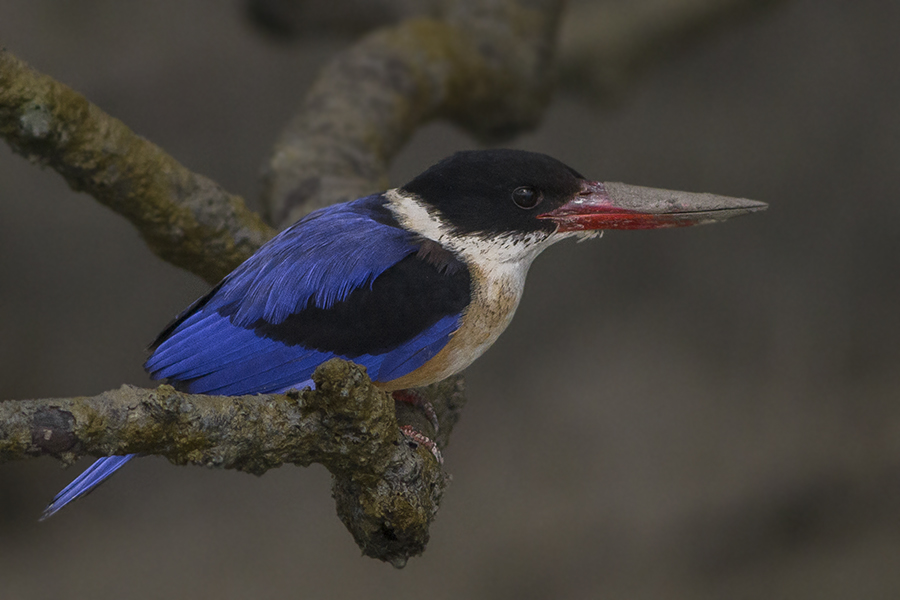
Blue-breasted Kingfisher
Halcyon malimbica
Order: Coraciiformes / Family: Alcedinidae

Wikimedia Commons
About the Blue-breasted Kingfisher
The Blue-breasted Kingfisher (Halcyon malimbica) is a striking member of the Alcedinidae family, renowned for its vivid blue plumage and distinct behaviors. This bird inhabits the dense forests and mangroves of West and Central Africa, thriving in regions ranging from Senegal to the Democratic Republic of Congo. In these lush environments, the Blue-breasted Kingfisher plays a significant ecological role, acting as both predator and prey within its ecosystem. This bird is primarily a resident species, with some localized movements influenced by seasonal changes or habitat availability. Its presence is often an indicator of a healthy forest ecosystem, reflecting the rich biodiversity of its habitat.
The Blue-breasted Kingfisher is particularly significant for its contribution to controlling insect and small vertebrate populations, which it hunts with remarkable precision. Its diet, consisting largely of insects, small fish, and amphibians, helps maintain the ecological balance in its native habitats. As a top predator in its niche, it influences the population dynamics of its prey, thus shaping the community structure of the forest and wetland ecosystems it inhabits.
During the breeding season, this kingfisher becomes more vocal, often heard before it is seen. Its calls are an important aspect of its social and reproductive behaviors, facilitating communication between mates and establishing territorial boundaries. The bird's ecological significance extends beyond its predatory role; it also contributes to seed dispersal and pollination indirectly through its interactions within the ecosystem, making it a vital component of its native environment.
The Blue-breasted Kingfisher belongs to the family Alcedinidae, within the order Coraciiformes. These birds typically live average 6 years, with a maximum recorded of 11 years..
How to Identify a Blue-breasted Kingfisher
The Blue-breasted Kingfisher is easily identifiable by its vibrant blue breast, contrasting with its white underparts and dark head. Adult plumage exhibits a striking mix of cobalt blue, white, and black, with the wings and back showcasing a rich, iridescent blue. The species has a stout, bright red bill, which is a key feature distinguishing it from similar kingfishers. Juveniles tend to have duller plumage, lacking the full intensity of the adult's coloration, and their bills are often slightly darker.
In terms of sexual dimorphism, males and females are similar in appearance, making it difficult to distinguish between the sexes in the field. However, careful observation may reveal subtle differences in size, with males being slightly larger on average. The flight silhouette of the Blue-breasted Kingfisher is characterized by rapid wingbeats and a slightly arched posture, typical of kingfishers. When perched, it sits upright on exposed branches or utility wires, scanning for prey with keen eyesight.
Confusion with other kingfisher species may occur, especially with the Woodland Kingfisher, which also sports vibrant blues. However, the Blue-breasted Kingfisher's distinctive breast coloration and broader distribution in forest habitats help in accurate identification.
Having trouble telling birds apart? Upload a photo to our bird identification tool for an instant species match.
Blue-breasted Kingfisher Habitat and Range
Preferred Habitat
The Blue-breasted Kingfisher thrives in a variety of forested environments, preferring dense woodlands and mangrove swamps. This bird is commonly found from sea level up to elevations of about 1,000 meters, where it takes advantage of the rich availability of prey. In coastal regions, it frequents mangrove forests, while inland it is often associated with riverine forests and areas with abundant water sources.
Seasonal habitat shifts are minimal but may occur in response to changes in prey availability or water levels. The species shows a preference for undisturbed habitats, although it can adapt to secondary forests and plantations to some extent. While typically associated with rural and wild areas, it occasionally ventures into urban fringes where suitable habitats exist, though such instances are relatively rare.
The Blue-breasted Kingfisher's presence in these habitats is indicative of a healthy ecosystem, and its territorial and nesting behaviors are intricately linked to the availability of suitable habitat features, such as dense foliage and abundant prey.
Geographic Range
The Blue-breasted Kingfisher's range spans much of West and Central Africa, a region characterized by rich biodiversity and varied ecosystems. Its core distribution extends from Senegal and Gambia in the west through to Nigeria, Cameroon, and as far east as the Democratic Republic of Congo. This species is largely resident, with some populations in northern areas exhibiting slight movements in response to seasonal changes.
The bird's range is primarily marked by its preference for dense forests and mangroves, habitats that stretch across these countries. Migration corridors are generally limited, with individuals tending to remain within their established territories year-round. However, during periods of drought or habitat disturbance, some local movements may be observed as the birds seek more favorable conditions.
Population density hotspots are typically found in regions with extensive mangrove systems, such as the Niger Delta, where the availability of food resources is high. In areas where habitat is threatened by human activities, the density of Blue-breasted Kingfishers can decrease significantly, underscoring the importance of conservation efforts in maintaining suitable environments for this species.
Want to know which birds visit your area? Browse our backyard birds by location guides for region-specific species lists.
What Does the Blue-breasted Kingfisher Eat?
The diet of the Blue-breasted Kingfisher is diverse, primarily comprising insects, small fish, amphibians, and occasionally small reptiles. Insects such as beetles and grasshoppers form a significant portion of its diet, particularly during the breeding season when the demand for high-protein food increases. Small fish and amphibians are also crucial components of its diet, providing essential nutrients that support the bird's energetic lifestyle.
Feeding techniques are varied and adapted to the type of prey. For insects, the kingfisher often employs a sit-and-wait approach, perching silently before swooping down to capture its prey with precision. When hunting for fish or amphibians, it may hover briefly above water before diving to seize its target. Prey size generally ranges from small insects to amphibians up to the size of a frog, with the kingfisher able to adjust its hunting strategy accordingly.
Seasonal changes can influence the bird's diet, with a shift towards more aquatic prey during the wet season when water levels rise and fish become more abundant. Feeding typically occurs during daylight hours, with peak activity observed in the early morning and late afternoon.
Blue-breasted Kingfisher Behavior and Social Structure
The Blue-breasted Kingfisher exhibits a range of behaviors that reflect its adaptability and ecological niche. It is generally solitary or found in pairs, particularly during the breeding season when pairs establish and defend territories with vigor. Territorial behavior is pronounced, with individuals using vocalizations and physical displays to ward off intruders and delineate boundaries.
Courtship displays are elaborate, involving aerial acrobatics and vocal exchanges that strengthen pair bonds. Males often present food to females as part of the courtship ritual, a behavior that not only demonstrates their hunting prowess but also cements the pair's relationship.
In terms of daily activity patterns, the Blue-breasted Kingfisher is primarily diurnal, with most foraging and territorial activities occurring during daylight. The bird is less active during the hottest parts of the day, preferring to rest in shaded areas. Flocking behavior is uncommon, though outside the breeding season, small groups may form around abundant food sources.
The kingfisher responds to predators with a mix of vocal alarms and evasive flight, using its agility to escape threats. The presence of a predator often triggers a series of sharp calls, serving both to alert nearby conspecifics and to confuse or deter the predator.
Blue-breasted Kingfisher Nesting and Reproduction
The nesting habits of the Blue-breasted Kingfisher are closely tied to its habitat preferences, with nests typically located in burrows excavated into riverbanks or termite mounds. These burrows provide a secure environment for raising young, protecting them from predators and environmental fluctuations. The entrance to the nest burrow is usually small and discreet, helping to camouflage its location.
A typical clutch consists of 2 to 4 eggs, which are incubated by both parents for approximately 21 to 23 days. During this period, the nesting pair is highly attentive, with one parent always present at the nest while the other forages. After hatching, the young remain in the nest for an additional 24 to 28 days before fledging.
Parental roles are well-defined, with both male and female sharing responsibilities for feeding and protecting the young. The fledglings are dependent on their parents for food and protection for several weeks post-fledging, gradually learning to hunt and fend for themselves. The Blue-breasted Kingfisher typically raises one brood per year, although in regions with abundant resources, a second brood may occasionally occur.
Blue-breasted Kingfisher Sounds and Vocalizations
The Blue-breasted Kingfisher is known for its distinctive calls, which are a key component of its communication repertoire. The primary song is a series of loud, staccato notes that rise and fall in pitch, often described as a resonant 'klee-klee-klee' sound. This song is typically delivered from a prominent perch, serving both to attract mates and to assert territorial boundaries.
Call notes are varied, including sharp, piercing whistles and softer, chattering sounds used in close communication between mates or family members. Alarm calls are harsher, serving to alert conspecifics of potential threats and to deter predators. These sounds are an integral part of the bird's daily life, with vocal activity peaking at dawn and dusk when the forest is most alive with avian chatter.
The Blue-breasted Kingfisher's vocalizations are unique yet reminiscent of other kingfisher species, providing an auditory clue to its presence in dense habitats where visual detection may be challenging.
Interesting Facts About the Blue-breasted Kingfisher
- 1The Blue-breasted Kingfisher can dive into water at speeds of up to 40 km/h to catch prey, showcasing its agility and precision.
- 2During courtship, the male Blue-breasted Kingfisher may present a fish to the female, a gesture that strengthens pair bonds and demonstrates his hunting skills.
- 3This kingfisher's call is so loud it can be heard up to 2 kilometers away, making it one of the most vocal birds in its habitat.
- 4Despite its striking colors, the Blue-breasted Kingfisher is often heard before it is seen due to its preference for dense forest habitats.
- 5The species' scientific name, Halcyon malimbica, refers to the Greek myth of Halcyon, a bird said to calm the seas, reflecting its serene presence around water.
- 6Blue-breasted Kingfishers are known for their territorial nature, often engaging in aerial duels to defend their patch of forest.
- 7The kingfisher's bright plumage is a result of structural coloration, where microscopic structures in feathers reflect light to produce vivid hues.
Blue-breasted Kingfisher Conservation Status
According to the IUCN Red List, the Blue-breasted Kingfisher is currently classified as Least Concern, reflecting its relatively stable population across its range. However, localized populations face threats from habitat loss and degradation, primarily due to deforestation and wetland drainage for agriculture and development. Conservation efforts focus on preserving the bird's natural habitats and mitigating the impacts of human activities. Protected areas and national parks within its range play a crucial role in safeguarding key populations. Community-based conservation initiatives are also important, promoting sustainable land use practices that benefit both the Blue-breasted Kingfisher and local human populations. Historically, the population of this species has shown resilience, but continued monitoring is necessary to ensure that its status remains stable. Preservation of mangroves and forested areas remains a priority, as these habitats are essential for the species' survival and ecological success.
Other Alcedinidae Species


Birds Similar to the Blue-breasted Kingfisher
These species are often confused with the Blue-breasted Kingfisher due to similar appearance or overlapping range.