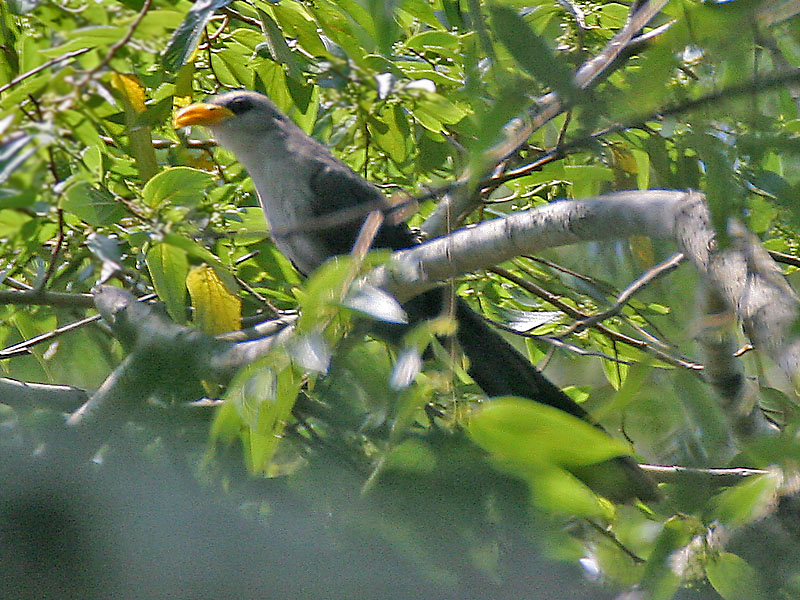
Blue Malkoha
Ceuthmochares aereus
Order: Cuculiformes / Family: Cuculidae

Wikimedia Commons
About the Blue Malkoha
The Blue Malkoha (Ceuthmochares aereus) is a striking bird that graces the dense tropical forests of sub-Saharan Africa. It belongs to the Cuculidae family, which includes the well-known cuckoos. This bird is characterized by its vibrant blue feathers and contrasting yellow bill, making it a visually captivating species. The Blue Malkoha plays a significant ecological role in its habitat, primarily as an insectivore, helping to control insect populations and maintain the balance of the forest ecosystem. Typically found in the understory and mid-canopy levels of forests, the Blue Malkoha is a secretive and elusive bird, often going unnoticed despite its vivid coloration.
As a resident of regions such as West Africa, including countries like Ghana, Nigeria, and the Ivory Coast, the Blue Malkoha thrives in humid tropical and subtropical forests. It also inhabits regions of Central Africa, found in countries like Cameroon and the Democratic Republic of the Congo. This bird's presence is a testament to the rich biodiversity of these areas. Its ecological role extends beyond pest control, as it participates in seed dispersal, aiding in the propagation of various plant species that constitute its diet.
Seasonal changes influence the behavior and movement of Ceuthmochares aereus. While not migratory, the Blue Malkoha adjusts its activity patterns based on food availability and breeding cycles. During the breeding season, these birds become more vocal, engaging in distinctive calls that resonate through the forest. Their ability to thrive in diverse forest habitats underscores their adaptability and resilience amid environmental changes.
The Blue Malkoha belongs to the family Cuculidae, within the order Cuculiformes. These birds typically live average 6-8 years, with a maximum recorded of 12 years..
How to Identify a Blue Malkoha
The Blue Malkoha stands out with its striking blue plumage, a key field mark that aids in its identification. Adult birds display a uniform blue coloration across their bodies, with a striking yellow bill that provides a stark contrast. The eyes are surrounded by bare skin, which is typically pale blue, adding to its distinctive appearance. Juvenile Blue Malkohas tend to have duller feathers, lacking the vibrant sheen seen in adults, and their bills may appear more muted in color.
There is little sexual dimorphism in this species, meaning males and females share similar plumage patterns. This can make it challenging to differentiate between the sexes based on appearance alone. However, during the breeding season, subtle behavioral differences may become apparent. In terms of size, the Blue Malkoha falls into the medium category, typically measuring about 40 cm in length.
The flight silhouette of the Blue Malkoha is characterized by broad, rounded wings and a long tail, which it uses to maneuver deftly through dense foliage. Unlike some other birds, it does not engage in long, sustained flights, preferring to move from tree to tree within its forested habitat. When perched, it often sits upright on branches, blending seamlessly with the verdant backdrop of its environment.
Having trouble telling birds apart? Upload a photo to our bird identification tool for an instant species match.
Blue Malkoha Habitat and Range
Preferred Habitat
The Blue Malkoha predominantly inhabits tropical and subtropical forests, favoring dense, humid environments where it can find ample cover. It is most commonly seen in the lower and mid-canopy levels, where it forages for insects and other small prey. These areas provide the ideal combination of food resources and nesting sites, crucial for its survival and reproduction.
This bird can be found at various elevations, typically up to 1500 meters, though it is more frequently observed in lowland forests. It is not particularly adaptable to urban environments, preferring the seclusion and natural abundance of rural and forested areas. The presence of primary and secondary growth forests offers a suitable habitat for the Blue Malkoha throughout the year.
Seasonal shifts do not largely influence the Blue Malkoha's habitat preferences, as it remains within its forested range year-round. However, the availability of food and nesting materials can prompt slight movements within its range to optimize living conditions and reproductive success.
Geographic Range
The Blue Malkoha's range is confined to the tropical regions of sub-Saharan Africa, where it is a resident species. It is particularly prevalent in the forests of West Africa, with significant populations in countries such as Ghana, Nigeria, and the Ivory Coast. The bird also extends its range into parts of Central Africa, including Cameroon and the Democratic Republic of the Congo.
Unlike many other bird species, the Blue Malkoha does not undertake long-distance migrations. Instead, it remains within its established range throughout the year, adapting to seasonal changes in food availability and breeding conditions. This resident behavior allows it to maintain a consistent presence in its preferred habitats.
Population density tends to be higher in regions where the forest canopy is dense and undisturbed. Areas with extensive logging or deforestation exhibit lower populations, as the Blue Malkoha relies heavily on the intact forest structure for survival. Conservation of these forest habitats is vital for maintaining the health and stability of Blue Malkoha populations.
Want to know which birds visit your area? Browse our backyard birds by location guides for region-specific species lists.
What Does the Blue Malkoha Eat?
The Blue Malkoha's diet primarily consists of insects, making it a crucial player in controlling insect populations within its forest environment. It feeds on a variety of insects, including caterpillars, beetles, and mantids. This bird's foraging technique is characterized by methodical movements through the foliage, where it carefully inspects leaves and branches for prey.
During certain seasons, when insects are less abundant, the Blue Malkoha may supplement its diet with fruits and berries. This dietary flexibility allows it to adapt to fluctuations in food availability, ensuring its survival year-round. Small reptiles and amphibians occasionally form part of its diet, though insects remain the primary food source.
The Blue Malkoha typically forages during daylight hours, with peak activity in the early morning and late afternoon. This schedule maximizes its chances of encountering prey while avoiding the heat of midday. Its hunting strategy involves both careful stalking and sudden pouncing, demonstrating its adaptability as a forager.
Blue Malkoha Behavior and Social Structure
The Blue Malkoha exhibits a solitary and secretive nature, often moving quietly through the forest canopy. It prefers to remain inconspicuous, relying on the dense foliage to shield it from potential predators. This bird is not known for forming large flocks, instead opting for a solitary or paired existence, especially during the breeding season.
Territorial behavior is observed during the breeding season, with males becoming more vocal and active in defending their chosen areas. These vocalizations serve as both territorial markers and courtship calls, attracting females while deterring rival males. Courtship displays include subtle movements and calls, designed to entice a mate without drawing undue attention from predators.
The Blue Malkoha's daily activity patterns revolve around foraging and resting. It is predominantly active during the cooler parts of the day, such as early morning and late afternoon. In response to potential threats, it relies on its ability to blend into the foliage and remain motionless until the danger has passed.
Blue Malkoha Nesting and Reproduction
The Blue Malkoha constructs its nest in the dense foliage of the forest, often choosing locations that offer both concealment and proximity to food sources. The nest is a simple structure, typically a shallow cup made from twigs, leaves, and other plant materials. This construction provides sufficient support for the eggs and chicks while blending seamlessly with the surrounding vegetation.
The typical clutch size for the Blue Malkoha is two to three eggs. Both parents participate in the incubation process, which lasts approximately 14-16 days. This shared responsibility extends into the fledging period, with both male and female malkohas taking turns feeding and protecting the young.
Fledging occurs about 18-21 days after hatching, with chicks remaining in the nest until they are strong enough to venture out. The parental care continues even after the chicks leave the nest, ensuring they learn essential foraging and survival skills. The Blue Malkoha typically raises one brood per year, focusing its efforts on ensuring the success of each offspring.
Blue Malkoha Sounds and Vocalizations
The Blue Malkoha is known for its distinctive vocalizations, which include a variety of calls and songs. Its primary song consists of a series of soft, rhythmic notes, often described as a gentle 'cooing' sound that resonates through the forest. This song serves both as a territorial call and a means of communication between mates.
In addition to its primary song, the Blue Malkoha emits sharp call notes that signal alarm or alert others to potential threats. These calls are higher in pitch and more abrupt, serving as a deterrent to predators and a warning to other malkohas in the vicinity.
During the dawn chorus, the Blue Malkoha's song is more prominent and frequent, taking advantage of the quieter morning hours to establish territory and attract mates. Its vocalizations, while not as elaborate as some other bird species, are nonetheless an integral part of its behavioral repertoire.
Interesting Facts About the Blue Malkoha
- 1The Blue Malkoha's vibrant plumage provides effective camouflage in the dappled light of the forest canopy.
- 2Unlike many cuckoo species, the Blue Malkoha does not engage in brood parasitism, opting to raise its own young.
- 3Its diet primarily consists of insects, but it occasionally consumes small reptiles and amphibians.
- 4The Blue Malkoha can be found up to elevations of 1500 meters, favoring dense, humid forests.
- 5Despite its bright coloration, the Blue Malkoha is notoriously difficult to spot due to its secretive behavior.
- 6Both male and female Blue Malkohas participate in nest building, incubation, and chick rearing.
- 7The species' range includes West and Central Africa, covering countries like Ghana, Cameroon, and the DRC.
Blue Malkoha Conservation Status
The Blue Malkoha is currently listed as a species of Least Concern on the IUCN Red List, indicating a stable population trend. However, threats such as habitat destruction and deforestation pose significant risks to its long-term survival. The expansion of agricultural land and logging activities in its range contribute to the loss of critical forest habitats. Conservation efforts focus on protecting these vital habitats through the establishment of protected areas and sustainable land management practices. Historical population changes have been influenced by shifts in land use and forest cover, highlighting the importance of ongoing conservation actions. Community-based initiatives that promote forest conservation and sustainable development are crucial for ensuring the future of the Blue Malkoha and other forest-dependent species. Continued research and monitoring are also necessary to track population trends and address emerging threats.
Other Cuculidae Species


Birds Similar to the Blue Malkoha
These species are often confused with the Blue Malkoha due to similar appearance or overlapping range.