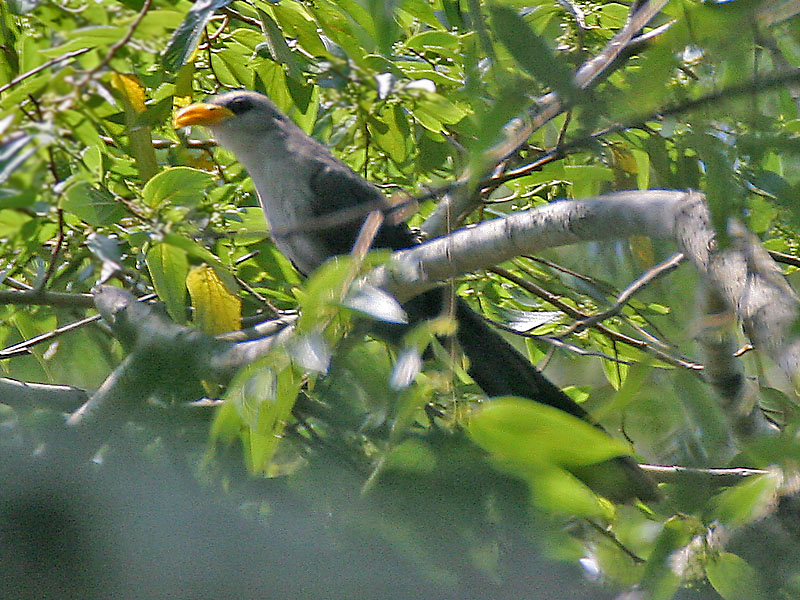
Olive Long-tailed Cuckoo
Cercococcyx olivinus
Order: Cuculiformes / Family: Cuculidae

Wikimedia Commons
About the Olive Long-tailed Cuckoo
The Olive Long-tailed Cuckoo (Cercococcyx olivinus) is a captivating bird species primarily found in the montane and lowland rainforests of Central and West Africa. This cuckoo's adaptability to dense, evergreen forests makes it an integral part of these ecosystems. It is especially prevalent in countries like Cameroon, Gabon, and the Democratic Republic of the Congo, where it inhabits both primary and secondary forests. Its presence is often indicated by its distinctive calls, heard among the canopy. Ecologically, the Olive Long-tailed Cuckoo plays a crucial role as a brood parasite, laying its eggs in the nests of other bird species. This behavior impacts host populations and contributes to a dynamic ecological balance. The cuckoo's breeding season corresponds with the rainy season, a period marked by abundant food resources. During these months, their activity increases, as does the visibility of both adult and juvenile birds. The Olive Long-tailed Cuckoo's choice of habitat often includes regions with high humidity and lush vegetation, thriving at elevations ranging from sea level to 2,400 meters. The species adapts well to variations in forest density, from dense undergrowth to open forest canopies. Despite its elusive nature, the Olive Long-tailed Cuckoo is a key indicator of forest health and biodiversity, reflecting the intricate interdependencies within its habitat.
The Olive Long-tailed Cuckoo belongs to the family Cuculidae, within the order Cuculiformes. These birds typically live average 5-7 years, with a maximum recorded of 10 years..
How to Identify a Olive Long-tailed Cuckoo
The Olive Long-tailed Cuckoo is a medium-sized bird, measuring approximately 33-35 cm in length, with its long tail accounting for much of its size. Its plumage is predominantly olive-green, providing excellent camouflage within its forest habitat. The bird's long tail feathers, dark with lighter barring, are a key identification feature, easily distinguishing it from other cuckoos. Adult plumage is characterized by a subtle iridescence, while juveniles exhibit a more muted color palette. There is little sexual dimorphism in this species, with males and females appearing quite similar. However, males may exhibit slightly longer tails. The Olive Long-tailed Cuckoo can be confused with species like the Barred Long-tailed Cuckoo, but the latter displays more pronounced barring and lacks the olive hue. In flight, the Olive Long-tailed Cuckoo shows a graceful, undulating pattern, with its tail spread wide. When perched, it often holds its tail slightly cocked, a posture that aids in identification.
Having trouble telling birds apart? Upload a photo to our bird identification tool for an instant species match.
Olive Long-tailed Cuckoo Habitat and Range
Preferred Habitat
The Olive Long-tailed Cuckoo primarily inhabits tropical and subtropical forests, thriving in both primary and mature secondary growth. It is commonly found in the dense rainforest regions of Central and West Africa, such as the Congo Basin and along the Guinea-Congo Forest Belt. The bird prefers elevations up to 2,400 meters, often near water sources. While it predominantly resides in forested areas, it can occasionally be seen in wooded savannas during transitional seasons. The Olive Long-tailed Cuckoo shows a preference for humid, lush environments, avoiding arid or open landscapes. It is rarely observed in urban areas, maintaining a strong association with forested habitats throughout the year.
Geographic Range
The Olive Long-tailed Cuckoo's range extends across Central and West Africa, with sightings reported from countries including Nigeria, Cameroon, Gabon, and the Democratic Republic of the Congo. During the breeding season, it is more concentrated in areas with abundant host species for egg-laying. Its range does not significantly shift seasonally, as the bird remains primarily within the dense forests throughout the year. However, some altitudinal movement may occur, with individuals descending to lower elevations during wet seasons. The species is not considered migratory, maintaining a relatively stable presence in its preferred habitats. Population density hotspots include the Congo Basin and the forested regions of Central Cameroon, where the cuckoo's calls resonate through the treetops.
Want to know which birds visit your area? Browse our backyard birds by location guides for region-specific species lists.
What Does the Olive Long-tailed Cuckoo Eat?
The Olive Long-tailed Cuckoo primarily feeds on insects, with a particular preference for caterpillars, which are abundant in its forest habitat. Its diet also includes spiders, beetles, and occasionally small lizards, showcasing its adaptability as an insectivore. The cuckoo employs a methodical foraging technique, moving slowly through the undergrowth and canopy, using its long tail for balance as it probes foliage for hidden prey. Seasonal diet variations occur, with an increased intake of caterpillars during the wet season when these larvae are plentiful. Its feeding schedule is diurnal, with peak foraging activity in the early morning and late afternoon, taking advantage of the cooler temperatures and active prey.
Olive Long-tailed Cuckoo Behavior and Social Structure
The Olive Long-tailed Cuckoo exhibits solitary behavior outside of the breeding season, often remaining elusive amid the dense foliage. It is known for its brood parasitic behavior, laying eggs in the nests of other bird species, such as warblers. This strategy involves the female cuckoo carefully timing her egg-laying to coincide with the host's nesting period. Courtship displays are subtle, involving vocalizations and tail displays. Territoriality is generally subdued, likely due to the cuckoo's non-nesting habits. It does not form flocks, maintaining a solitary or paired existence. When threatened by predators, the cuckoo relies on its cryptic plumage and swift flight to escape. Its daily activities are primarily diurnal, with most vocalizations and movements occurring during daylight, particularly in the cooler parts of the day.
Olive Long-tailed Cuckoo Nesting and Reproduction
As a brood parasite, the Olive Long-tailed Cuckoo does not build its own nest. Instead, it lays its eggs in the nests of other bird species, particularly small insectivorous birds. The cuckoo's eggs closely mimic the host's in size and color, increasing the likelihood of acceptance. A female may lay several eggs per breeding season, using different host nests to increase reproductive success. Once hatched, the young cuckoo often ejects the host's eggs or chicks, ensuring its own survival. The incubation period is relatively short, approximately 12-14 days, to align with the host's breeding schedule. The fledging timeline involves rapid growth, with the young cuckoo developing quickly to match the size of its host's offspring, despite being a different species.
Olive Long-tailed Cuckoo Sounds and Vocalizations
The Olive Long-tailed Cuckoo's vocalizations are distinctive and melodious, characterized by a series of clear, flute-like notes that rise and fall in pitch. Its song consists of 4-5 notes, repeated in a rhythmic pattern that echoes through the forest canopy. The call notes are softer and less structured, often used for communication between mates. Alarm calls are sharp and abrupt, serving as a warning to nearby birds of potential threats. The cuckoo participates in the dawn chorus, contributing its unique song to the symphony of forest sounds. Its vocalizations can be compared to a distant flute, carrying over long distances in its dense habitat.
Interesting Facts About the Olive Long-tailed Cuckoo
- 1The Olive Long-tailed Cuckoo can be identified by its unique 'kuk-kuk-kuk' call, often heard but rarely seen.
- 2Despite its name, the Olive Long-tailed Cuckoo is not olive within, but its plumage reflects its forested environment.
- 3The cuckoo's tail accounts for nearly half of its total body length, aiding in its agile maneuvers through dense foliage.
- 4As a brood parasite, the Olive Long-tailed Cuckoo relies on over 15 different host species to raise its young.
- 5The Olive Long-tailed Cuckoo exhibits remarkable mimicry in egg appearance, matching the host's eggs almost perfectly.
- 6Its preferred diet includes caterpillars, which it deftly extracts from foliage using its sharp bill.
- 7The Olive Long-tailed Cuckoo can thrive at elevations up to 2,400 meters, adapting to various forest strata.
Olive Long-tailed Cuckoo Conservation Status
The Olive Long-tailed Cuckoo is currently listed as Least Concern by the IUCN, with a stable population trend. Primary threats include habitat loss due to deforestation and human encroachment. Conservation efforts focus on preserving forest habitats and maintaining biodiversity within the cuckoo's range. Historical population changes have been minimal, largely due to the cuckoo's adaptability and wide distribution across Central and West Africa.
Other Cuculidae Species


Birds Similar to the Olive Long-tailed Cuckoo
These species are often confused with the Olive Long-tailed Cuckoo due to similar appearance or overlapping range.