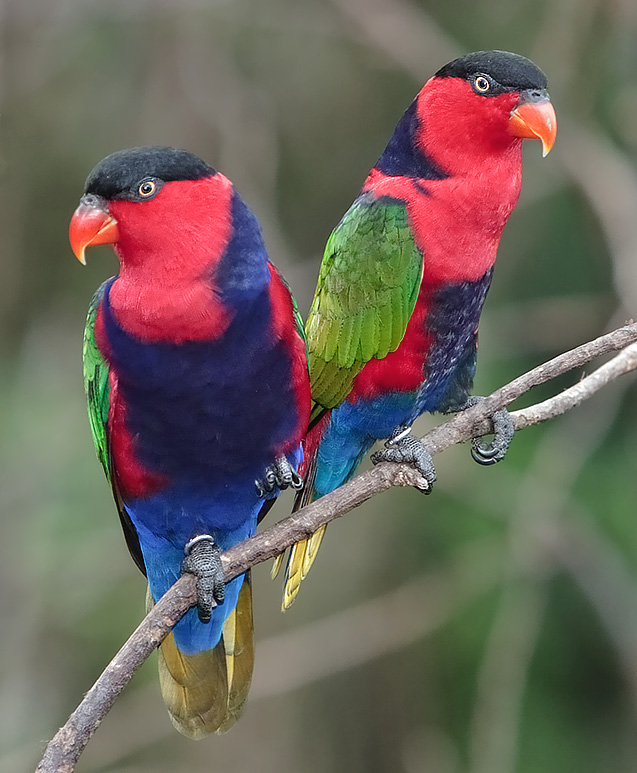
Blue-streaked Lory
Eos reticulata
Order: Psittaciformes / Family: Psittacidae

Wikimedia Commons
About the Blue-streaked Lory
The Blue-streaked Lory, scientifically known as Eos reticulata, is a striking parrot species endemic to the islands of Indonesia, particularly in the Lesser Sundas. This bird captures attention with its vivid plumage and distinctive patterns. The Blue-streaked Lory plays a significant ecological role in its environment, primarily through its interactions with native flora. As an avid consumer of nectar, the Blue-streaked Lory aids in the pollination of various plant species within its habitat. This mutualistic relationship underscores the bird's importance in maintaining the health and diversity of its ecosystem.
The Blue-streaked Lory thrives in the humid, tropical forests of Indonesia, where it takes advantage of the dense canopy for shelter and food. These lories exhibit seasonal behaviors, such as increased vocalization and activity during the breeding season, which aligns with the rainy season in their native habitat. This seasonality ensures that there is an abundance of food resources available for raising their young. The species' reliance on intact forest habitats makes it a key indicator of forest health and highlights the importance of preserving these environments.
Despite its ecological importance, the Blue-streaked Lory faces several threats that could impact its population. Habitat destruction due to logging and agricultural expansion poses significant risks to the species. Additionally, the capture of these birds for the pet trade has historically affected their numbers. Conservation efforts are essential to ensure the survival of the Blue-streaked Lory, emphasizing the need for habitat protection and regulations to curb illegal trade. By conserving this species, we protect not only a unique bird but also the intricate web of life it supports in its tropical forest home.
The Blue-streaked Lory belongs to the family Psittacidae, within the order Psittaciformes. These birds typically live average 15-20 years, with a maximum recorded of 25 years..
How to Identify a Blue-streaked Lory
Identifying the Blue-streaked Lory involves observing its distinctive plumage. Adults showcase a brilliant combination of blue and red feathers, with the blue streaks being particularly prominent on the head and wings. The rest of the body is predominantly red, making it an unmistakable sight among the green backdrop of tropical forests. Juveniles tend to have a more muted coloration, with less pronounced blue streaks and a slightly duller red hue. This difference in coloration helps in identifying age groups in the wild.
Male and female Blue-streaked Lories are similar in appearance, with no significant sexual dimorphism observed. This similarity can make it challenging to distinguish between the sexes without close inspection or genetic testing. In flight, the Blue-streaked Lory displays a rapid and direct flight pattern, often accompanied by high-pitched calls. Its perching posture is upright, with a strong grip on branches, allowing it to feed comfortably on nectar and fruits.
While its bright colors make it easily identifiable, the Blue-streaked Lory can sometimes be confused with other lory species in its range, such as the Red Lory. However, the distinctive blue streaks on the head and wings of Eos reticulata serve as a reliable distinguishing feature. Observing these field marks in combination with its vocalizations helps in accurate identification in the field.
Having trouble telling birds apart? Upload a photo to our bird identification tool for an instant species match.
Blue-streaked Lory Habitat and Range
Preferred Habitat
The Blue-streaked Lory predominantly inhabits the tropical and subtropical moist lowland forests of Indonesia, with a strong preference for undisturbed primary forest areas. These forests provide the necessary food resources and nesting sites essential for their survival. While typically found in lowland regions, the Blue-streaked Lory can also be observed at elevations up to 1,000 meters, particularly in areas where food sources are abundant.
Seasonal shifts in habitat use are minimal, as the Blue-streaked Lory is largely sedentary. However, local movements may occur in response to the availability of food resources, prompting temporary shifts to nearby secondary forests or plantations that offer flowering plants. Although primarily associated with rural forested environments, the Blue-streaked Lory occasionally ventures into edge habitats and degraded forest areas, especially when traditional habitats are under threat.
Urban presence is rare for this species, as the Blue-streaked Lory's specialized diet and habitat requirements limit its ability to thrive in heavily modified landscapes. Conservation of forest habitats is crucial for maintaining their population, emphasizing the need for sustainable land-use practices in their range.
Geographic Range
The Blue-streaked Lory is endemic to Indonesia, with its distribution primarily confined to the Lesser Sunda Islands. Key locations include islands such as Sumba, Timor, and Flores, where the species finds suitable habitats in the dense, tropical forests. This restricted range makes the Blue-streaked Lory particularly vulnerable to habitat loss and changes in land use within these islands.
As a non-migratory species, the Blue-streaked Lory does not undertake long-distance seasonal migrations. Instead, it maintains a relatively stable presence within its preferred habitats year-round. However, local movements in search of food are common, particularly during periods of scarcity.
Population densities of the Blue-streaked Lory can vary significantly across its range, often correlating with the availability of suitable forest habitats. Areas with intact primary forests generally support higher densities of this species, highlighting the importance of these ecosystems for their survival. Conservation efforts in these regions focus on protecting existing habitats and mitigating the impacts of deforestation and habitat fragmentation.
Want to know which birds visit your area? Browse our backyard birds by location guides for region-specific species lists.
What Does the Blue-streaked Lory Eat?
The diet of the Blue-streaked Lory primarily consists of nectar, which it sources from a variety of flowering plants. This nectarivorous diet is essential for providing the high-energy requirements necessary for the bird's active lifestyle. The Blue-streaked Lory employs a specialized brush-tipped tongue to efficiently extract nectar from flowers, a feeding technique that also facilitates pollination.
In addition to nectar, the Blue-streaked Lory consumes fruits, seeds, and occasionally insects to supplement its diet. The consumption of fruits not only provides additional nutrients but also aids in seed dispersal, contributing to the regeneration of forest ecosystems. During certain seasons, when nectar is less abundant, the intake of these alternative food sources becomes more pronounced.
The Blue-streaked Lory typically forages in the early morning and late afternoon, periods that coincide with peak activity of flowering plants. This schedule allows the lory to maximize its energy intake while minimizing exposure to midday heat. The bird's foraging strategy often involves moving in small groups, which may help in locating food sources and reducing the risk of predation.
Blue-streaked Lory Behavior and Social Structure
The Blue-streaked Lory exhibits a range of intriguing behaviors, particularly in its social structure and interactions. This species is highly social, often observed in small flocks that facilitate feeding and protection from predators. Within these groups, individuals engage in mutual grooming, which strengthens social bonds and aids in feather maintenance.
Territorial behavior is relatively uncommon in Blue-streaked Lories, as they rely more on social structures than on defending specific territories. However, during the breeding season, pairs may become more protective of nesting sites, displaying aggressive behaviors towards intruders. Courtship displays in Blue-streaked Lories are characterized by mutual preening and synchronized vocalizations, which help to reinforce pair bonds.
Daily activity patterns of the Blue-streaked Lory are closely tied to its foraging habits. The birds are most active during the cooler parts of the day, engaging in feeding, social interactions, and vocal communications. In response to predators, Blue-streaked Lories rely on their agility and speed, often taking to the air in swift, coordinated movements to evade threats. The species' vocal nature also serves as an early warning system within flocks, alerting members to potential dangers.
Blue-streaked Lory Nesting and Reproduction
Blue-streaked Lories nest in tree cavities, a choice that provides protection from predators and environmental elements. These natural cavities are often found in large, mature trees, emphasizing the importance of old-growth forests for their reproductive success. Occasionally, the lories may also use nest boxes if natural cavities are scarce.
The typical clutch size for Blue-streaked Lories ranges from two to three eggs. Both parents share responsibilities during the incubation period, which lasts approximately 24 to 26 days. This biparental care extends to the maintenance and defense of the nesting site, ensuring the safety of the eggs and, subsequently, the hatchlings.
After hatching, the young remain in the nest for about 8 to 10 weeks, during which time they are fed by both parents. The fledging period is a critical time for the young lories, as they learn crucial skills for survival, such as foraging techniques and social interactions. The species typically raises one brood per year, aligning reproductive efforts with the availability of food resources.
Blue-streaked Lory Sounds and Vocalizations
The vocalizations of the Blue-streaked Lory are characterized by high-pitched, rapid sequences of calls. These calls, varied in rhythm and pitch, serve multiple purposes, including communication within flocks and territory establishment. The primary song is a series of sharp, chattering notes that can be heard echoing through the forest.
In addition to their song, Blue-streaked Lories produce a range of call notes used in different contexts, such as contact calls when foraging or alarm calls when sensing danger. These alarm calls are particularly abrupt and piercing, designed to alert other flock members of potential threats.
During the dawn chorus, Blue-streaked Lories are especially vocal, contributing to the vibrant soundscape of their tropical habitats. This period of heightened vocal activity coincides with increased social interactions and the establishment of daily foraging routes. The sounds of the Blue-streaked Lory, while unique, are often compared to those of other lory species, though their distinctive tonal quality sets them apart.
Interesting Facts About the Blue-streaked Lory
- 1The Blue-streaked Lory's vibrant colors make it one of the most colorful parrots in the world, with its striking blue and red plumage.
- 2Despite its beauty, the Blue-streaked Lory is rarely seen in captivity due to strict regulations and its specialized care requirements.
- 3The Blue-streaked Lory's tongue is uniquely adapted for feeding on nectar, featuring a brush-like tip for efficient extraction.
- 4This lory species is an important pollinator, playing a crucial role in the reproduction of several tropical plant species.
- 5Blue-streaked Lories communicate using over ten distinct vocalizations, each serving different social and survival functions.
- 6The species has a limited range, being endemic only to specific islands in Indonesia, highlighting its ecological vulnerability.
- 7A Blue-streaked Lory can live up to 20 years in the wild, provided it has access to an undisturbed habitat and adequate food sources.
Blue-streaked Lory Conservation Status
The Blue-streaked Lory is currently listed as Near Threatened on the IUCN Red List, with its population trend showing signs of decline. Primary threats to this species include habitat destruction due to deforestation and land conversion for agriculture. Furthermore, the illegal pet trade has historically affected its numbers, though regulatory efforts have somewhat curbed this practice. Conservation initiatives focus on habitat protection and restoration, aiming to preserve the tropical forests that the Blue-streaked Lory depends on. Organizations are working with local communities to promote sustainable land use and to raise awareness about the importance of conserving this species. Historically, the population of the Blue-streaked Lory was more robust, but increasing human activities have led to habitat fragmentation and a reduction in suitable nesting sites. Continued conservation efforts are critical to reversing these trends and ensuring the long-term survival of the species.
Other Psittacidae Species


Birds Similar to the Blue-streaked Lory
These species are often confused with the Blue-streaked Lory due to similar appearance or overlapping range.