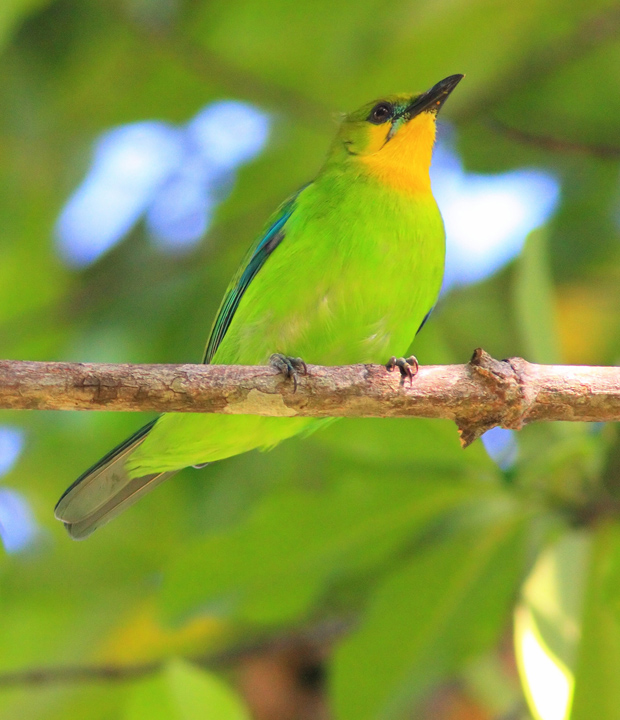
Blue-winged Leafbird
Chloropsis moluccensis
Order: Passeriformes / Family: Chloropseidae

Wikimedia Commons
About the Blue-winged Leafbird
The Blue-winged Leafbird (Chloropsis moluccensis) is a captivating avian species thriving in the lush tropical forests of Southeast Asia. Renowned for its vibrant green plumage and striking blue wings, this species is not only a visual delight but also plays a vital role in its ecosystem. Found primarily in countries such as Thailand, Malaysia, Indonesia, and the Philippines, the Blue-winged Leafbird inhabits lowland forests, mangroves, and plantations up to 1,500 meters above sea level. These birds exhibit a preference for dense foliage, where they can forage and nest with relative safety from predators and human disturbance.
The ecological significance of the Blue-winged Leafbird extends beyond its beauty as it serves as a pollinator and seed disperser. The bird's diet, consisting largely of fruits and nectar, facilitates the pollination of various plant species, thereby contributing to the maintenance of the forest's biodiversity. In addition to their ecological role, these leafbirds are also indicators of forest health, as they thrive in undisturbed habitats with rich flora.
Seasonal behaviors of the Blue-winged Leafbird include shifts in foraging patterns. During the breeding season, they become more territorial and their songs fill the air as they establish and defend territories. Outside the breeding season, these birds are more social and may join mixed-species feeding flocks. Their adaptability to different forest environments, including secondary growth and edge habitats, allows them to persist in areas affected by human activities, although they are less commonly found in heavily degraded habitats. This adaptability underscores their resilience, yet also highlights the importance of preserving natural forests for their continued survival.
The Blue-winged Leafbird belongs to the family Chloropseidae, within the order Passeriformes. These birds typically live 5-7 years with max recorded at 9 years.
How to Identify a Blue-winged Leafbird
Adult Blue-winged Leafbirds are easily recognized by their vivid green body and the bright blue coloration on their wings and tail. The males sport a striking black patch on their face and throat, which contrasts sharply with the overall green plumage. Females lack this black facial marking, and their blue wing markings are less pronounced, making them somewhat less conspicuous than their male counterparts. Juveniles resemble females but are generally duller in color.
In terms of size, the Blue-winged Leafbird measures approximately 16 to 18 centimeters in length, making it a medium-sized songbird. While observing these birds, note their streamlined body, short legs, and slender, slightly curved bill, which is well-suited for feeding on nectar and small fruits. The flight of the Blue-winged Leafbird is direct and swift, with rapid wingbeats.
When perched, these birds often adopt an upright posture, frequently bending their bodies slightly forward to reach for food. The green plumage of the Blue-winged Leafbird provides excellent camouflage against the foliage, making them sometimes challenging to spot despite their vibrant colors. Careful observation is required to distinguish them from similar species, such as the Lesser Green Leafbird, which lacks the distinctive blue wings.
Having trouble telling birds apart? Upload a photo to our bird identification tool for an instant species match.
Blue-winged Leafbird Habitat and Range
Preferred Habitat
The Blue-winged Leafbird favors a variety of forested habitats, predominantly occupying lowland rainforests and secondary growth forests. It is commonly found in tropical regions, particularly in Southeast Asia, including Thailand, Malaysia, and parts of Indonesia. These birds are versatile, occasionally inhabiting mangroves and rubber plantations where dense vegetation is available.
Their habitat range extends from sea level up to altitudes of about 1,500 meters, though they primarily thrive in lower elevations. During the breeding season, the birds may shift slightly within their habitat to areas with abundant food resources, such as fruiting trees and flowering plants. The Blue-winged Leafbird can sometimes be seen in urban-adjacent areas where gardens and parks offer suitable foraging opportunities.
Despite their adaptability, they prefer areas with minimal human disturbance. The destruction of forest habitats poses a significant threat, as they are less frequently observed in heavily degraded forests, emphasizing the importance of habitat conservation to ensure their continued presence in the wild.
Geographic Range
The Blue-winged Leafbird's range is predominantly confined to Southeast Asia, where it is a resident breeder. The species is widespread across the Malay Peninsula, Sumatra, Borneo, Java, and the Philippines. In Thailand, it is found in both the central plains and southern regions, while in Malaysia and Indonesia, it inhabits primary and secondary lowland forests.
Unlike many migratory birds, the Blue-winged Leafbird does not partake in long-distance migrations, but it may undertake local movements in response to seasonal food availability. These birds remain largely sedentary, tending to stay within their established territories or neighboring areas throughout the year.
Population density tends to be higher in regions with extensive forest cover, such as Borneo and Sumatra. In areas where deforestation is rampant, population densities are notably reduced. Consequently, regions with protected forests and national parks, such as Taman Negara in Malaysia and Gunung Leuser National Park in Sumatra, serve as important refuges for these birds.
Want to know which birds visit your area? Browse our backyard birds by location guides for region-specific species lists.
What Does the Blue-winged Leafbird Eat?
The diet of the Blue-winged Leafbird is primarily composed of fruits and nectar, which they supplement with insects and other small arthropods. These birds exhibit a preference for small, sweet fruits such as berries and figs, which they pluck directly from trees and shrubs.
During the breeding season, their diet shifts slightly to include a higher proportion of insects. This increase in protein intake supports the nutritional needs of their growing young. Foraging techniques are diverse, ranging from hovering like a hummingbird to gleaning insects from leaves and branches.
The Blue-winged Leafbird typically feeds throughout the day, with peak activity occurring in the early morning and late afternoon. These birds often forage singly or in pairs, but they may also join mixed-species flocks, particularly during non-breeding periods. Their ability to exploit a wide range of food resources allows them to thrive in various forest habitats.
Blue-winged Leafbird Behavior and Social Structure
The Blue-winged Leafbird exhibits a range of intriguing behaviors, particularly in social and territorial contexts. These birds are generally seen alone or in pairs, although they may join mixed-species flocks during the non-breeding season to maximize foraging efficiency.
Territorial behavior is most pronounced during the breeding season, when males fiercely defend their territories through song and physical displays. The males' song is an essential part of their courtship, used to attract females and establish dominance over rival males. In addition to their vocalizations, these leafbirds engage in wing displays, showcasing their vivid blue feathers to intimidate potential competitors.
Flocking behavior is common outside the breeding season. Blue-winged Leafbirds are often found in the company of other nectarivorous and frugivorous species. This social structure enhances their ability to locate food resources and provides increased protection against predators.
Daily activity patterns of the Blue-winged Leafbird involve periods of intense foraging interspersed with rest and preening. They are diurnal, with peak activity occurring during the cooler parts of the day, such as early morning and late afternoon. In response to predators, these birds rely on their cryptic coloration and the dense foliage of their habitat for concealment, often remaining still and silent until the threat has passed.
Blue-winged Leafbird Nesting and Reproduction
The nesting habits of the Blue-winged Leafbird are characterized by meticulous construction and strategic placement. These birds build open cup nests, typically in the fork of a tree or shrub, using materials such as fine twigs, roots, and leaves. The nests are often lined with softer materials like mosses or feathers to provide insulation for the eggs.
Preferred nesting sites are usually located at moderate heights, between 2 to 15 meters above the ground, offering protection from ground-dwelling predators. Clutch sizes range from 2 to 3 eggs, which are incubated primarily by the female. The incubation period lasts approximately 14 to 16 days.
Once hatched, the chicks are altricial and require considerable parental care. Both parents participate in feeding the young, providing a diet rich in insects to ensure rapid growth and development. Fledging occurs approximately 12 to 14 days after hatching, but the young may remain dependent on their parents for some time afterward.
The Blue-winged Leafbird typically produces one or two broods per year, depending on environmental conditions and food availability. Their reproductive success is closely tied to the health of their habitat, emphasizing the importance of conserving natural forest areas to support their breeding endeavors.
Blue-winged Leafbird Sounds and Vocalizations
The Blue-winged Leafbird is known for its melodious and varied vocalizations. Its primary song consists of a series of rich, fluid whistles and warbles, delivered in a rhythmic sequence. The song is both musical and complex, with pitch and tempo variations that add to its allure.
Call notes of the Blue-winged Leafbird are generally soft and include a variety of chirps and chatters. These calls serve multiple purposes, from maintaining contact between mates to signaling alarm in response to potential threats. During the dawn chorus, the bird's songs are particularly pronounced, contributing to the vibrant soundscape of their forest habitat.
Alarm calls are typically sharper and more abrupt than their song, alerting nearby birds to the presence of predators. The vocal repertoire of the Blue-winged Leafbird is diverse, playing a crucial role in their social interactions and territorial defense.
Interesting Facts About the Blue-winged Leafbird
- 1The Blue-winged Leafbird is one of the few bird species that can mimic the calls of other birds, enhancing its vocal repertoire.
- 2Despite being primarily a nectar feeder, the Blue-winged Leafbird contributes to forest health by dispersing seeds of the fruits it consumes.
- 3The vivid blue coloration on the wings of the Blue-winged Leafbird is due to the microscopic structure of the feathers, not pigments.
- 4During the breeding season, the Blue-winged Leafbird becomes highly territorial, with males engaging in elaborate displays to defend their space.
- 5These birds are known to join mixed-species flocks, which can include up to 20 different bird species, enhancing foraging success.
- 6The Blue-winged Leafbird's ability to adapt to secondary forests and plantations allows it to persist in areas undergoing environmental change.
- 7Their green plumage provides excellent camouflage among the leaves, making them difficult to spot even when they are vocalizing.
Blue-winged Leafbird Conservation Status
The Blue-winged Leafbird is currently listed as Least Concern by the IUCN, reflecting a relatively stable population trend. However, habitat loss due to deforestation and land conversion remains a significant threat to their long-term survival. As forests are cleared for agriculture and urban development, suitable habitats for the Blue-winged Leafbird diminish, leading to population declines in heavily impacted areas. Conservation efforts focused on protecting and restoring natural forest habitats are essential to ensuring the species' continued presence in its native range. Protected areas and national parks play a crucial role in safeguarding the habitats of the Blue-winged Leafbird. Conservation organizations also work to raise awareness about the ecological importance of these birds and the need for sustainable land-use practices. Historical population changes have shown resilience in areas with effective habitat management, highlighting the potential for recovery if conservation measures are implemented.
Other Chloropseidae Species


Birds Similar to the Blue-winged Leafbird
These species are often confused with the Blue-winged Leafbird due to similar appearance or overlapping range.