
Yellow-throated Leafbird
Chloropsis palawanensis
Order: Passeriformes / Family: Chloropseidae
Wikimedia Commons
About the Yellow-throated Leafbird
The Yellow-throated Leafbird, scientifically known as Chloropsis palawanensis, is a vibrant member of the family Chloropseidae. This species is endemic to the island of Palawan in the Philippines, where it thrives in the tropical lowland forests. Its ecological role is significant, as it contributes to the seed dispersal and pollination within its habitat. These birds are often found flitting through the canopy, engaging in a myriad of vocalizations that add to the rich soundscape of their environment. These leafbirds prefer dense forest areas where they can find ample food and shelter, playing a vital role in maintaining the ecological balance. They rely heavily on the abundant plant life for sustenance, primarily consuming fruits and nectar but also preying on insects. Their presence indicates a healthy ecosystem, as they are sensitive to environmental changes and require unfragmented forests for survival. During the breeding season, their behavior becomes more conspicuous, with males engaging in elaborate displays to attract mates. They vigorously defend their territories, ensuring that their offspring have access to sufficient resources. Seasonal variations in Palawan's climate don't significantly alter the bird's habitat preferences, but shifts in food availability can lead to slight changes in their foraging habits. Despite being relatively common in their restricted range, the Yellow-throated Leafbird faces threats from habitat destruction due to logging and agricultural expansion. Conservation efforts are crucial to preserve the forests of Palawan, safeguarding not only this species but the entire ecosystem.
The Yellow-throated Leafbird belongs to the family Chloropseidae, within the order Passeriformes. These birds typically live 5-7 years with max recorded at 9 years.
How to Identify a Yellow-throated Leafbird
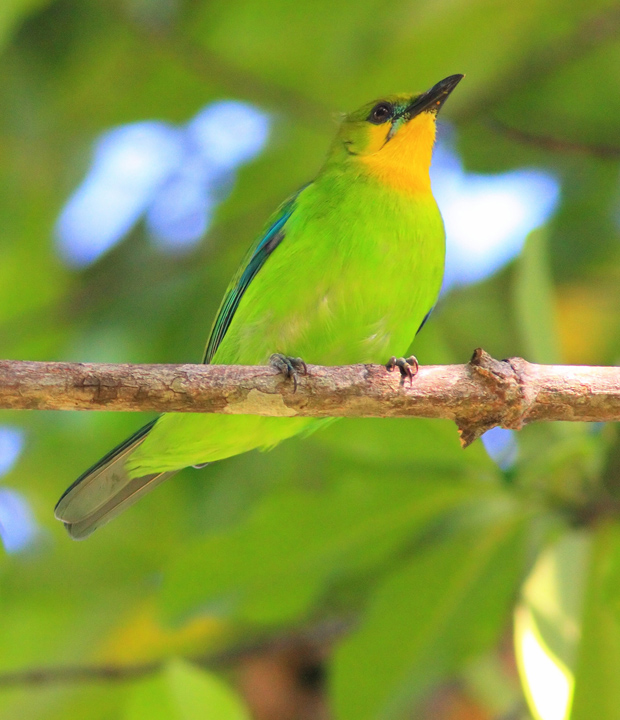
The Yellow-throated Leafbird is medium-sized, measuring about 19 centimeters in length. Its vivid green plumage makes it well-camouflaged in the foliage, but the unmistakable yellow throat sets it apart. Males have a brighter and more intense yellow on the throat, extending towards the chest, whereas females exhibit a duller shade. Juveniles resemble females but are even less vibrant, with more subdued greens and yellows. A distinguishing feature is the thin black line that runs from the beak through the eye, enhancing their striking appearance. In flight, the Yellow-throated Leafbird displays a quick, undulating movement, which is characteristic of many small passerines. When perched, they maintain a slightly upright posture, often tilting their heads to survey their surroundings. While similar in appearance to other leafbirds, such as the Greater Green Leafbird (Chloropsis sonnerati), the Yellow-throated Leafbird's specific coloration and size help differentiate it. Observers should also note the habitat, as its occurrence is limited to Palawan.
Having trouble telling birds apart? Upload a photo to our bird identification tool for an instant species match.
Yellow-throated Leafbird Habitat and Range
Preferred Habitat
The Yellow-throated Leafbird inhabits tropical and subtropical moist lowland forests, primarily below 1000 meters in elevation. Its preference for dense canopy cover allows it to exploit the rich floral and faunal resources of these environments. These birds can be found in both primary and secondary forests, although they favor areas with a high density of fruiting trees. Unlike some species that adapt to urban environments, the Yellow-throated Leafbird remains largely within natural forested areas. During certain times of the year, small shifts may occur in their habitat use, often related to the availability of specific food sources. However, they are generally non-migratory and maintain stable territories throughout the year.
Geographic Range
The Yellow-throated Leafbird is endemic to the island of Palawan in the Philippines, making it a resident bird with no migratory patterns. Its distribution is limited to this region, where it is considered locally common in suitable habitats. Palawan's unique biogeographical position allows the Yellow-throated Leafbird to thrive without significant competition from similar species. Population density hotspots are typically found in the undisturbed lowland forests where the habitat remains intact. While the bird has a restricted range, its presence throughout Palawan indicates a relatively stable population, provided that forest habitats remain protected and free from excessive human encroachment.
Want to know which birds visit your area? Browse our backyard birds by location guides for region-specific species lists.
What Does the Yellow-throated Leafbird Eat?
The diet of the Yellow-throated Leafbird consists primarily of fruits and nectar, with a secondary reliance on insects. During the dry season, when fruit is less abundant, they may increase their consumption of insects, including caterpillars and small beetles. Foraging usually occurs in the upper canopy, where they use their agile movements to navigate through foliage in search of ripe fruits and nectar-rich flowers. The Yellow-throated Leafbird employs a gleaning technique, picking insects off leaves and branches with precision. They typically feed during the cooler morning and late afternoon hours, when activity levels of both insects and birds are heightened. Their feeding habits play a crucial role in pollination and seed dispersal, contributing to forest regeneration.
Yellow-throated Leafbird Behavior and Social Structure
Socially, the Yellow-throated Leafbird tends to be solitary or found in pairs, although small family groups may form outside the breeding season. They are highly territorial, with males often engaging in vocal defenses of their territories. Courtship involves males performing aerial displays and offering food to potential mates. Flocking behavior is rare, as these birds prefer to maintain distinct territories. In response to predators, they rely on their cryptic plumage and quick flight to evade threats. Their daily activity patterns include active foraging during the early morning and late afternoon, with periods of rest during the midday heat. Vocalizations are an integral part of their behavior, serving both territorial and mate attraction purposes.
Yellow-throated Leafbird Nesting and Reproduction
Yellow-throated Leafbirds build cup-shaped nests using fine plant fibers, moss, and spider silk, typically located high in the tree canopy. Nests are well-hidden among dense foliage, providing protection from predators. The typical clutch size ranges from two to three eggs, with both parents sharing incubation duties over a period of approximately 14 days. After hatching, both parents continue to feed and care for the chicks, which fledge after about 14 to 16 days. The species usually raises one brood per year, although in favorable conditions, a second brood may occur. Parental roles are shared, with both male and female involved in feeding and defending the young.
Yellow-throated Leafbird Sounds and Vocalizations
The primary song of the Yellow-throated Leafbird is a series of melodious whistles and chirps, characterized by a clear, rising pitch. These vocalizations are used to establish territory and attract mates. Call notes are sharp and distinct, often heard as a single or double whistle. Alarm calls are a rapid series of high-pitched notes, signaling potential threats to mates or offspring. During the dawn chorus, their songs intermingle with those of other forest species, creating a vibrant symphony at first light. The vocal repertoire is reminiscent of a flute-like quality, pleasant and easily distinguishable within the forest soundscape.
Interesting Facts About the Yellow-throated Leafbird
- 1The Yellow-throated Leafbird's preference for fruit and nectar means it plays a crucial role in pollinating native plants across Palawan.
- 2Despite its vibrant coloration, the Yellow-throated Leafbird blends seamlessly into its forest habitat, showcasing nature's camouflage prowess.
- 3The species' endemic status highlights the ecological uniqueness of Palawan, with the Yellow-throated Leafbird being a flagship species for conservation.
- 4Yellow-throated Leafbirds are known to mimic calls of other birds, displaying an impressive vocal range and adaptability.
- 5Their nests are often constructed with spider silk, providing a strong yet flexible structure for raising young.
Yellow-throated Leafbird Conservation Status
The IUCN currently lists the Yellow-throated Leafbird as Near Threatened, with its population trend considered stable but under pressure from habitat loss. Primary threats include deforestation for agriculture and logging, which reduce available habitat. Conservation efforts focus on preserving the remaining forest tracts in Palawan and mitigating further habitat destruction. Historical population changes have been linked to fluctuating levels of human activity on the island. Continued conservation measures are essential to ensure the survival of this vibrant species, as its limited range makes it vulnerable to environmental changes.
Other Chloropseidae Species


Birds Similar to the Yellow-throated Leafbird
These species are often confused with the Yellow-throated Leafbird due to similar appearance or overlapping range.

